

Senate Minority Leader Hesselbein Hopeful for More Bipartisan 2026
Wants Legislature to cap prescription drugs cost and expand homestead tax credit.
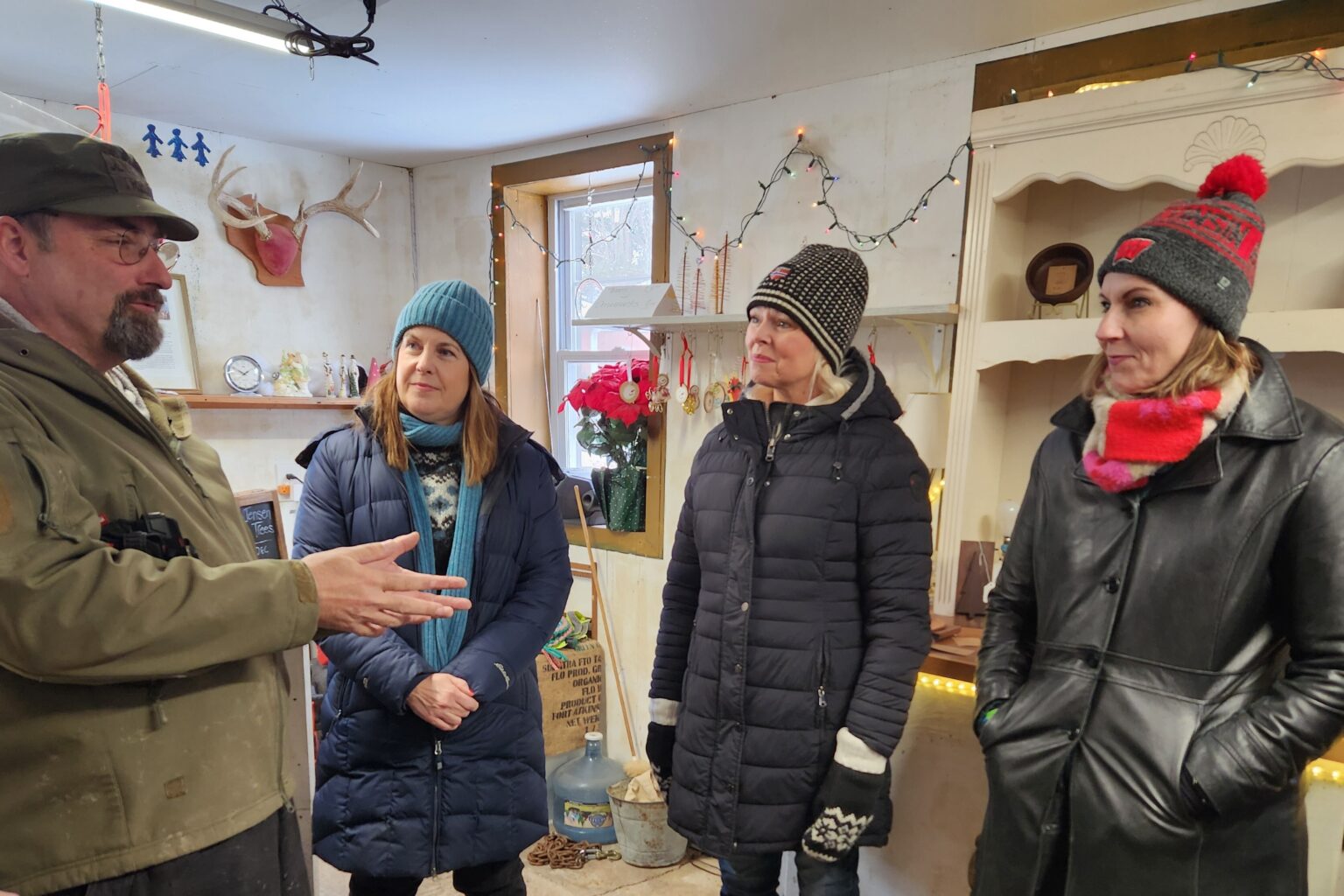
Senators and two current representatives seeking Senate seats in 2026 have been touring the state to highlight affordability and the effects of Republican policy choices, including tariffs and cuts to health care at the federal level. Senate Minority Leader Dianne Hesselbein, second from left, listens as Christmas Tree farm operator Lance Jensen discusses his business with Hesselbein and Sens. Sarah Keyeski and Melissa Ratcliff, during a visit to Jensen’s farm on Dec. 8. (Photo by Erik Gunn/Wisconsin Examiner)
Senate Minority Leader Dianne Hesselbein told the Wisconsin Examiner in a year-end interview that while she may have had a seat at the budget negotiating table this year, the Legislature still hasn’t engaged in as much bipartisan work as she had hoped.
Democratic lawmakers entered this year with bolstered numbers under new voting maps, but still in the minority. The closely divided partisan breakdown in the Senate — 15 Democrats and 18 Republicans — led to Republicans scrapping their plans to cut the University of Wisconsin budget and providing additional funding for K-12 schools, in budget negotiations with Democratic Gov. Tony Evers where Hesselbein had a seat at the negotiating table. But the current session still hasn’t matched up to Hesselbein’s “really high hopes at the beginning of the session that we were going to be able to do some really good bipartisan work.”
Hesselbein noted that at the start of the session, lawmakers introduced three bills she thought were “really strong.”
“Unfortunately, Republicans are refusing to work with us on those issues,” Hesselbein said. “I am hopeful that they will go spend time with their families back home over the holidays, and they will realize that we can still get a lot of great things done for the state of Wisconsin in the spring.”
One bill would provide school breakfast and lunch to students at no cost, another would make several policy changes aimed at helping bring down the costs of prescription drugs and the final one would expand the homestead tax credit to provide additional relief to low-income homeowners and renters.
Hesselbein said the “Healthy Schools Meals” legislation would help “every single kid, make sure they get a good nutritious lunch at school” and help “save the average family like $1800 a year on grocery costs.” She said the prescription drug legislation would help prevent more people from “choosing to cut their medicine in half” due to costs and the tax credit would help people stay in their homes longer.
“These were three really common-sense bills. I still really think they are, and all we needed was two Senate Republicans to help us get these bills across the finish line and show that they care about the people of the state of Wisconsin and that they want to do some bipartisan work,” Hesselbein said. “Unfortunately, they weren’t interested in doing that work with us, and they don’t have a plan to help people with the rising costs in the state of Wisconsin.”
Hesselbein said that passing helpful legislation, including the three bills she mentioned, could mitigate the upheaval of President Donald Trump’s administration.
“There’s so much chaos and confusion happening with the Trump administration that sometimes it’s hard to keep track of it day to day,” she said. “…What we can do as legislators in the state of Wisconsin is pass bills that actually help people.”
Hesselbein said Senate Democrats continue to have conversations with Republicans in the hopes that they can get more legislation passed. One pressing concern is the Knowles-Nelson stewardship program which, without legislative action, will sunset early in 2026.
“We’re very worried about that happening, so our doors are open to any ideas they have,” Hesselbein said of her Republican colleagues, adding that she hopes a bill authored by Sen. Jodi Habush-Sinykin (D-Whitefish Bay) can move forward.
Hesselbein noted that the stewardship program, which was created in 1989 to fund land conservation in Wisconsin, has bipartisan roots. It is named after former Republican Gov. Warren Knowles and former Democratic Gov. Gaylord Nelson and was signed into law by Republican Gov. Tommy Thompson.
“This has never been a partisan issue,” Hesselbein said, noting that the program is popular with people across Wisconsin who love the outdoors, “whether they’re going hiking or they’re fishing, or they’re hunting.”
Hesselbein also said she is hopeful that the bill she coauthored, which would bolster education on menopause and perimenopause, will advance. It received a public hearing in the Senate earlier this year.
Wisconsin Senate is the ‘most flippable’ in 2026
Next year will be a definitive election year in Wisconsin with control of the Senate, Assembly and governor’s office up for grabs.
Hesselbein said she believes that the Wisconsin State Senate is “the most flippable chamber” in the United States — and Democrats are working hard towards that goal. Wisconsin’s 17 odd-numbered Senate districts are up for reelections in 2026. It’s the first time new legislative maps adopted in 2024 that reflect the 50/50 partisan divide in the state will be in effect for those districts.
Hesselbein said Democrats are focused on winning districts that previously went to former Vice President Kamala Harris in 2024, former President Joe Biden in 2020, Gov. Tony Evers in his two elections and to Mary Burke, who lost to former Gov. Scott Walker in 2014.
Two seats targeted by Democrats to flip are Senate District 5, which is currently held by Sen. Rob Hutton (R-Brookfield) and Senate District 17, which is currently held by Sen. Howard Marklein (R-Spring Green).
“Fair maps and great candidates matter, and we already have people on the field that are out there knocking on doors listening to voters today on a cold day in Wisconsin… We have people that want to be elected to do the right thing for the people in the state of Wisconsin,” Hesselbein said.
Democratic candidates in Wisconsin and nationwide are hammering a message about affordability. Through the State Senate Democratic Campaign Committee, senators and two current representatives seeking Senate seats in 2026 have been touring the state to highlight the effects of Republican policy choices, including tariffs and cuts to health care at the federal level. They also recently launched an ad titled “Aisle 5.”
The ad opens as a group of Democratic lawmakers, including Sen. Sarah Keyeski (D-Lodi), Sen. Brad Pfaff (D-Onalaska) and Hesselbein, declare: “Same groceries from the same store. Same people in power, calling the shots and driving the prices up.” The words “Senate Republicans” pop up on the screen. “My colleagues and I are fighting every single day against tariffs that make beef, eggs, and even cheese more expensive,” Hesselbein says. “But guess what? They don’t care. We can’t keep hoping they’re going to make the right choice because they’ve shown us they won’t.”
Hesselbein vowed in the interview with the Examiner that under Democratic control the Senate will have more floor sessions, be more transparent and “be actually doing the people’s work.”
“When Senate Democrats are fortunate enough to be the majority, we will continue to work with our Republican colleagues and get the best policies to help the people in the state of Wisconsin, especially when it comes to rising costs,” she told the Examiner.
Senate Democrats’ ability to pursue their agenda will not only rely on winning the majority, but will also depend on who wins the consequential gubernatorial race, though Hesselbein said she is prepared to work with whoever wins.
“I was able to work with a Republican governor when Scott Walker was there. I was able to pass some bills,” Hesselbein said. “I’m hoping we have a Democratic governor so we can finally start listening to the people of the state of Wisconsin and get things done because we’ve been waiting a long time.”
Hesselbein said she doesn’t plan to endorse anyone in the Democratic primary for governor.
Many of the candidates have legislative experience including state Sen. Kelda Roys (D-Madison) and state Rep. Francesca Hong (D-Madison) as well as Lt. Gov. Sara Rodriguez, Milwaukee County Exec. David Crowley, former Lt. Gov. Mandela Barnes and former state Rep. Brett Hulsey. Other Democratic candidates include former Wisconsin Economic Development Corporation CEO Missy Hughes and former Department of Administration Sec. Joel Brennan.
“I have too many friends,” Hesselbein said of her decision not to make an endorsement. “I have been in caucus with some of them… They are really good people, and when the going got tough, they never ran from an argument or anything, so I’m really looking forward to seeing how that race shapes up.”
Hesselbein said she is looking forward to seeing each candidate’s platform and a “robust” discussion among them.
“What are the plans that they have for the state of Wisconsin? How do they see us addressing rising costs and affordability? What is their plan for K-12 education, higher education? For the environment and all the things that we’ve been hearing about for years that people in the state of Wisconsin want us to effectively address,” Hesselbein said.
Senate Minority Leader Dianne Hesselbein hopeful for more bipartisan work in 2026 was originally published by the Wisconsin Examiner.
If you think stories like this are important, become a member of Urban Milwaukee and help support real, independent journalism. Plus you get some cool added benefits.
Political Contributions Tracker
Displaying political contributions between people mentioned in this story. Learn more.















Right On!