

Public Concerned About Sheriff’s Use Of Surveillance Technology
Sheriff wants facial recognition technology. Will it indirectly help ICE?
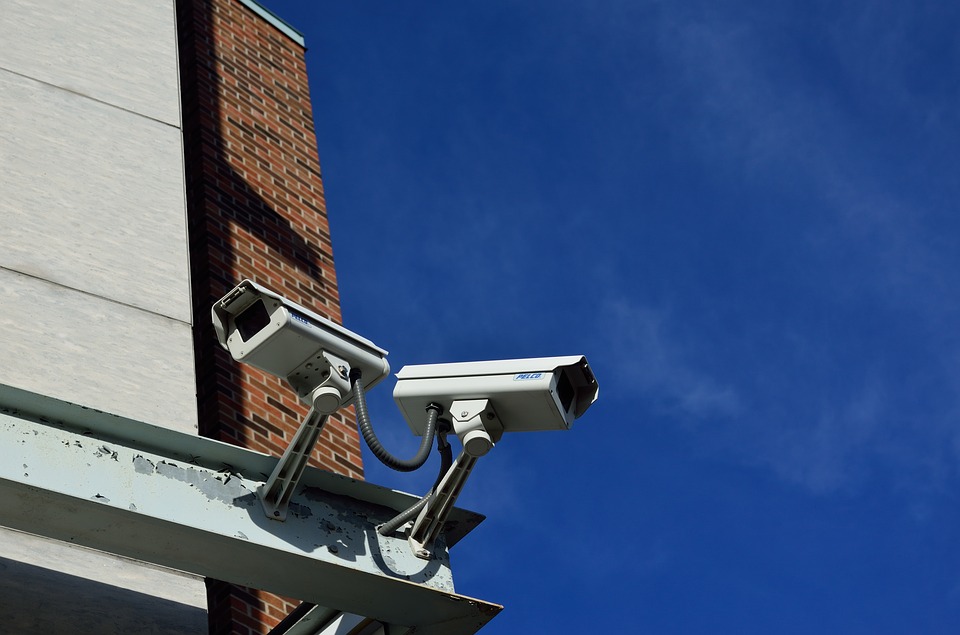
Security cameras. (Pixabay License).
The public continues to push back against the Milwaukee County Sheriff’s Office (MCSO) plans for expanded surveillance infrastructure and adoption of facial recognition technology.
At issue are the agency’s use of Flock cameras, an advanced surveillance camera system that scans and reads license plates, running them against law enforcement databases, and its desire to purchase facial recognition services from Biometrica, a Nevada-based company. The MCSO appeared before the Milwaukee County Board’s Committee on Judiciary, Law Enforcement and General Services on Tuesday.
Community members testified to concerns about the sheriff’s office expanding, or adding to, its surveillance capabilities, and the threat the technologies pose to civil liberties. But, more broadly, residents are also concerned about the federal government’s ability to exploit these technologies for its increasingly aggressive immigration enforcement operations or to violate constitutionally protected rights, like free speech.
Sheriff Denita Ball told supervisors in June her office was pursuing a contract and data sharing agreement with Biometrica for facial recognition technology services. The Milwaukee County Board responded with a resolution requesting a county policy governing facial recognition technology that protects civil liberties, First Amendment rights and prevents criminalization of racial and ethnic minorities in Milwaukee.
Earlier this year, Biometrica was negotiating an agreement with the Milwaukee Police Department to provide access to a facial recognition algorithm in exchange for 2.5 million mugshots.
Amanda Merkwae, advocacy director for the ACLU, said Biometrica contracts with other agencies have given the company access to historical and real-time booking and warrant data, which is a concern because Biometrica also markets a service called eMotive that can alert organizations if employees are arrested.
Ka Wade, Biometrica chief privacy officer, told supervisors Tuesday the company is committed to transparency. Wade previously told Urban Milwaukee the firm does not work with federal Immigration and Customs Enforcement (ICE).
Working with the county’s information management services, the MCSO produced the draft policy presented to supervisors at the committee meeting. It lays out prohibited uses of the technology, who would have access, how the data is stored and a restriction on sharing data outside of the agency.
The MCSO wants to employ facial recognition technology as an investigative tool, Chief Deputy Brian Barkow said. It would not be connected to camera feeds; there would be no live scanning of faces, surveilling or tracking county residents, he said. The agency wants the technology for lead generation: creating a list of suspect identities by feeding an image of a suspect in a crime into the technology and generating a list of probable matches.
“So we get a sexual assault or a non-fatal shooting or a homicide that occurs, and we obtain video — could be from a church or a gas station across the street. We take that image and we run that image through this facial recognition software, and it comes back with a score of possible candidates as to who this, possibly, who this person is,” Barkow said.
The policy dictates a facial recognition match cannot be the sole source of probable cause for an arrest. “Investigators still have to conduct the investigation… the district attorney’s office would never issue okay charges based on something like this… it is a tool that’s utilized to point an investigator potentially in the right direction,” Barkow said.
But community members and activists expressed dissatisfaction with the draft policy and were generally opposed to any adoption of facial recognition technology. Emily Sterk, with the League of Women Voters, said the draft policy contained “dangerously broad language,” and added, “We reiterate our stance, urging Milwaukee County to ban the sheriff’s office current and future use of [facial recognition technology].”
Of additional concern was the agency’s desire to expand a network of high-tech, artificial-intelligence-powered cameras capable of scanning and reading license plates. The cameras are produced by Flock Safety, and the MCSO has already placed a number of them in county-owned parks.
When a vehicle drives past a Flock camera, an image is taken of the car and license plate. The data is stored for 30 days and is searchable by law enforcement agents that have access to Flock. License plates can be flagged as stolen or involved in a crime, and when a Flock camera spots them the system can notify law enforcement, said Matt Johnson, deputy chief information officer for the county’s Information Management Services Division.
Barkow said MCSO does not allow the data collected by its Flock cameras to be used for purposes related to immigration or reproductive health, nor does the sheriff’s office cooperate with federal Immigration and Customs Enforcement (ICE) operations and only shares information with the agency when it is required by federal law.
But other law enforcement agencies have access to the MCSO’s Flock data, and ICE has reportedly accessed data from municipal Flock cameras around the country during immigration enforcement operations. The agency has also used biometric data maintained in law enforcement databases to find immigrants in Milwaukee.
Sup. Justin Bielinski asked Barkow how the MCSO could be certain no one was using the data for immigration- or abortion-related investigations. Flock data has been used by law enforcement in states with abortion bans to track women across state lines to arrest them for receiving abortions.
Barkow conceded it would be impossible to prevent in every circumstance. “There are loopholes,” he said.
Bielinski, who is chair of the law enforcement committee, said the political situation in the U.S. must be a consideration when the introduction of surveillance technologies is proposed. Other countries, for example, don’t have a “wannabe Mussolini as president,” he said.
“So we know that Brad Schimel right now is the acting U.S. Attorney [for the Eastern District of Wisconsin]. We have to operate under the assumption that there is an instance where the federal government might decide to ask for things that they probably shouldn’t have, or to do things in a way that maybe isn’t above board,” Bielinski said.
Sup. Juan Miguel Martinez said he is “vehemently opposed” to facial recognition technology, which he said “would absolutely destroy and shatter public trust completely as it is.”
Emilio De Torre, executive director of the Milwaukee Turners, has been a vocal opponent of surveillance expansion and facial recognition technology use by law enforcement in Milwaukee. He said the MCSO and local government in Milwaukee need to be “extremely cautious” about employing these technologies.
“We’ve heard over and over again… that the federal government is actively accessing surveillance information from Flock cameras, red light cameras, social media, biometric libraries, Ring doorbells and anything else they can get their hands on,” De Torre said. “This is a ridiculously dangerous time to allow any additional surveillance and tracking and face mapping software.”
If you think stories like this are important, become a member of Urban Milwaukee and help support real, independent journalism. Plus you get some cool added benefits.


MKE County
-
Committee Approves Towing Reckless Drivers, With Objections
 Mar 12th, 2026 by Graham Kilmer
-
Domes Project on Track for 2027 Groundbreaking
 Mar 12th, 2026 by Graham Kilmer
-
Judges Won’t Extend Schimel’s U.S. Attorney Appointment
 Mar 10th, 2026 by Graham Kilmer



















Facial recognition FR) technology has problems with distinguishing facial features of people of color. While I applaud MCSO decision to not use facial recognition as the only means of identifying and charging individuals. FR flaws still create fear in Milwaukee–a minority majority city.
How will MCSO address the racial flaws? How will they prevent racial profiling? How will they protect the constitutional rights of those “identified” by FR? How will MCSO protect the rights individuals recognized by FR from the ICE?
These are ethical matters that must be addressed before MCSO–or any law enforcement agency–acquires and implements AI based technology. There is a long history of law enforcement misusing new technology. The stakes are higher today because of the impact AI flaws have on BIPOC, those who oppose the actions of the current administration, and women who are forced to seek health care out-of-state.
In 1930s Germany, IBM sold the Nazi regime technology to identify an individual’s ancestry back to great, great grandparents. The Nazis used it to identify non-practicing Jews and send them to the death camps.
Before MCSO implement FR and other AI technologies, there must be comprehensive discussions with every racial and ethnic communities in Milwaukee County–this includes communities of color in the City of Milwaukee. The goal of these discussions to establish procedures to protect the rights of county residents from the misuse of AI data by other governmental entities.
I agree with mkwagner, it is possible that facial recognition technology isn’t perfect. Improvements are being made every day.
Why would BIPOC (“Black, Indigenous, and People of Color”) be against something that could improve safety?
There are far too many crimes, shootings, and people being killed. Yet there seems to be a push to be against early intervention or finding the person responsible.
No police in the schools . . . Why not have police in the schools? Look at the School Resource Officer in Berlin Central School and the work she is doing to protect students from cyberbullying. Early intervention – safeguard our students from drugs, crime, . . . is better than waiting and allowing – then long prison terms.
I want more money for crime labs, and I want the person committing sexual assault in treatment/jail. . . I don’t want children to be sexually assaulted, and if this is a tool to help stop sexual assault (or any assaults), why not?
““So we get a sexual assault or a non-fatal shooting or a homicide that occurs, and we obtain video, which could be from a church or a gas station across the street. We take that image, and we run that image through this facial recognition software, and it comes back with a score of possible candidates as to who this, possibly, who this person is,” Barkow said.”
There may be people who don’t want their license plates recorded when they are driving to buy drugs at 2 am or visit a strip club, or… commit a crime.
“License plates can be flagged as stolen or involved in a crime, and when a Flock camera spots them, the system can notify law enforcement, said Matt Johnson, deputy chief information officer for the county’s Information Management Services Division.”
If you are concerned about ICE, why not change the laws governing how people become citizens? I agree that there is something wrong. Women could vote, and then the US Constitution was changed. In the US, the laws can be changed – not sure if blaming the police or ICE is the answer. (Although there can be kindness in enforcing the laws.)
I believe, and I may be wrong, that there is value in treating all people equally. We should expect to be held accountable equally.
I learn from other comments and I’m interested in what others have to say.
Thank you!