Hales Corners Gets State Aid To Combat PFAS Contamination
Safe Drinking Water Loan Program helps smaller Wisconsin villages fund water projects.
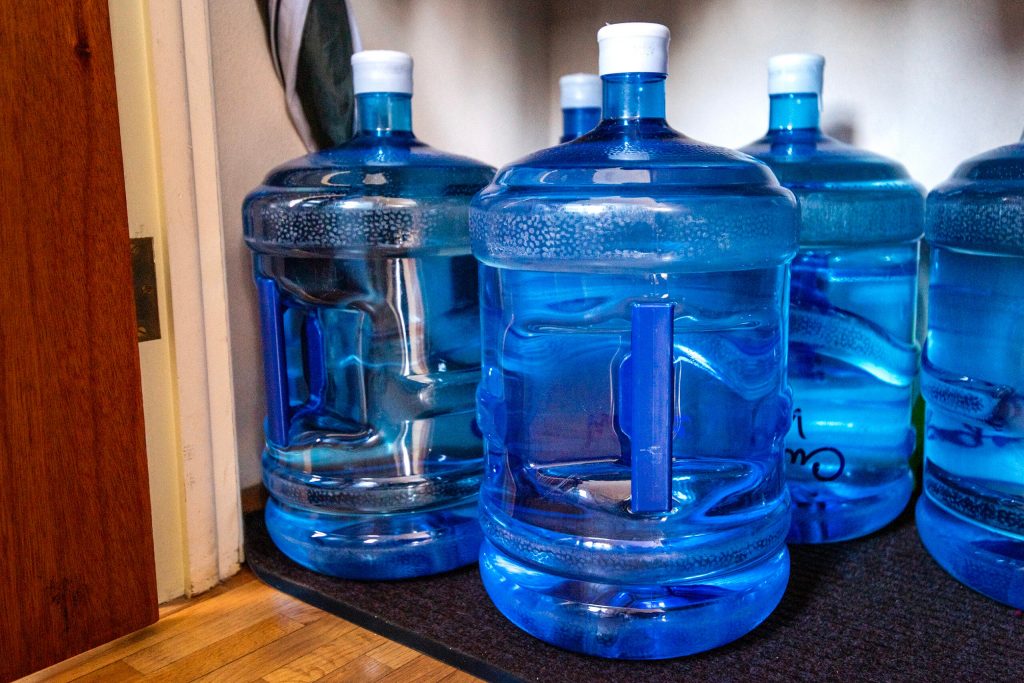
Water stored in a closet near Margie Walker and Jim Boisen’s kitchen in their French Island home Friday, Feb. 21, 2025. Angela Major/WPR
Two Wisconsin villages recently awarded aid from the state’s Safe Drinking Water Loan Program say the money will let them move forward with much-needed projects.
In the southwest corner of Wisconsin, the village of Dickeyville runs on a budget of around $400,000 a year.
The community needs a new municipal water well to continue supplying clean water to its population of just over 1,000 people. Its existing wells were installed in 1950 and 1967 and are struggling to keep up.
The price tag for a new well in 2025? Close to $3 million.
“It’s not like we have money just sitting somewhere to be able to pull from,” Dickeyville village president Matt Gantenbein told WPR’s “Wisconsin Today.” “It would take us 40 years to come up with $3 million to put it into a new well.”
The village is also attracting industrial projects and wants to grow, but that can’t happen without improved water infrastructure.
Gantenbein and the village staff worked with a local engineering firm to apply for financial assistance from the state’s Safe Drinking Water Loan Program.
Last month, Gov. Tony Evers announced Dickeyville is one of 74 municipalities in the state to receive a portion of $282 million for water infrastructure projects this year.
The village is set to receive just under $2 million, nearly half of which is coming through principal forgiveness and won’t need to be paid back. The rest will come at a subsidized interest rate.
“It’ll help our residents in town immensely, so that we don’t have to continue to go to the residents and keep raising rates,” Gantenbein said.
For other communities in Wisconsin, funding from the Safe Water Drinking Loan Program will be the difference between clean and contaminated water coming into their homes.
The village of Hales Corners, southwest of Milwaukee, is dealing with PFAS contamination in its wells.
Village administrator Sandy Kulik told “Wisconsin Today” that their local water utility is privately run and not owned by the village. That’s made applying for state and federal funding more complicated.
The only feasible solution they found was to connect impacted residents into Milwaukee’s water system. The village has already borrowed over $8 million to get started on the project while pursuing outside funding to help cover the costs.
With the help of U.S. Rep. Bryan Steil and U.S. Sen. Ron Johnson, Hales Corners received emergent contaminant grant funding from the federal government in addition to state loan funding.
“If we didn’t receive the funding, the neighbors would have been special assessed around $35,000 per household to get that water up and running,” Kulik said. “With the emergent contaminant grant, that drops in half, and then the other half of the funding is through the Safe Drinking Water Loan Program.”
Hales Corners is getting close to $5 million from the state. Like Dickeyville, about half of the loan funding will be forgiven and the other half is at the subsidized interest rate.
Kulik feels the same kind of financial squeeze as Gantenbein, lacking a clear solution without help from these government programs.
“It doesn’t matter what size you are, the state levy limit laws put us all in the same place, trying to figure out how to do all these things that need to be done,” Kulik said. “They’re not wants. They’re needs. We have to fix these things.”
Latest state aid making clean water projects possible for smaller Wisconsin communities was originally published by Wisconsin Public Radio.
If you think stories like this are important, become a member of Urban Milwaukee and help support real, independent journalism. Plus you get some cool added benefits.