

Test Results Show High PFAS Levels in Wisconsin’s Landfill Runoff
UW-Madison researchers analyzed 4 potential sources of PFAS pollution in groundwater.
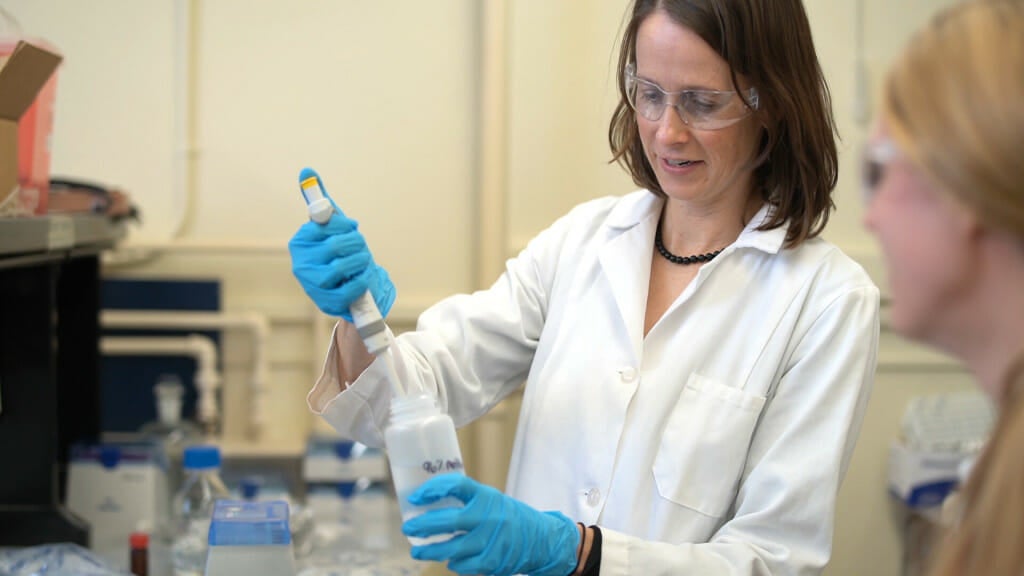
Christy Remucal conducts research on PFAS at UW-Madison. Photo courtesy of Wisconsin Sea Grant
Early results of a new study show landfill runoff contained the highest levels of PFAS among liquid wastes sampled statewide in Wisconsin.
Since 2023, researchers at the University of Wisconsin-Madison have been collecting and analyzing samples from four waste materials that could be potential sources of PFAS in groundwater, which provides drinking water to two-thirds of state residents. It’s also a source of drinking water for around 800,000 private wells.
Kaitlyn Gruber, a fifth-year Ph.D. student at UW-Madison and the study’s lead author, said the identities and locations of facilities sampled are confidential under agreements reached with study partners. She said samples collected from 16 landfills, including six that remain open, showed total PFAS levels between 878 to 36,600 parts per trillion.
“Currently, the (Environmental Protection Agency) does not require any monitoring or reporting for PFAS in landfill solid waste or leachates,” Gruber told the council.
The EPA has established drinking water standards for PFAS, but no federal or state limits exist for the chemicals in groundwater. Wisconsin health officials have recommended PFAS standards in groundwater that mirror federal limits released last year, which include limits for two of the most widely studied chemicals at 4 parts per trillion.
PFAS, short for per-and polyfluoroalkyl substances, are a group of thousands of synthetic chemicals that have been linked to serious health risks that include kidney and testicular cancer. The so-called forever chemicals don’t break down easily in the environment.
One of the study’s goals was to conduct a forensic analysis of PFAS to pinpoint potential sources of contamination.
“Originally we were thinking maybe all landfill leachates could have a similar amount of the same PFAS, but it really wasn’t the case in this study,” Gruber said.
Gruber worked on the project with Christy Remucal, professor of civil and environmental engineering at UW-Madison.
“Overall, we found quite a bit of variability in both concentrations and the types of PFAS that were detected,” Remucal said.
Gruber said the findings may help lawmakers and state regulators make decisions about handling of different wastes.
“What commonly happens is this leachate is pumped out of the landfill and then brought to a treatment plant” for further treatment, Remucal said.
The Wisconsin Department of Natural Resources does not bar disposal of PFAS waste at the state’s solid waste disposal facilities, Gruber said. They aren’t required to accept waste containing the chemicals either.
Researchers also examined biosolids, or sewage sludge, that are spread on farm fields as a nutrient-rich alternative to fertilizer. WPR previously reported the material is applied to more than half a million acres statewide each year.
Remucal said most sludge samples from municipal wastewater treatment plants had relatively low PFAS concentrations.
“In Wisconsin, there are limits on what can be land-applied, and there was only one of the 17 samples that exceeded those recommendations,” Remucal said.
Most levels ranged around 30 parts per billion, but one sample showed total PFAS concentrations of more than 1,300 parts per billion. The DNR’s interim strategy for biosolids dictates that the agency shouldn’t approve new land applications sites when combined levels of PFOA and PFOS exceed 150 parts per billion in order to limit risks to human health and the environment.
Researchers also found that the 33 chemicals detected in samples represent just a fraction of the extractable organic fluorine found within them. That organic fluorine is an indicator of other PFAS or fluorinated chemicals that aren’t currently identified through testing.
Early study results show landfill runoff in Wisconsin has high PFAS levels was originally published by Wisconsin Public Radio.
If you think stories like this are important, become a member of Urban Milwaukee and help support real, independent journalism. Plus you get some cool added benefits.
More about the PFAS Problem
- Gov. Evers Signs New PFAS, Lead Regulations - Danielle Kaeding - Mar 2nd, 2026
- Gov. Evers Builds Upon Efforts to Clean Up Wisconsinites Water, Approves New Rule Changes Strengthening Pfas Drinking Water Standards - Gov. Tony Evers - Mar 2nd, 2026
- PFAS Levels in Great Lakes Fish Are Dropping - Danielle Kaeding - Feb 6th, 2026
- Gov. Evers and GOP Lawmakers Near a Deal on PFAS Pollution - Danielle Kaeding - Jan 22nd, 2026
- Gov. Evers Optimistic About Reaching Final Deal With Republican Lawmakers to Secure Release of $125 Million in Long-Awaited Pfas Investments - Gov. Tony Evers - Jan 21st, 2026
- Bipartisan Push to Tell Counties Faster When Water Tests Fail - Henry Redman - Dec 19th, 2025
- MKE County: County Seeks to Sue PFAS Producers, Oil Companies - Graham Kilmer - Dec 10th, 2025
- Wisconsin Reviewing EPA-Approved Pesticides For PFAS - Danielle Kaeding - Dec 9th, 2025
- State Nears Settlement with Johnson Controls/Tyco Over PFAS Spills - Danielle Kaeding - Dec 4th, 2025
- Senate Bill Promotes Soybean-Based Firefighting Foam to Replace PFAS - Danielle Kaeding - Dec 2nd, 2025
Read more about PFAS Problem here























If I’m reading this right, the PFAS concentration for biosolids is expressed in parts per BILLION, and not parts per TRILLION. To better compare, multiply the biosolids concentrations by 1000/1000. PFAS concentrations of biosolids ranged from 30 parts per BILLION to 1,300 parts per BILLION, AKA 30,000 parts per TRILLION to 1,300,000 parts per TRILLION. Compare to landfills: “samples collected from 16 landfills, including six that remain open, showed total PFAS levels between 878 to 36,600 parts per TRILLION.” In other words, most of the biosolids samples have PFAS concentrations in the upper range of those found in landfill samples, and one biosolids sample exceeded the highest landfill sample concentration by about (1,300,000/36,600) 35.5 times.