Frankly Music Concert Is All About Strings
Performing three all-string works by Strauss, Schoenberg and Brahms.
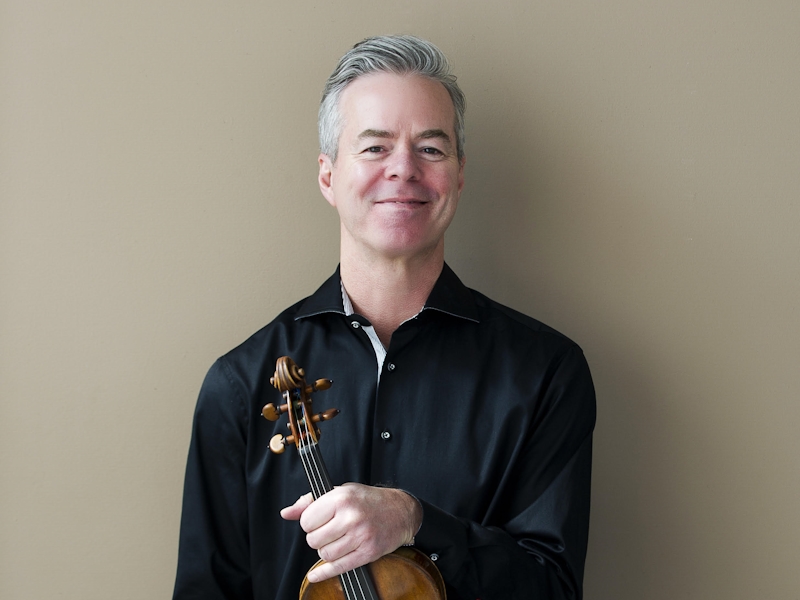
Frank Almond. Photo courtesy of Frankly Music.
Theoretical physicists have passionate debates about string theory: the idea that the fundamental building blocks of nature are not particles but strings. But there’s little disagreement that string instruments are the building blocks of chamber music, and Frankly Music’s upcoming concert, entitled “String Theory,” will provide plenty of evidence. The performance, on Monday, May 6, closes the series’ 20th anniversary season.
Frankly Music founder and violinist Frank Almond will be joined by five other string players: Charlene Kluegel, violin; Samantha Rodriguez, viola; Alejandro Duque, viola; Kenneth Olsen, cello, and Adrien Zitoun, cello.The program opens with the String Sextet from the opera Capriccio by Richard Strauss. The composer’s last opera, written in 1941, Capriccio centers on a debate, advanced by a poet and a musician wooing the same woman, as to whether words or music are the highest art. When the opera is performed, the Sextet is played on the stage as the curtains rise. Writer Evan Judson describes the piece as “a lusciously scored string sextet that functions both as a prelude to the action and as the first topic of conversation in the on-stage drama.”
Transfigured Night, by Arnold Schoenberg, continues the words and music theme, presenting a musical interpretation of a 19th century German poem by Richard Dehmel. “Everyone sees the name of Arnold Schoenberg and runs the other way,” Almond said. He acknowledges that Schoenberg’s 12-tone compositions, once described by a New York Times critic as “dreadful, aggressively dissonant pieces,” can be challenging for the listener. But Transfigured Night is an early work, written in 1899 when Schoenberg was 25. Almond describes the sextet as a lush extension of Wagner and Mahler that illustrates Schoenberg’s “unbelievable skill in writing for strings.” Dehmel’s controversial poem tells the story of a woman’s shameful confession: she has borne the child of another man. According to musicologist Kai Christiansen, “Schoenberg’s music unmistakably expresses the narrative: a brooding introduction, an angst-ridden confession full of unresolved longing, a brief return of the dark but moonlit setting, a deeply loving reply, noble and equal longing, and a final transfiguration into radiant grace and serenity.”
]Almond finds the final piece on the program, the String Quintet in G major by Johannes Brahms, to be “almost symphonic in scope.” (Some writers believe the Quintet evolved from sketches Brahms wrote for a symphony, although Almond isn’t convinced that’s the case.) Scored for two violins, two violas, and one cello, the four-movement work features the cello prominently. Christiansen declares it to be “exuberant, elegant, subtle, original and unmistakably Brahms in nearly every bar.” Brahms anticipated it would be his swan song; he wrote his publisher of his intent to retire from composing. He had second thoughts, and subsequently wrote two sonatas for clarinet and piano. But for Frankly Music, the Quintet is an appropriately celebratory end to its 20th season presenting chamber music gems to Milwaukee audiences.String Theory will be performed at 7 p.m. Monday, May 6, at Schwan Concert Hall, Wisconsin Lutheran College, 8815 W. Wisconsin Ave. Tickets are available online.
If you think stories like this are important, become a member of Urban Milwaukee and help support real, independent journalism. Plus you get some cool added benefits.


Preview
-
Present Music Celebrates Hindu Festival
 Mar 16th, 2026 by Michael Barndt
-
Frankly Music Showcases Virtuoso Players
 Mar 10th, 2026 by Michael Barndt
-
Six Centuries of Secular Song
 Mar 3rd, 2026 by Michael Barndt