

Why GOP Fears Advisory Referendums
Vernon County's vote against abortion ban helps explain local restrictions in revenue sharing bill.
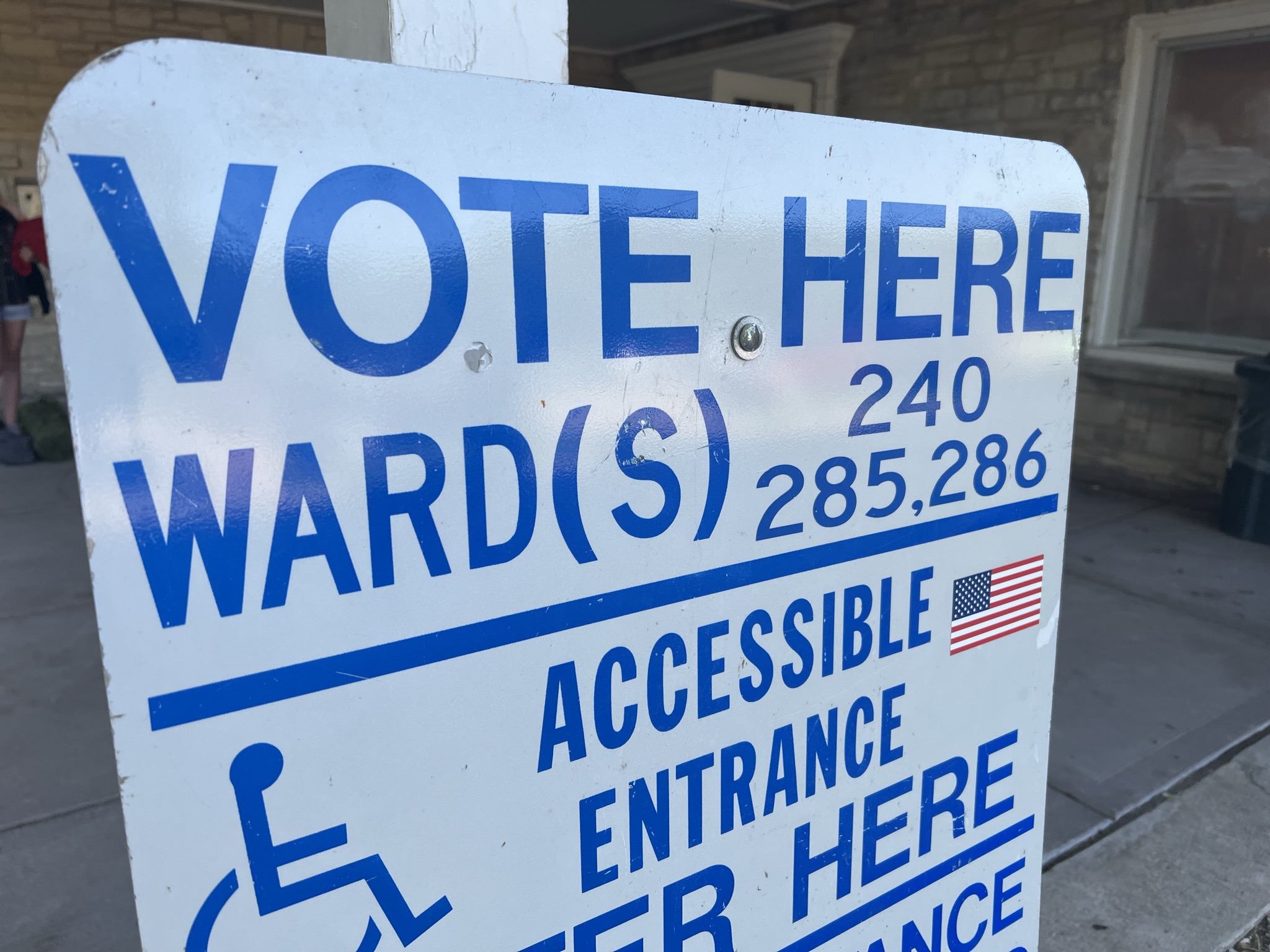
Vote here sign outside a Milwaukee polling place. Photo by Jeramey Jannene.
Local governments in Wisconsin, especially Milwaukee County and the City of Milwaukee are facing a severe financial crisis. A major cause is that payments from the state have not been adjusted for inflation. In the words of the Legislative Reference Bureau:
“With certain exceptions, each county and municipality receives a county and municipal aid payment equal to the amount of the payment the county or municipality received in 2012.”
In other words, state aid has lost about a quarter of its buying power since it was set in 2012. Meanwhile, state revenues have greatly increased, driven both by growing economic activity, including in both the city and county of Milwaukee, and inflation.In response to this crisis, a bill, AB245 was passed by Republicans in the state Assembly and sent to the state Senate, where it now sits.
At this point, it is unclear whether AB245 would be sufficient to the coming financial crisis. What is clear that the bill has many provisions aimed at tying the hands of local governments in Wisconsin, particularly in the city and county of Milwaukee. These include:
- Limiting the use of the supplemental county and municipal aid to law enforcement, fire protection, emergency medical services, emergency response communications, public works, and transportation.
- Prohibiting the use of tax money for streetcars.
- County and city funding of cultural and entertainment partners would be limited to 5% of the budget.
- Milwaukee Public Schools would be required to have 25 “school resource officers,” school-based police officers.
- The bill reduces the authority of the Milwaukee Fire and Police Commission and requires that at least one member of that commission be selected from a list submitted by the police and fire union.
- Any new programs undertaken by the County Board or Common Council would require a 2/3 vote.
Other provisions in the bill go well beyond either Milwaukee or any relevance to the need to better fund local governments. Perhaps the most telling provision prohibits a county or municipality from holding an advisory referendum. This is evidently a response to a series of referenda by several local governments on abortion.
Several local governments included an advisory referendum on their ballots that asked whether “Wisconsin Statute 940.04, which bans abortion at any stage of pregnancy without exception for rape, incest, or health of the patient, be repealed to allow legal access to abortion care?” The graph below shows the results I could find from voters in four counties and one city. The percentage answering Yes to repeal is shown in blue; the percentage answering No is shown in red.The results show overwhelming support for repealing the ban. Some may dismiss this result as expected reflecting the Democratic skew of Milwaukee, La Crosse, and Dane counties and the City of Racine. However, Vernon County is a different story.
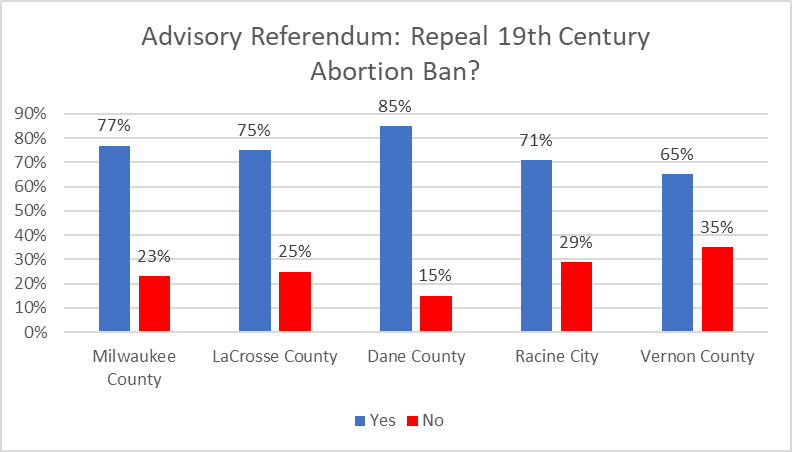
Advisory Referendum: Repeal 19th Century Abortion Ban?
In contrast to the other four jurisdictions that conducted an advisory referendum on this topic, Vernon County is highly competitive politically. This is apparent in the graph below. The first two pairs of columns show county results in the fall 2022 general election. Vernon County voters supported Ron Johnson, the Republican, over Mandela Barnes for U.S. Senator by a narrow margin. The same voters narrowly chose Democrat Tony Evers for governor over Tim Michels.
The next pair of columns show Vernon County results for Supreme Court justice in the spring 2023 election. Although the race was theoretically nonpartisan, Democrats heavily supported Janet Protasiewicz, while Daniel Kelly gained the support of the Republican party. Two key issues in the race were the the state ban on abortions and the gerrymander of legislative and congressional districts that heavily favors Republicans.With a campaign that focused on those two issues, Protasiewicz received 55% of the Vernon County vote, close to her state-wide margin. The final pair of columns shows the referendum vote in the same election. Almost twice as many voters supported repealing the 1849 ban on abortion as those voting to keep it. I calculate that between 16% and 25% of Kelly supporters voted in favor of repealing the 1849 ban on abortion on the same ballot.
While not surprising, this is not good news for Republican candidates. The prohibition on advisory referendums in AB245 is the classic response to bad news: if one does not like the message, kill the messenger.

Vernon County 2022 and 2023 Elections
Several of the restrictions in AB245 appear to be payoffs in response to past political support, such as the reduction in power of the Milwaukee Fire and Police Commission, a reward to the Milwaukee police union. Other beneficiaries are owners of nonmetallic quarries in disputes with local residents.
Another provision would restrict the ability of local health officers to respond to health emergencies.
If there is a single theme to the large number of provisions in AB245 that have little or nothing to do with the need to better fund local government, it is that the Republicans in the Legislature believe that they are better judges of the needs of Milwaukee and other cities and counties than are the residents of those areas and their representatives.The extreme Wisconsin gerrymander further contributes to this mismatch. By skewing the makeup of the state Legislature, the gerrymander distorts decision-making away from the needs of Wisconsin’s largest cities.
But it has also resulted in distorting standard Republican ideology.Traditionally, Republicans have argued in favor of local decision-making, that local officials are best able to judge local needs. Yet, AB245 flips this theory on its head, moving decision-making from the local level to the state Legislature, while prohibiting citizens in every city and county in the state from expressing their opinion via advisory referendums.
Legislation Link - Urban Milwaukee members see direct links to legislation mentioned in this article. Join today
More about the Local Government Fiscal Crisis
- Mayor Johnson’s Budget Hikes Fees, Taxes In 2025, Maintains Services - Jeramey Jannene - Sep 24th, 2024
- New Milwaukee Sales Tax Collections Slow, But Comptroller Isn’t Panicking - Jeramey Jannene - Jun 28th, 2024
- Milwaukee’s Credit Rating Upgraded To A+ - Jeramey Jannene - May 13th, 2024
- City Hall: Sales Tax Helps Fire Department Add Paramedics, Fire Engine - Jeramey Jannene - Jan 8th, 2024
- New Study Analyzes Ways City, County Could Share Services, Save Money - Jeramey Jannene - Nov 17th, 2023
- New Third-Party Study Suggests How Milwaukee Could Save Millions - Jeramey Jannene - Nov 17th, 2023
- Murphy’s Law: How David Crowley Led on Sales Tax - Bruce Murphy - Aug 23rd, 2023
- MKE County: Supervisors Engage in the Great Sales Tax Debate - Graham Kilmer - Jul 28th, 2023
- MKE County: County Board Approves Sales Tax - Graham Kilmer - Jul 27th, 2023
- County Executive David Crowley Celebrates County Board Vote to Secure Fiscal Future and Preserve Critical Services for Most Vulnerable Residents - David Crowley - Jul 27th, 2023
Read more about Local Government Fiscal Crisis here


Data Wonk
-
Who Do You Trust to Conduct Elections Fairly?
 Apr 6th, 2026 by Bruce Thompson
-
Is Non-Citizen Voting a Real Threat to Elections in Wisconsin?
Mar 18th, 2026 by Bruce Thompson
-
How Global Climate Change Affects Milwaukee
 Mar 11th, 2026 by Bruce Thompson