

I-94 Rebuild Could Be Multi-Modal Success
Transit, buses, ride-sharing, biking, walking should be part of the plan.
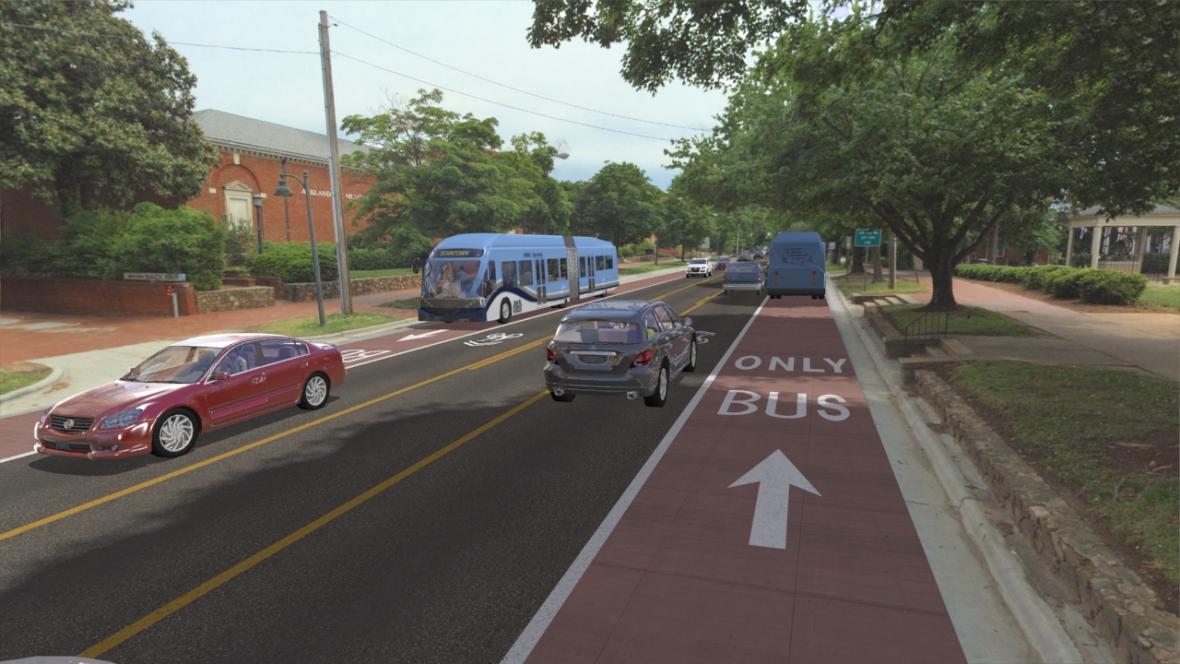
Rendering of Milwaukee County Bus Rapid Transit.
The reconstruction of the I-94 corridor from 70th Street to 16th Street in Milwaukee, proposed as part of Governor Tony Evers’ 2021-2023 budget, is a project with significant long-lasting regional impact. It’s a once-in-a-generation opportunity to improve safety and efficiency along this critical corridor. We must ensure that this project is a true economic win, one that both improves the roadway, makes safety upgrades and builds capacity for current and future users, and one that expands multiple transportation modes, including fixed route transit, rideshare services, shuttles, and better conditions for biking and walking. We must act swiftly, and boldly, to achieve a multimodal regional transportation system that allows our region to compete globally.
Funding these kinds of projects is complex, and we recognize that we cannot simply take money that would support the freeway rebuild and shift it to transit or other multimodal improvements. But we can, and should, pursue every opportunity to prioritize transit and other modes. This project presents with an opportunity to do just that, through intentional use of the funds that would come along with this project to lessen congestion.
The East-West corridor brings thousands of commuters to their jobs every day. This includes drivers and non-drivers, and includes commuters traveling in both directions, from the city to the suburbs, and vice versa. This corridor is already slated for a significant upgrade in transit service with Milwaukee County’s Bus Rapid Transit route, due to open in late 2022. Traffic mitigation dollars related to the freeway project should be leveraged to expand on this route, including a potential Waukesha County bus rapid transit line serving Bluemound Road, and a new bus rapid route connecting Milwaukee’s central city with suburbs to the north and south, and next generation on demand shuttles to serve the “last mile” of transit commutes between the city and suburbs.The timing of this particular project is important. As our region recovers from the economic disruption caused by the COVID-19 pandemic, moving forward on this project now brings thousands of jobs in the next few years. At the same time, smart investments in multimodal transportation, done with dollars that would come along with this project, could fast-track regional multimodal transportation in Southeastern Wisconsin bringing us much closer to the multimodal system our region can leverage for greater economic impact.
The COVID-19 pandemic has exacerbated several long term trends that undermine economic vitality in our region – the spatial mismatch between job opportunities and residents who lack reliable cars, and an aging workforce and stagnant population growth. Strong regional multimodal transportation addresses these challenges head on and deserve our attention as we confront aging and outdated infrastructure.
We call upon Wisconsin’s leadership to think broadly when considering an upgrade of this critical piece of regional infrastructure. Commit to meaningful investments in all modes of travel, including fixed route and next-generation transit, which will position our region for long term success and vitality. Our region has many priorities, but few priorities have more long term impact than infrastructure, and infrastructure is more than roads.
By Dave Steele, Executive Director, Regional Transit Leadership Council and Board Members, Regional Transit Leadership Council, Kathy Ehley, Samantha Maldonado, Mark Gottlieb, Tracy Johnson and Andrew Davis.
(Disclosure: Urban Milwaukee President Jeramey Jannene is a board member of the Regional Transit Leadership Council)


Op-Ed
-
Does Wisconsin Really Need New Gas Plants?
 Oct 16th, 2026 by John Imes
-
The Real Cost of Weakening Head Start Standards
 Sep 29th, 2026 by Ruth Schmidt and Jennie Mauer
-
No Need To Pretend; Trump Is On The Ballot
 Sep 20th, 2026 by Bill Christofferson
Transportation
-
Wisconsin Wins $218 Million Grant To Extend Hiawatha To Madison
 Oct 16th, 2026 by Jeramey Jannene
-
MCTS Reports Rising Fare Collection
 Oct 15th, 2026 by Graham Kilmer
-
$80 Million Air Cargo Center Takes Off At Mitchell Airport
 Oct 15th, 2026 by Graham Kilmer
















Dave Steele said, ” Funding these kinds of projects is complex, and we recognize that we cannot simply take money that would support the freeway rebuild and shift it to transit or other multimodal improvements.” Under the Intermodal Surface Transportation Act of 1991 and the 1998 TEA 21 states and cities have the flexibility to spend Interstate money on other transportation facilities including transit, trains and bicycle facilities. WisDOT keeps implying that Federal law limits spending to their plan to widen I 94. It doesn’t.