
Proactive Rental Inspections Poised To Return To Milwaukee
Uptown neighborhood would be first test site.
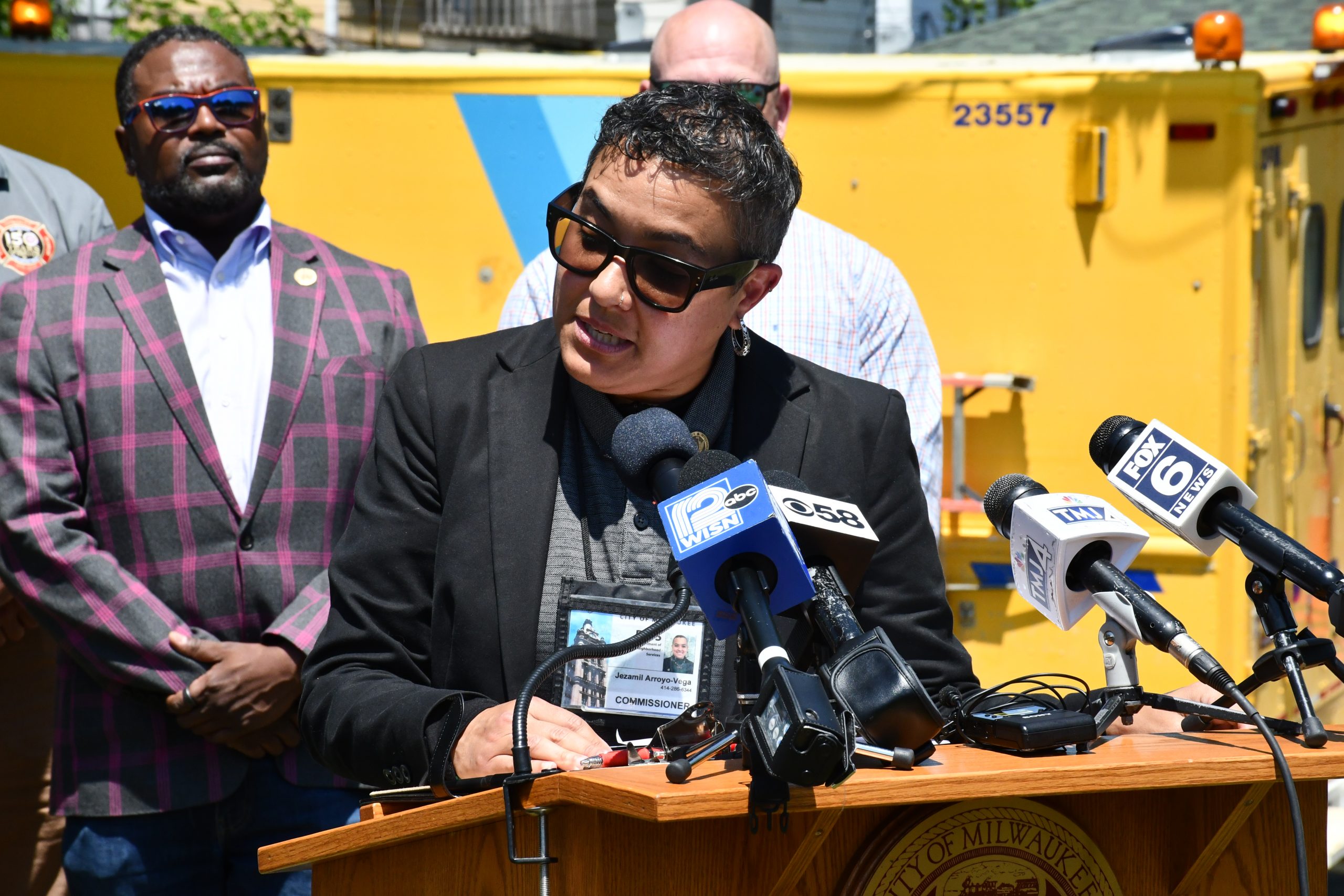
DNS Commissioner Jezamil Arroyo-Vega announces inspection program. Photo by Jeramey Jannene.
Milwaukee is moving closer to reviving proactive inspections of rental housing, starting with approximately 200 properties in the Uptown neighborhood.
The Common Council’s Zoning, Neighborhoods & Development Committee unanimously endorsed a five-year pilot program Tuesday that would allow Department of Neighborhood Services inspectors to inspect rental properties without first receiving a complaint.
“Uptown was selected because the data shows this kind of investment can make a real difference,” said DNS Commissioner Jezamil Arroyo-Vega.
The targeted area includes about 200 eligible rental properties and 399 housing units. DNS intends to start slowly, conducting approximately 20 initial inspections per month.
“This is the right place to begin, because the data clearly demonstrates that this is an area that wants focused attention,” said Stamper.
City data shows 58% of eligible properties in the district have received at least one complaint since 2023. In 2025 alone, DNS recorded 214 unique enforcement complaints in the area, about 90 complaints per 100 eligible parcels.
Approximately 62% of the units are owned by property owners who live outside Milwaukee.
“This is a carefully structured five-year pilot,” said area Alderman Russell W. Stamper, II said. “Habitable properties will not be burdened with unnecessary inspections.”
The legally designated district is generally bounded by W. Center Street, N. Sherman Boulevard, W. North Avenue and N. 50th Street, with the boundary jogging along N. 46th Street and W. Meinecke Avenue.
It is substantially smaller than the broader Uptown area Mayor Cavalier Johnson targeted this summer for his 12-week Adopt-A-Neighborhood initiative, which extends from W. Capitol Drive to W. North Avenue and N. Sherman Boulevard to N. 60th Street.
The inspection district was one of the most significant pieces of that initiative when Johnson announced it in July.
“The pilot program is an opportunity to build relationships, connect people with resources, and work toward a shared goal of stronger and healthier neighborhoods,” Arroyo-Vega told the committee Tuesday. “We hope this can be a template for other neighborhoods in Milwaukee.”
How The Inspections Would Work
Deputy Commissioner Michael Mazmanian said the department would begin by notifying affected property owners before attempting to schedule proactive inspections.
Owner-occupied single-family homes would not be inspected under the program.
The program also would not give inspectors unrestricted access to homes.
“If access is denied, that’s the end of that inspection process,” Mazmanian said.
State law generally requires the occupant to consent to an inspection, though it also allows municipalities to obtain a special inspection warrant.
Properties that pass their initial inspection would be removed from the proactive inspection cycle for five years.
If a violation is found, the ordinance gives owners at least 30 days to make repairs, except when a condition creates an imminent danger to a tenant.
If violations are not corrected in time, the property could become subject to annual inspections and reinspection fees. Two consecutive annual inspections without a habitability violation would again remove the property from the program for five years.
The program is focused specifically on “habitability violations,” a category defined by state law that includes a lack of running water, unsafe heating or electrical systems, serious structural hazards, malfunctioning plumbing or sewage systems, missing smoke or carbon monoxide detectors, rodent or insect infestations and excessive mold.
Inspection fees are also constrained by state law.
Mazmanian said an owner could face a $90 fee for an initial inspection that results in an unresolved violation and a $150 fee for a subsequent program inspection.
“Until that violation is corrected, we would continue to charge reinspection fees,” he said.
Property owners would not be charged when no habitability violation is found.
Moving Away From A Complaint-Driven System
The city’s current enforcement system largely relies on tenants or neighbors contacting DNS when there is a problem.
City Attorney Evan Goyke said one goal of the proactive model is to identify unsafe conditions without requiring tenants to file a complaint against their landlord.
“One of the goals of a proactive program like this is it does not rely on a tenant’s complaints,” said Goyke.
About a decade ago, the city previously operated broader proactive housing inspection programs, but changes to state law curtailed those efforts. Wisconsin law now allows municipalities to establish targeted rental inspection districts only when they can demonstrate conditions such as blight, high rates of building code complaints or violations, deteriorating property values or increased conversions of single-family homes to rentals.
“This is not a program that can just be dropped on a map,” said Goyke.
The Uptown complaint data is being used to establish the findings necessary to meet that state standard.
Stamper said the city’s earlier proactive inspection effort was effective before the change in state law and praised Johnson for advancing a new version in his district.
Committee chair Ald. Robert Bauman also backed the proposal.
“This is certainly a good program and I applaud Ald. Stamper for moving it forward,” Bauman said.
The proposal also drew support from neighborhood residents and groups that have pushed the city to take a more proactive approach to housing conditions.
Mabel Lamb, executive director of the Sherman Park Community Association, said her organization would assist the city with outreach.
The association is part of the Reclaiming Our Neighborhoods coalition, which helped champion the inspection proposal and has conducted its own surveys of neighborhood housing conditions.
Ana Branderhorst, an area resident who works with the Sherman Park Community Association, said improving the condition of rental properties is part of a larger effort to create stability and encourage residents to remain in the neighborhood.
“The problem right now is that maintenance is not required and it only happens if an individual landlord chooses to do it,” she said.
The ordinance would expire five years after taking effect unless the Common Council reauthorizes it.
The legislation specifically prohibits the city from adding additional inspection districts during the five-year pilot, meaning any expansion to other neighborhoods would come only after the city has evaluated the Uptown experiment.
The full council is to consider the proposal on Sept. 22.
Legislation Link - Urban Milwaukee members see direct links to legislation mentioned in this article. Join today
If you think stories like this are important, become a member of Urban Milwaukee and help support real, independent journalism. Plus you get some cool added benefits.
Political Contributions Tracker
Displaying political contributions between people mentioned in this story. Learn more.
- July 12, 2025 - Cavalier Johnson received $100 from Evan Goyke
- September 17, 2019 - Cavalier Johnson received $100 from Evan Goyke
- February 20, 2016 - Cavalier Johnson received $250 from Robert Bauman
- July 20, 2015 - Russell W. Stamper, II received $50 from Evan Goyke