‘Revive’ Housing Pilot Advances After Months Of Negotiations
City finally names four teams to design replicable, attached homes on standard Milwaukee lots.
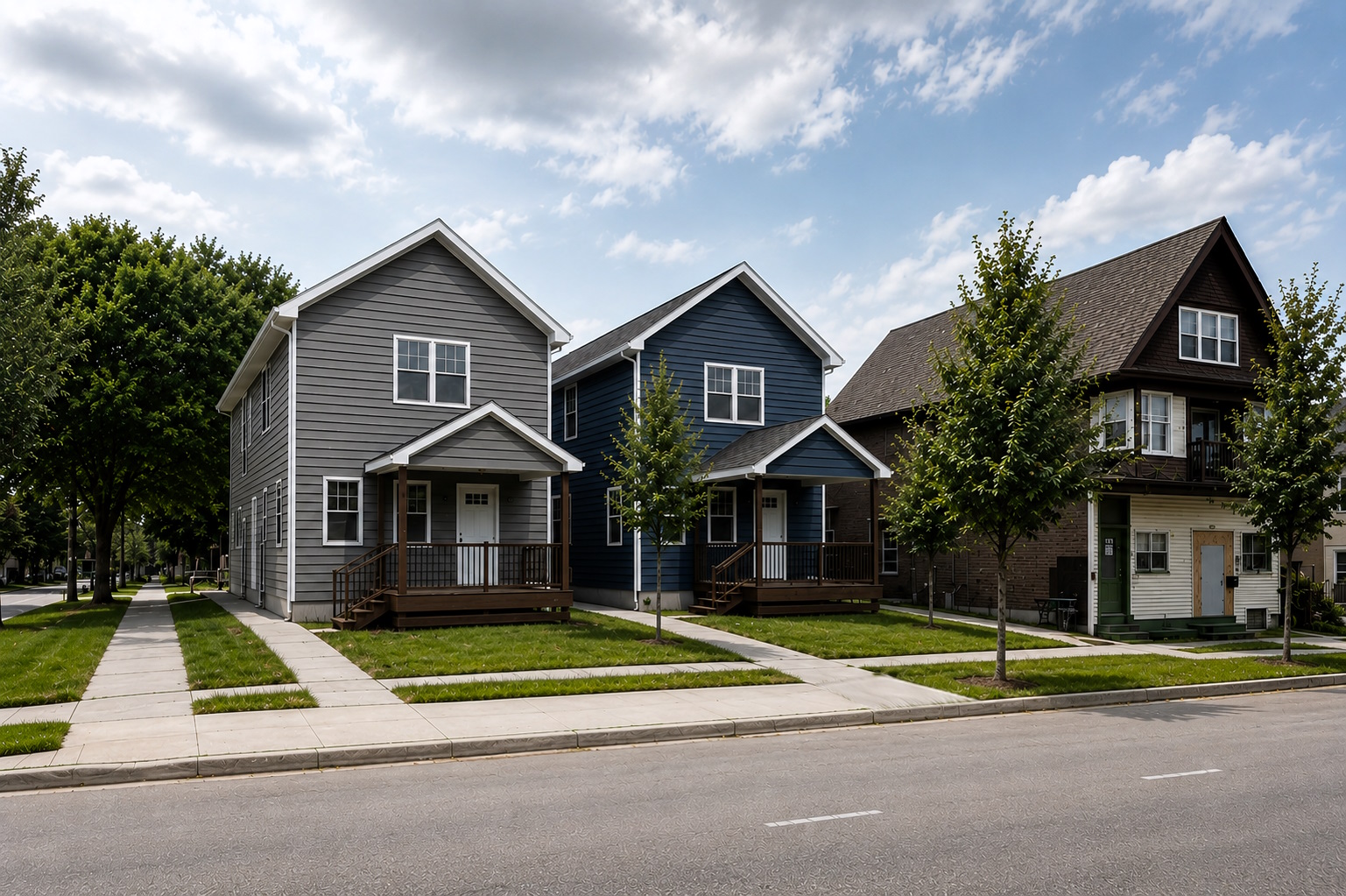
Townhomes at 2034-2038 W. Greenfield Ave. Rendering from VIA CDC.
The City of Milwaukee has selected four development teams to build a new generation of affordable, owner-occupied housing on vacant city lots, nearly seven months after the city originally expected to announce the winners.
The Department of City Development announced Thursday that it is working with Community First, Moxie Development Collective, UniteWI and VIA CDC on its Revive Housing Development: Attached Housing Pilot Program.
The initiative is intended to produce about 20 new homes, including townhouses, duplexes and other forms of “missing middle” housing that fall between detached single-family homes and larger apartment buildings.
The homes would be built on city-owned vacant lots and sold to households earning no more than 80% of the area median income.
The four teams are:
- Community First, working with co-developer VERA Property Management and Engberg Anderson.
- Moxie Development Collective, working with Sean Meyers Architect.
- UniteWI, working with co-developer Emem Group and DreamBuilders.
- VIA CDC, working with BMR Design Group.
Their selection has been a long time coming.
DCD issued a request for qualifications in November 2025 seeking developers interested in creating housing types that are common in older Milwaukee neighborhoods but have rarely been newly constructed in recent decades. Proposals were due Jan. 16, and the department originally anticipated announcing three selected development teams on Feb. 20.
Instead, negotiations continued through the spring.
By May, DCD officials said they were preparing to work with as many as four development teams. One had identified a cluster of vacant lots near King Park as its preferred location, while the other three were looking at sites in the near north side district represented by Ald. Milele A. Coggs, the near northwest side district represented by Ald. Russell W. Stamper, II and the south side district represented by Ald. JoCasta Zamarripa.
DCD’s Thursday announcement did not identify which developer was interested in King Park or assign any of the four teams to specific sites. The department said it is now working with the developers to identify appropriate city-owned lots and advance designs through the city approval process.
Each team will receive a $25,000 design subsidy to develop a housing model that can fit on standard Milwaukee lots and be replicated elsewhere.
The city has $2.8 million available to subsidize construction — $1.6 million approved as part of the city’s 2026 budget and $1.2 million from a federal PRO Housing grant awarded by the U.S. Department of Housing and Urban Development.
That funding is now expected to support about 20 homes. When the city solicited developers last fall, it said the pilot could create as many as 25 units.
The subsidy is necessary because the city intends to sell the homes at prices affordable to households earning no more than 80% of the area median income, while construction costs are substantially higher. Conceptual financial models issued with the 2025 solicitation estimated that about $100,000 in subsidy could be required for each unit.
“Milwaukee families deserve more opportunities to own a home and build wealth in their neighborhood,” said Mayor Cavalier Johnson in announcing the selections. “By putting vacant City-owned lots back to productive use and supporting new, affordable homes, we are investing in Milwaukee neighborhoods and creating more pathways for homeownership.”
The program is part of Johnson’s declared 2026 “Year of Housing” and the “revive” component of his broader Raze & Revive initiative, which was launched in 2024 as the city accelerated demolition of deteriorated tax-foreclosed houses.
The connection between the Revive program and where the new homes would be built became a point of contention at City Hall this spring.
Johnson’s administration proposed using revenue generated by The Brewery District to support housing development on a large collection of vacant lots near King Park, immediately west of Interstate 43.
The city is pursuing the acquisition of 19 privately owned lots there and would combine them with 19 city-owned parcels to assemble nearly two full blocks for new development. A tax incremental financing district amendment included $1.5 million to support housing development and another $1.5 million for site acquisition, preparation and infrastructure.
But Coggs and Ald. Robert Bauman questioned why the King Park development was being tied to Revive.
Coggs said the city should ensure that neighborhoods experiencing the most recent demolitions also receive a substantial share of the investment generated by the program. Most of the vacant King Park lots, in contrast, are the legacy of a sweeping urban renewal program that demolished approximately 900 homes in the area beginning in the 1960s.
Bauman, whose district includes the King Park site, argued that its proximity to Downtown, Marquette University, Aurora Sinai Medical Center and the Milwaukee County Courthouse presented an opportunity for a larger mixed-income development rather than a project tied specifically to the subsidized Revive program.
DCD officials stressed at the time that no existing Revive money was being shifted to King Park and that the additional TIF funding would expand the overall pool available for housing.
The Common Council ultimately approved the broader financing plan, but additional council votes will be necessary before specific housing developments can proceed.
DCD said Thursday that the four selected teams will present their proposals to the Common Council later this fall.
“Expanding the types of housing we build is an important part of addressing Milwaukee’s housing needs,” said DCD Commissioner Lafayette Crump. “This initiative gives us an opportunity to work directly with local development teams to build new attached housing models and turn underutilized land into high-quality, affordable homes that fit within Milwaukee’s existing neighborhoods.”
The program grew out of the city’s Housing Element plan, formerly known as Growing MKE. The comprehensive plan update calls for allowing and encouraging more housing types, including townhouses, rowhouses and duplexes, as a way to increase the city’s housing supply and provide more options at different price points.
If you think stories like this are important, become a member of Urban Milwaukee and help support real, independent journalism. Plus you get some cool added benefits.
Political Contributions Tracker
Displaying political contributions between people mentioned in this story. Learn more.
- July 9, 2025 - Cavalier Johnson received $500 from Lafayette Crump
- December 1, 2023 - Cavalier Johnson received $500 from Lafayette Crump
- April 22, 2019 - Cavalier Johnson received $50 from Lafayette Crump
- February 20, 2016 - Cavalier Johnson received $250 from Robert Bauman
- February 16, 2016 - Milele A. Coggs received $50 from Lafayette Crump
- July 20, 2015 - Russell W. Stamper, II received $50 from Lafayette Crump
- October 15, 2014 - Robert Bauman received $100 from Lafayette Crump
- September 8, 2014 - Robert Bauman received $100 from Lafayette Crump