
Trump ICE Plan Would Sweep Up Wisconsin Voter Data
Homeland Security eyes full voter rolls as legal experts warn of privacy law violations.
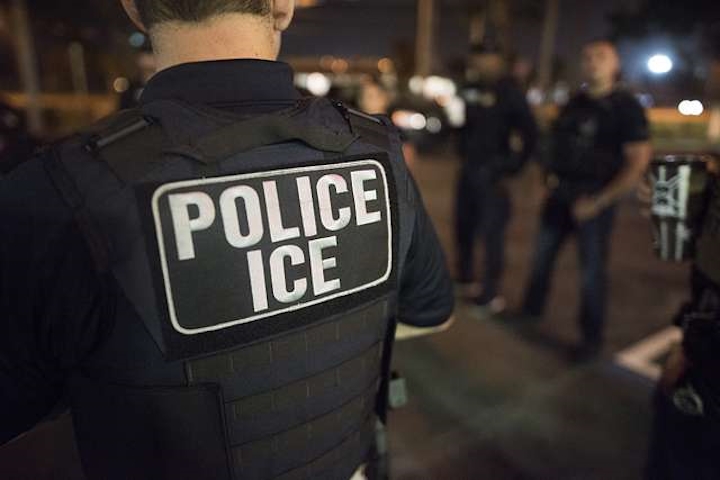
U.S. Immigration and Customs Enforcement. (Public Domain).
Wisconsin residents could find themselves on a new federal law enforcement list simply for registering to vote.
Under President Donald Trump, the federal government has attempted to assemble a centralized database of voter information. Since he lost the 2020 presidential election, the president has repeatedly claimed the election was stolen from him. In the wake of the election, his campaign filed legal challenges against election results across the country, including in Wisconsin, which he lost.
After he retook office in 2025, the U.S. Department of Justice (DOJ) launched an effort to collect complete, unredacted copies of states’ voter registration records. In Wisconsin, state law prohibited the release of the full dataset the DOJ requested, and when the Wisconsin Election Commission (WEC) refused the request, the DOJ sued. A federal judge dismissed the suit in May.
Now, the U.S. Department of Homeland Security (DHS) is trying a different tack, but there is reason to believe the new strategy would violate state and federal privacy laws.
DHS recently published procurement documents outlining a project capable of capturing all publicly available voter registrations in all 50 states. The federal agency is looking for a contractor who can collect the registrations on behalf of U.S. Immigration and Customs Enforcement (ICE), and more specifically, the Homeland Security Investigations (HSI) unit.
FedScoop, a publication covering government tech, reported the federal procurement documents earlier this month, which state the voter data would be used for “fraud detection” efforts. The program is connected to DHS efforts.
The president has repeatedly claimed the 2020 election was stolen from him, and that one of the reasons he lost was because of illegal voting by non-citizens. He has previously made these claims without evidence. Now DHS is “laser focused” on finding and prosecuting people who have illegally voted, according to a spokesperson for the agency.
“While ICE Homeland Security Investigations is not able to comment on any active investigations, HSI is actively rooting out and investigating election fraud wherever it can be found,” the DHS spokesperson said. “We have repeatedly demonstrated that illegal aliens can and do vote in our elections. Under President Trump, HSI is committed to restoring integrity to our election systems and ensuring that American citizens and only American citizens are electing American leaders.”
In April 2025, DHS “overhauled” a program that allows states and localities to verify the immigration status and U.S. citizenship of an individual. Out of the 60 million voter verification queries since then, only 24,000 cases, equivalent to 0.04% of the registrations searched, have been identified as “potential non-U.S. citizens on voter rolls,” according to DHS.
With the new voter registration project, ICE is seeking a contractor who can acquire and deliver publicly available voter registrations and voting histories from all 50 states and the District of Columbia. ICE is telling prospective contractors they should not automatically provide the agency with party affiliations unless the contracting officer formally requests them in writing.
Based on the contracting documents, ICE is seeking voter registrations that are publicly available in Wisconsin through the Wisconsin Election Commission (WEC), according to Emilee Miklas, WEC communications director. A complete voter roll can be purchased from WEC for $12,500. The commission also processes custom requests through the Badger Voters portal.
But even if the records themselves are publicly accessible, that doesn’t mean what the federal government has in mind is legal per se.
Rachel Snyder, an attorney with Law Forward, told Urban Milwaukee the procurement documents describe a project that would appear to violate Wisconsin’s data privacy laws. Earlier this year, Law Forward joined the lawsuit the DOJ brought against WEC, arguing on the said of the election commission and on behalf of Wisconsin voters. Snyder pointed pointed to the state’s laws cover “matching programs,” or how individual, personally identifiable information collected by the government can be used.
State law requires the government give notice to citizens when personally identifiable information is going to be used to match their identity to information in another database. “And to my knowledge, there’s no agreements here among the various government agencies that would comply with Wisconsin’s requirements,” Snyder said.
There’s also the federal Privacy Act of 1974, governing how agencies collect and use personal information from the public. Again, federal agencies are required to publish an official notice explaining what personal information they are collecting and how they are using it.
The ICE voter registration project is just one angle the federal government is taking to create a nationwide database of voter information. Common Cause, a nonpartisan, pro-democracy advocacy organization, is suing the DOJ over attempts to create a national voter database.
“These repeated efforts to obtain and consolidate voter information do appear to be an attempt to interfere with elections, especially as we approach the midterm elections this fall, and that is something clearly barred by the Constitution, and something that no American should be willing to let happen,” Snyder said.
Under the Trump administration, the U.S. Census Bureau analyzed non-citizen voting in the 2020 election the president lost. More than 160 million voters cast ballots in the election. The census bureau analyzed 128 million voter records and only found 24,000 cases where it could report “with high confidence” that a voter record was linked to a person who did not have citizenship. In Wisconsin, the bureau found 500 instances of a voter record tied to a non-citizen voter. Trump lost Wisconsin in 2020 by more than 20,000 votes.
If you think stories like this are important, become a member of Urban Milwaukee and help support real, independent journalism. Plus you get some cool added benefits.