How Gerrymandered Are Wisconsin’s Congressional Districts?
The data tells the story. Will it help win two court court cases?
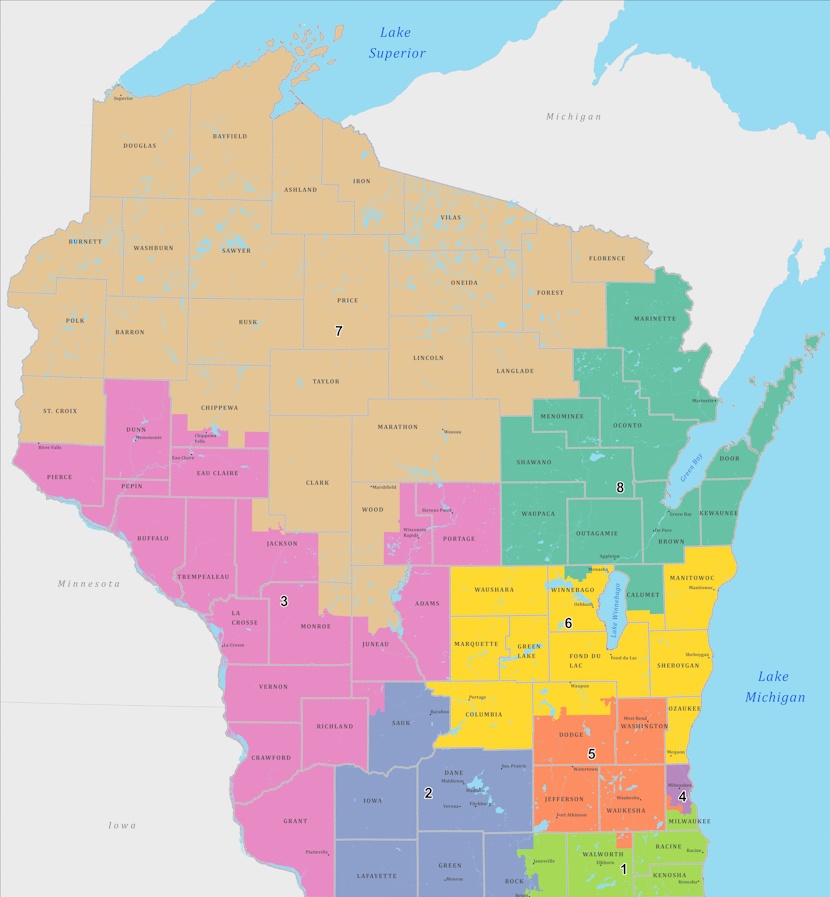
2023 Congressional Districts.
Every 10 years, American states are required to adjust their legislative districts to reflect changes in their populations. The aim is to create Wisconsin Assembly, Senate and U.S. congressional districts that have equal populations.
Following the 2010 U.S. Census, Wisconsin Republicans enjoyed a legislative “trifecta” in which the state Assembly and Senate had Republican majorities and the governor, Scott Walker, was also a Republican. In addition, although nominally nonpartisan, most of the Wisconsin Supreme Court justices were conservative. Controlling all points of power, Republicans were able to create voting districts that strongly favored Republicans. Wisconsin’s legislative districts were widely described as among the most gerrymandered in the nation.
Ten years later, following the 2020 census, the Republican-dominated Legislature again adopted maps that would have continued the Republican electoral advantage. However, by this time, Republican Gov. Walker had been replaced by a Democrat, Tony Evers. Evers proceeded to veto the bill incorporating the Legislature’s attempt at new maps. The task of developing new maps then fell to the Wisconsin Supreme Court.
The court invited submissions of proposed district maps. It announced that it would favor proposals that made the “least change” to the existing 2010 maps. As a result, the new maps almost perfectly replicated the prior map. Ninety-four and a half percent of Wisconsin voters were assigned to their same congressional district as before. Not surprisingly, the new maps were at least as partisan as those developed after the 2010 census. Despite the ultimate effect, it appears that the conservative court majority sincerely believed they were acting in a nonpartisan fashion.
The new maps for Wisconsin Senate and Assembly districts lasted only a single election cycle. It was discovered that they broke a legal requirement that districts be contiguous — that there be no “islands” in which a part of a district is completely surrounded by other districts. Problems with these islands resulted when developers wanted city services from a nearby but not contiguous village or city.
The discovery that the existing Wisconsin state districts were illegal eventually led to a new set of state Senate and Assembly districts that were far less partisan than the districts generated through the “least-change” principle. However, because there were no contiguity issues with congressional districts, the right-tilted map for these districts was left undisturbed.
Although Wisconsin is a very competitive state, the current congressional map is strongly skewed to favor Republicans, as shown in the graph below of voting in 2024. Of Wisconsin’s eight congressional districts, the Cook Political Report classifies two districts as solidly Democratic, centered on Milwaukee and Madison. Cook classifies four districts as solid Republican, one as likely Republican and one as tossup.
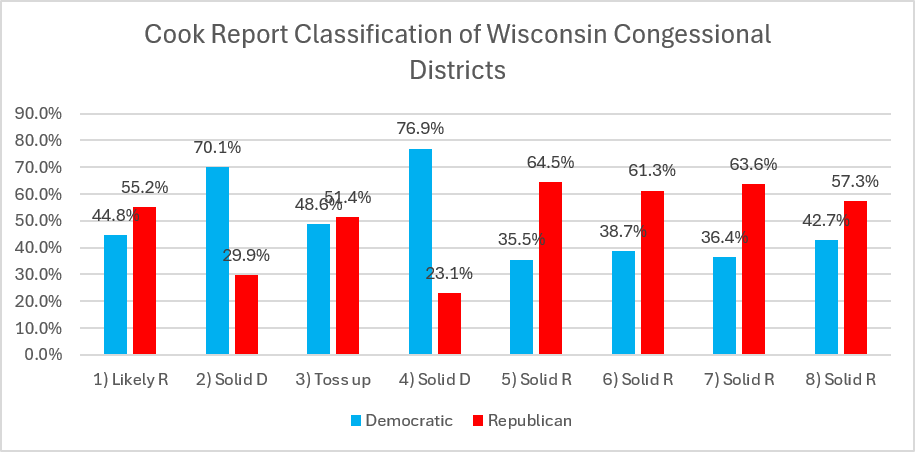
Cook Report Classification of Wisconsin Congressional Districts
Starting in 2025, two lawsuits challenging the Wisconsin congressional delegation have been wending their way through the Wisconsin electoral system. A major complicating factor for both suits is that they are being brought under two relatively obscure sections of state law.
Section 751.035(1) of Wisconsin statutes states that:
Upon receiving notice under s. 801.50 (4m), the supreme court shall appoint a panel consisting of 3 circuit court judges to hear the matter. The supreme court shall choose one judge from each of 3 circuits and shall assign one of the circuits as the venue for all hearings and filings in the matter.
Sections (2) and (3) immunize the panel from interference from any court other than the Supreme Court itself:
No party may move for substitution of any circuit court judge assigned under this section. … An appeal from any order or decision issued by the panel assigned pursuant to sub. (1) may be heard by the supreme court and may not be heard by a court of appeals for any district.
Section 801.50 (4m) adds more detail to setting up a three-judge panel:
Venue of an action to challenge the apportionment of any congressional or state legislative district shall be as provided in s. 751.035. Not more than 5 days after an action to challenge the apportionment of a congressional or state legislative district is filed, the clerk of courts for the county where the action is filed shall notify the clerk of the supreme court of the filing.
A history note accompanying this text notes that while this section was added in 2011 “this is only the second time this law has been invoked and the previous occasion completed ambiguously.” Apparently, the Walker administration hoped that these requirements would act to discourage challenges to Republican gerrymandering, requiring that the panel consist of three judges, each from different counties.
The Supreme Court proceeded to establish two three-judge panels, one for each of the lawsuits. One is called Elizabeth Bothfeld v. Wisconsin Elections Commission, or “Bothfeld.” The second lawsuit is called Wisconsin Business Leaders for Democracy, or “WECB.”
Oral hearings on each of the two lawsuits have been scheduled for Sept. 16, 2026, in the Supreme Court’s Madison courtroom (at 9 a.m. for Bothfeld and 10:30 a.m. for WECB).
In a future column, I plan to look at some of the issues that have been raised by these cases.
If you think stories like this are important, become a member of Urban Milwaukee and help support real, independent journalism. Plus you get some cool added benefits.


Data Wonk
-
Learning Our Lesson From COVID-19
 Aug 19th, 2026 by Bruce Thompson
-
Most Republicans Support Raising the Minimum Wage
 Aug 5th, 2026 by Bruce Thompson
-
The Economics of the Minimum Wage
Jul 22nd, 2026 by Bruce Thompson