We Energies Deal Would Buy Power From Point Beach Nuclear Plant Into 2050s
State PSC must approve it. Consumer advocacy group questions whether costs too high.
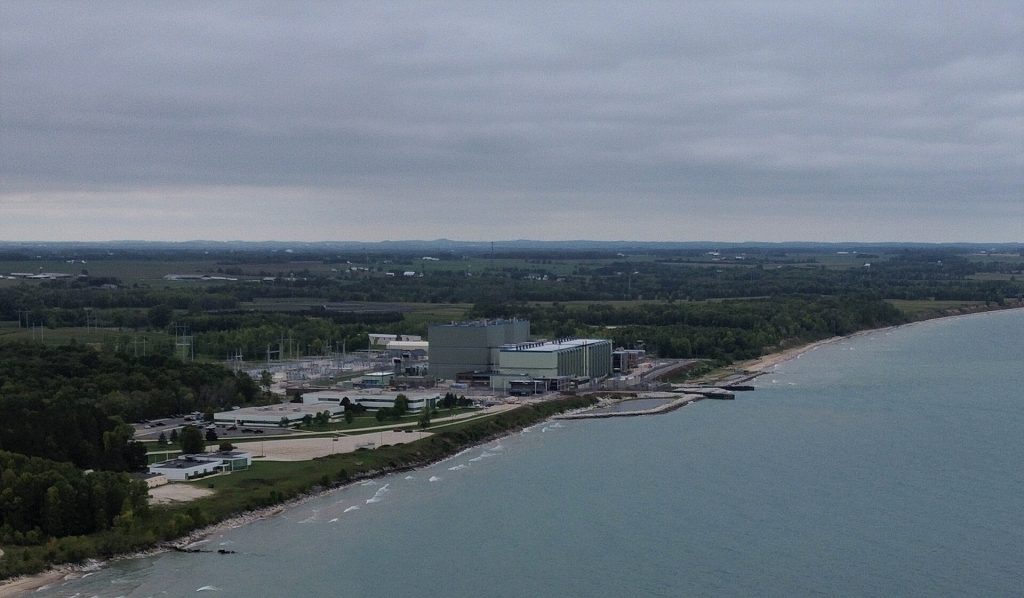
The Point Beach Nuclear Plant along Lake Michigan in Two Rivers, Wisconsin. (Yodel2010/Wikimedia Commons, CC BY-SA 4.0)
We Energies plans to continue purchasing energy from a nuclear plant in Manitowoc County through 2053, but ratepayer advocates say there aren’t enough details yet to know whether the deal shields customers from rising costs.
This week, the utility’s parent company told the U.S. Securities and Exchange Commission that We Energies entered into a power purchase agreement with NextEra Energy to buy 86 percent of the energy from Units One and Two of the Point Beach Nuclear Plant.
The plan comes as We Energies is working to meet an expected spike in energy demand associated with data centers. A recent draft report from state utility regulators showed electricity demand in Wisconsin could increase by more than 40 percent by 2032, driven by hyperscale data centers.
The agreement still needs to be approved by the Public Service Commission of Wisconsin, and there were no financial details available in the SEC filing.
While the filing says the new deal “will result in savings for customers,” ratepayer advocates say the existing Point Beach agreement has become increasingly costly for We Energies customers in recent years. They want to see details of the new deal before making any conclusions.
“We certainly hope that it’s a much, much better deal than what we’re locked in now,” said Tom Content, executive director of the Citizens Utility Board of Wisconsin. “Obviously, we have no details and no information, and the one concern about a 20-year deal like this is it’s always hard to predict the future.”
If approved, the deal would extend the utility’s purchase of around one gigawatt of nuclear energy capacity beyond its current end date.
We Energies’ existing agreement to purchase power from the two units is set to expire in 2030 and 2033. But under the new agreement, the utility will purchase energy from Unit One through 2050 and Unit Two through 2053.
In a statement, We Energies spokesperson Brendan Conway said the agreement supports “around-the-clock reliability for customers” and will “provide customers with fuel savings” compared to the current deal with Point Beach.
“The agreement also provides long-term price certainty,” he stated. “The companies plan to file the agreement for approval with state regulators this fall.”
Conway added that more information would be released as part of the public regulatory process.
We Energies has said its current agreement to buy nuclear power from Point Beach is driving around 20 percent of its total requested rate increase for 2027.
In a presentation on its rate case, the company said the agreement was creating “unbalanced cost compared to energy it provides customers.”
That’s because the plant accounted for about a third of We Energies capacity needs, but the current power purchase agreement accounted for about two-thirds of the utility’s fuel budget in 2027, the company said.
The utility had been considering alternatives to extending its contract with NextEra.
In a May earnings call, Scott Lauber, CEO of WEC Energy Group, the parent of We Energies, said the company was still looking at its options regarding Point Beach. He said the costs of the agreement were “pretty high” and the utility was “going to look at affordability for our customers.”
Lauber said the cost of replacing the generation from the nuclear plant would be around $2 billion to $2.5 billion.
“At this time, we’re planning that we’re going to have to replace that, and we’ll put that in our five-year plan this fall, most likely replace it with some gas,” he said, noting later in the call some combination of gas and renewable energy may be needed.
When asked by investors about the Point Beach agreement at an earnings call later this summer, Lauber largely said the company would have more information at a future call.
Content, with the Citizens Utility Board, said his organization has been concerned about rising costs associated with the current Point Beach agreement for the better part of a decade.
Under the current power purchase agreement, the monthly cost of delivering one megawatt-hour of electricity to We Energies increased from $45.94 in 2016 to $75.51 in 2026, according to an SEC filing. By 2033, that cost was estimated to hit $122.45.
“We Energies, in every single rate case, are seeing the really expensive prices from this hockey stick-style increase of a power purchase agreement that was negotiated decades ago,” Content said. “We’re hamstrung by that, and, unfortunately, there’s no proposal to relieve that burden until 2030 and 2033.”
Last year, federal regulators approved the Point Beach Nuclear Plant’s license renewal, allowing Units One and Two to operate through 2050 and 2053, respectively.
NextEra, the plant’s owner, secured a power purchase agreement last year that would allow the city of Two Rivers to continue receiving nuclear energy from the plant into the 2050s.
That agreement was between NextEra and WPPI Energy, a member-owned nonprofit that serves 51 locally owned electric utilities.
NextEra spokesperson Bill Orlove said in a statement that the agreements with We Energies and WPPI help deliver “long-term benefits for the local community through reliable and low-cost energy, quality jobs and continued economic investment.”
We Energies plans to buy power from Point Beach Nuclear Plant into the 2050s was originally published by Wisconsin Public Radio.
If you think stories like this are important, become a member of Urban Milwaukee and help support real, independent journalism. Plus you get some cool added benefits.