EPA PFAS Rollback Puts Wisconsin Drinking Water Limits In Legal Crosshairs
Experts say state rules could be more vulnerable to lawsuits as federal standards weaken.
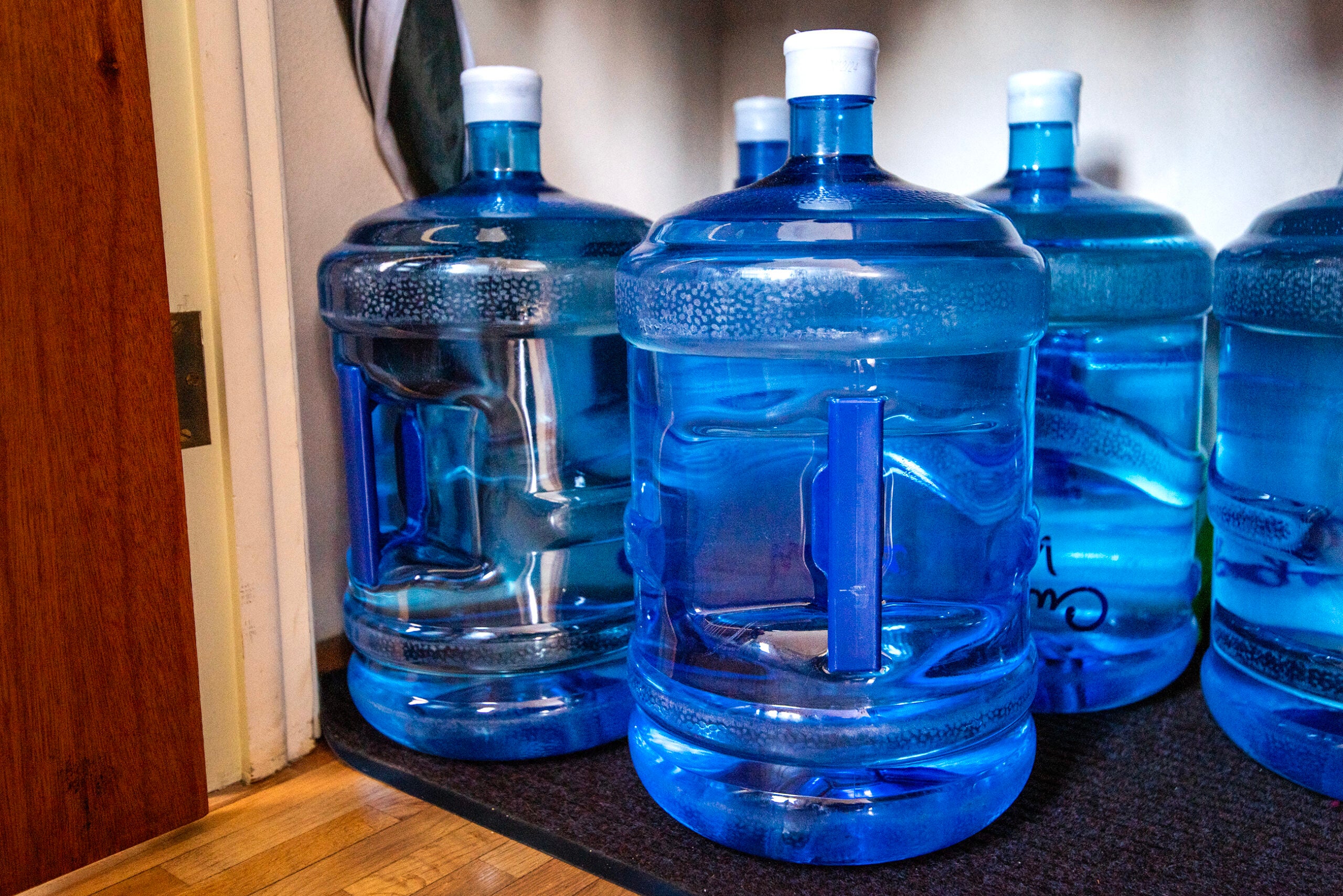
Water stored in a closet near Margie Walker and Jim Boisen’s kitchen in their French Island home Friday, Feb. 21, 2025. Angela Major/WPR
Some policy experts say Wisconsin’s drinking water standards for PFAS could be vulnerable to a legal challenge after the Environmental Protection Agency announced plans to roll back limits for some chemicals.
On Monday, the EPA proposed a rule that would maintain limits for the two most widely studied PFAS chemicals but drop standards for four others. EPA Administrator Lee Zeldin said the Biden administration “cut corners and failed to follow the law” when it set the first-ever drinking water standards for PFAS.
Gov. Tony Evers criticized the move.
“These actions by the Trump administration are reckless and a huge step backward in our efforts to keep folks healthy and safe,” Evers posted on X.
EPA first proposed rolling back PFAS standards last year amid lawsuits brought by water utilities and chemical companies, saying they wouldn’t survive a legal challenge. But the Wisconsin Department of Natural Resources forged ahead with regulations that align with the Biden-era limits this year, citing fears the state may lose its authority to regulate the chemicals if they weren’t adopted.
Dave Strifling, director of Marquette Law School’s Water Law & Policy Initiative, told WPR’s “Wisconsin Today” that state and federal law dictates Wisconsin’s rules may be no less stringent than federal requirements under the Safe Drinking Water Act.
Strifling said the state’s regulations “might be a little more susceptible to challenge than they were before the federal rollbacks occurred, but there’s a lot of uncertainty here.”
The state could face a challenge from water utilities or chemical companies arguing there’s not enough time to comply with the state regulations, Strifling said. The DNR’s argument that its limits had to align with Biden-era standards may no longer carry water if the EPA’s proposed rollback is successful.
A DNR spokesperson said the agency is evaluating next steps.

Marinette resident Doug Oitzinger stands over a ditch flowing into Green Bay where water samples have shown PFOS levels as high as 2,000 parts per trillion before it’s treated. Danielle Kaeding/WPR
Wisconsin residents facing PFAS contamination objected to the rollback, including Marinette resident Doug Oitzinger with the nonprofit group Save Our Water. Oitzinger said environmental advocates are already challenging the legality of the move, citing an anti-backsliding provision under the Safe Drinking Water Act that prevents weakening of standards.
“These are toxic substances that we should not be having in our drinking water, and certainly should not be flowing out into the environment,” Oitzinger said.
Steph Tai, an environmental law professor at the University of Wisconsin-Madison, questioned whether any legal challenge to the state’s regulations would be successful. Tai noted the Wisconsin Supreme Court previously sided with the DNR on a separate PFAS challenge.
“I think (EPA’s rollback) could make it more vulnerable to challenge, but again, there’s a much more regulation-friendly Supreme Court, so it’s little up in the air,” Tai said.
Along with its proposal, the EPA announced nearly $1 billion in new funding to address PFAS, including $15 million for Wisconsin. Evers also signed bills that allow spending $133 million in a PFAS trust fund to address the chemicals.
Federal regulators are defending standards for PFOA and PFOS that are set at 4 parts per trillion, but they’re stripping limits for PFNA, PFHxS, GenX and PFBS. Wisconsin approved standards for all six substances earlier this year.
With the rollback, Strifling told WPR the state’s limits could also face problems under a 2017 law known as the REINS Act that triggers legislative approval of regulations that cost more than $10 million in any two-year period. The DNR’s economic impact analysis of its rule said the proposed PFAS limits would cost the state nothing beyond what’s federally required.
Wisconsin Manufacturers and Commerce, the state’s largest business lobby, is among groups that argued the DNR failed to follow the law when the agency didn’t include state costs. Adam Jordahl, WMC’s director of environmental and energy policy, said they’d like to see the DNR revise state limits to match the EPA’s proposal.
“Otherwise, at a minimum, I do think if the department is going to press ahead with going more strict than the EPA, then the department does need to, I think, revisit the economic impact analysis,” Jordahl said.
The DNR estimated water utilities and businesses would have to spend $26.6 million to meet the Biden-era standards in the first year. The agency estimated 96 water systems may have to spend an estimated $12.6 million to address PFAS levels above those limits.
However, the agency said only four water systems would be affected by proposed limits for the four substances that EPA is weakening. Wisconsin’s PFAS standards are set to take effect on July 1.
Wisconsin PFAS limits may face legal challenge after EPA’s proposed rollback was originally published by Wisconsin Public Radio.
If you think stories like this are important, become a member of Urban Milwaukee and help support real, independent journalism. Plus you get some cool added benefits.
More about the PFAS Problem
- $10 Million Released To Tackle PFAS In Marinette, Peshtigo Wells - Danielle Kaeding - Sep 3rd, 2026
- Gov. Evers, DNR Celebrate Release of $10 Million Pfas Settlement Payment to Help Provide Safe Drinking Water to Affected Communities - Gov. Tony Evers - Sep 1st, 2026
- Gov. Evers, Wisconsin DNR Urge Release of $10 Million to Address PFAS - Danielle Kaeding - Aug 20th, 2026
- Baldwin, Colleagues Demand EPA Drop Its Effort to Weaken PFAS Drinking Water Protections for Millions of Americans - U.S. Sen. Tammy Baldwin - Aug 10th, 2026
- DNR Hosting Listening Session to Gather Feedback About Pfas Law Program Development - Wisconsin Department of Natural Resources - Jun 5th, 2026
- Wisconsin DOJ Reaches Settlement With Tyco Fire Products for Alleged PFAS Violations - Wisconsin Department of Justice - Jun 4th, 2026
- EPA PFAS Rollback Puts Wisconsin Drinking Water Limits In Legal Crosshairs - Danielle Kaeding - May 21st, 2026
- Gov. Evers Delivers Radio Address, Celebrates Release of Over $125 Million to Fight Pfas Statewide - Gov. Tony Evers - Apr 10th, 2026
- Wisconsin Conservation Voters Celebrates Double Win - Wisconsin Conservation Voters - Apr 8th, 2026
- Gov. Evers Signs Bills Releasing Funds to Combat PFAS Pollution - Baylor Spears - Apr 7th, 2026
Read more about PFAS Problem here