
We Could Fix Our Roads, Instead We Expand and Expand
All the city news you can use.
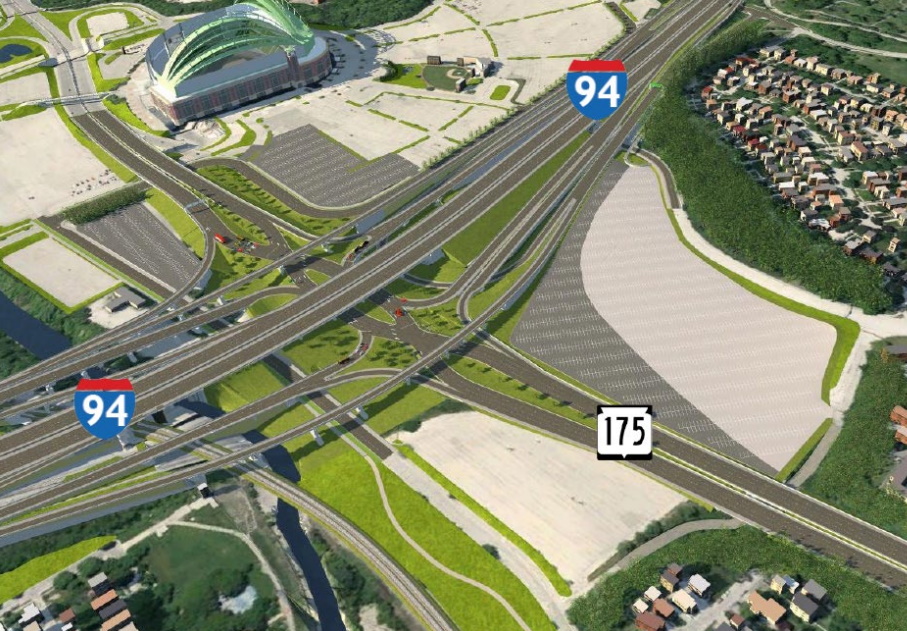
Diverging diamond design for Stadium Interchange. Image from I-94 Supplemental Environmental Impact Statement.
Every day at The Overhead Wire we sort through over 1,500 news items about cities and share the best ones with our email list. Each week, we take some of the most popular stories and share them with Urban Milwaukee readers. They are national (or international) links, sometimes entertaining and sometimes absurd, but hopefully useful.
First scissor stairs law in Washington State: Washington State has passed the first scissor stair reform in the country. These types of staircase designs allow for two separate stairways creating dual exits on the same floor which can reduce footprint and aid the construction of buildings on smaller lots. The hope is that allowing the stair type will lead to more possible housing types and construction of new units. (Markus Johnson | The Sightline Institute)
Dawn of electrotech: The global shocks of the Iran War are leading many countries to consider more stable energy supplies as oil, fertilizer, helium, and cooking gas supplies run low. Previous oil shocks impacted countries with recessions and rationing but this time there is a superior alternative energy source to oil and gas; electricity. China’s investment and exports in solar panels, electric vehicles, and battery cells are giving countries an alternative to oil dependence. (Kate Mackenzie and Tim Sahay | Phenomenal World)
Rethinking accessibility measures: Yuquan “Wendy” Zhou‘s PHD dissertation at USC has put together a different way of thinking about access. Her work moves away from static accessibility maps and towards a “people-based” look at how someone can access the destinations they need based on their location during the day and the hours a destination is open. It’s another important way of reasserting the importance of time based planning and changing how we think about access to destinations. (Christian Hetrick | USC Price)
Enough funding for fixing roads: Federal transportation funding is available for state highway departments to fix every crumbling road in the United States. However a new report suggests that much of the money continues to be spent on expansion to the point that we may not be able to maintain the system we’ve built over time. Instead of formula money, states need more accountability that would make them rethink how they spend precious transportation funds. (Kea Wilson | Streetsblog USA)
A Chinese approach to TOD above the tracks: Train maintenance and storage depot lands are one of the most overlooked property types in cities. To get the most out of the land, China has developed a technical system for developing whole neighborhoods over their depots. From an urbanism standpoint, the goal is to provide space for people while also masking the mechanics of what is happening underneath disappear. (Anderson Chider Hsieh | Planetizen)
Quote of the Week
These industry groups are well practiced and well-funded to lobby hard. The eight organizations analyzed in the paper collectively employed over two hundred lobbyists, spending over $100 million on lobbying and political donations.
–Kevin X. Shen in Union of Concerned Scientists discussing the amount of lobbying the road building industry does to keep people driving.
This week on the Talking Headways podcast, we’re joined by Stephanie Dockery to discuss the Bloomberg Philanthropies Public Art Challenge. Stephanie discusses how a bus art can get a cult following, how artists are creating attention in their cities with temporary art, and what happens after the projects disappear.
Want more links to read? Visit The Overhead Wire and signup.
If you think stories like this are important, become a member of Urban Milwaukee and help support real, independent journalism. Plus you get some cool added benefits.


Urban Reads
-
What Parts of the US Sprawl the Most?
![Sprawl. Photo by David Shankbone (David Shankbone) [GFDL (http://www.gnu.org/copyleft/fdl.html) or CC-BY-SA-3.0 (http://creativecommons.org/licenses/by-sa/3.0/)], via Wikimedia Commons [ https://commons.wikimedia.org/wiki/File%3ASuburbia_by_David_Shankbone.jpg ]](https://urbanmilwaukee.com/wp-content/uploads/2017/10/1024px-Suburbia_by_David_Shankbone-185x122.jpg) May 9th, 2026 by Jeff Wood
May 9th, 2026 by Jeff Wood
-
Why Are States Passing Laws to Reduce Driving?
 May 3rd, 2026 by Jeff Wood
-
Waymo Means Way More Cars on Streets
 Apr 26th, 2026 by Jeff Wood


















The more you read about what China is engaged in the more you realize that the US is a laggard and no longer the world leader. They are advancing with long term goals in mind, excelling at alternative energy, technology, and manufacturing, all of it complementing one another. It’s almost like they have continuous 5 year plans! (They are in their 15th five year plan covering years 2026 to 2030). I read an article how China is attempting to build a data center under water using the cool ocean water to help cut water and energy usage. The data center will be powered by a nearby wind farm. If successful, this will be a model for future data centers. I don’t know if this country is attempting anything like that, we would rather tell each other stories about how great we are.
Conflicts being ignored?? We have an older population in the US. There is an awareness that fewer new humans are being born.— We need to use less fuel for autos. We need to use human powered vehicles and mass transit. We need to build small housing that PEOPLE CAN AFFORD not expensive super structures for the rich (California’s small houses being built on the large lots that once housed only large housing). Speedy out of state developers seem to prey on Milwaukee. —— It’s small/realistic versus large/out of reach. — Roads have the same issue. I worry about the widening of roads because a landscape of concrete, noise and structures that we are not able to take good care of is not really an improvement while our climate is bringing us weather that will continue to freeze/thaw to rumple our city landscape. —— So, maybe this time in Milwaukee’s history we need to take a long ‘thoughtful pause’ and look at all these pieces of our civic puzzle’ A moratorium perhaps. We need to look at all of this all at once, which I feel we aren’t doing enough of.