
2 Wisconsin Health Systems Launching New Cancer Treatment Programs
Proton therapy programs will offered by Froedtert Hospital/MCW and UW Health.
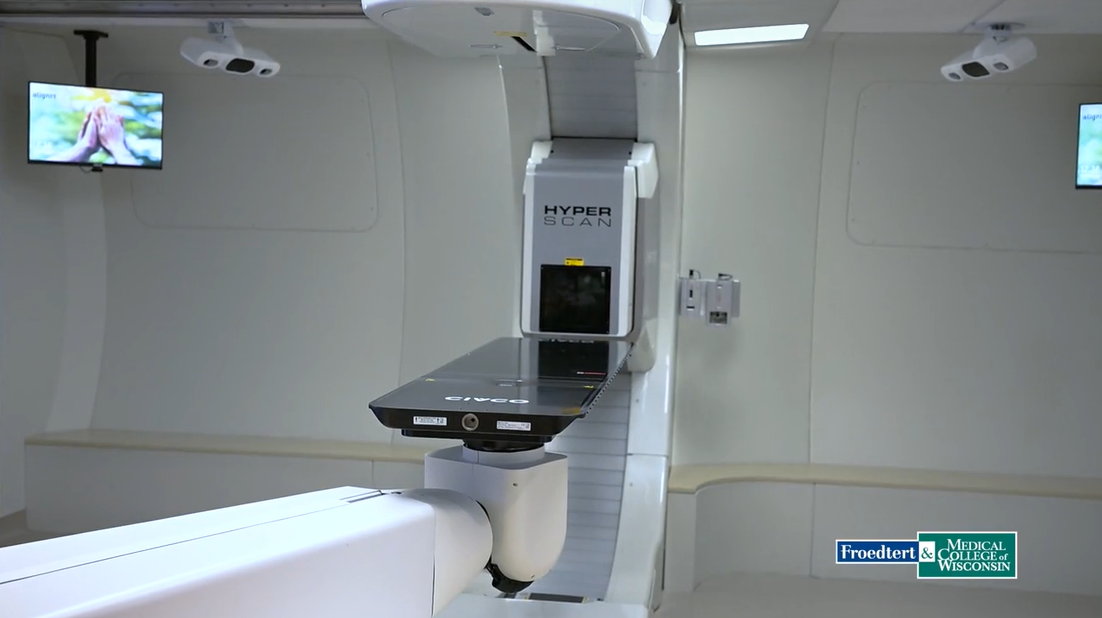
A machine that emits a proton beam as part of proton therapy cancer treatment is pictured. Courtesy Froedtert Hospital
Two of Wisconsin’s biggest health systems are launching new cancer therapy programs. Two doctors specializing in radiation therapy say the relatively rare treatment program is another valuable tool to treat a variety of malignant tumors.
Last month, Froedtert Hospital and the Medical College of Wisconsin treated its first patient using a form of cancer treatment called proton therapy. The treatment uses a machine the size of a building to target cancerous tumors by accelerating proton particles to nearly the speed of light and aiming those particles at specific parts of the body.
“It’s almost like a science fiction-type situation, that we can take these particles and we can deposit them in such a precise way to target malignant tumors,” said Dr. William Hall, a professor and chair of the Department of Radiation Oncology at Froedtert and the Medical College of Wisconsin.
He told WPR’s “Wisconsin Today” that the treatment can target a tumor down to the millimeter while depositing less radiation to surrounding tissue.
“If patients have previously been treated with radiation therapy, sometimes using proton therapy to limit the additional doses and low-dose distribution of radiation can be really beneficial,” Dr. Hall said. “For certain tumors like head and neck cancers or liver cancers, or tumors that are really close to ultra-sensitive organs but require high doses of radiation, proton therapy can be helpful.”
There are only about 50 proton therapy centers nationwide, according to the National Association for Proton Therapy.
The Food and Drug Administration approved proton therapy in 2001. A 2023 review found it can be particularly useful to treat children with cancer.
“For most adult patients … the body actually heals and tolerates low doses of radiation really well,” Dr. Hall said. “But for developing and growing organs like in pediatric patients, it can actually be quite beneficial.”
Dr. Hall said the health system had decided to pursue building a proton therapy program three or four years ago, after they determined there were enough patients to justify the cost of offering the treatment.
The 2023 review found that building one proton therapy facility with three or four treatment rooms costs from $100 million to $200 million.
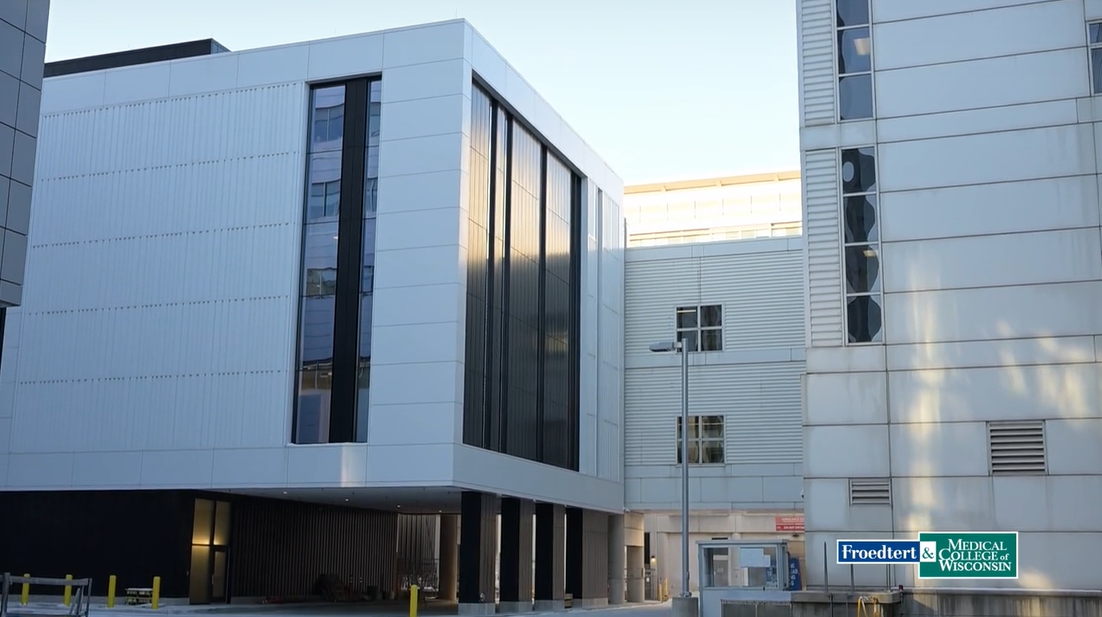
A building housing the treatment space and technology for Froedtert Hospital’s proton therapy program is pictured. Dr. William Hall, chair of the Department of Radiation Oncology at Froedtert and the Medical College of Wisconsin, told WPR the hospital built one of the smallest proton therapy machines available, and it occupies the space of an entire building. Photo courtesy Froedtert Hospital
UW Health launching proton therapy later in 2026
While Froedtert Hospital and the Medical College of Wisconsin began their proton therapy program last month, UW Health is close behind — set to launch the second proton therapy program in the state later this year.
Dr. Benjamin Durkee is a radiation oncologist at UW Health and medical director of UW’s Proton Therapy Program. He told “Wisconsin Today” that the health system is set to launch its own proton therapy program later this year. Dr. Durkee said that while treatment should be tailored to each individual patient, there is evidence that proton therapy could benefit seniors being treated for certain types of head and neck cancers.
“There’s less radiation dose to the critical structures in the head,” Dr. Durkee said. “That means lower rates of feeding tube dependence, quicker return to work and just overall better treatments.”
When asked about whether insurance will cover proton therapy, Dr. Durkee said doctors can prove the treatment will be helpful by running simulations to determine the best type of radiation treatment to provide.
“If I can simulate a comparison plan and I can demonstrate unequivocally that a patient will benefit from proton therapy, I can pass that along to the insurer or the employer, or whoever is paying, and I can say, ‘Hey, this is why we’re doing it. This is the benefit.’ And a lot of times they’ll agree with us,” Dr. Durkee said.
Ultimately, Dr. Hall with Froedtert said that treating cancer is a team sport.
“That team includes radiation oncologists, chemotherapy doctors. Doctors that give therapies like immunotherapy or cellular therapies. It includes surgeons,” Dr. Hall said. “The way that we make the best decision for the patient is often through either multidisciplinary clinics — where patients will see several different doctors — or we each see patients individually. And then we present those patients at multidisciplinary tumor boards, where we all work together.”
2 Wisconsin health systems launching cancer treatment programs new to the state was originally published by Wisconsin Public Radio.
If you think stories like this are important, become a member of Urban Milwaukee and help support real, independent journalism. Plus you get some cool added benefits.