

Cassellius Betting on Smaller Class Sizes
While cutting number of assistant principals. Will it improve MPS?
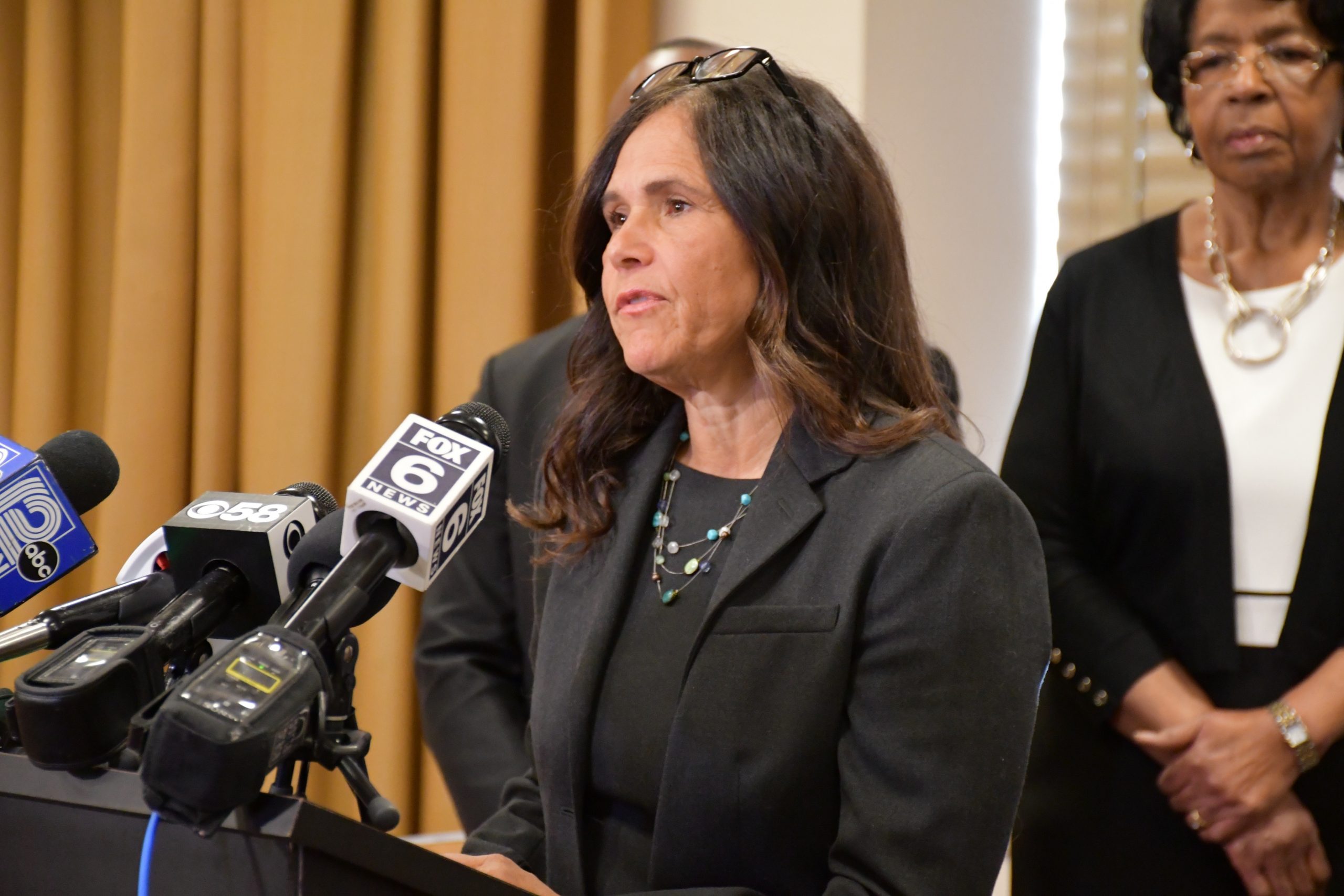
Milwaukee Public Schools Superintendent Brenda Cassellius speaks at an April 3 press conference. Photo by Jeramey Jannene.
Milwaukee school superintendent Brenda Cassellius is making a bet: If a district must spend its limited resources, it is better to place money on lowering class sizes than to keep many assistant principals and support staff to underpin classrooms.
Cassellius needs to eliminate a $46 million deficit. On the district’s website, she announced that cutting 260 jobs may save $30 million. Because of retirements and individuals leaving the system, only 201 employees received notices on March 24 that their jobs would be eliminated; however, those losing their positions could apply to vacancies in the district.
MPS assured the public that the cuts will have little negative impact on classroom teachers. In fact, it would allow the district to hire more classroom teachers and lower class sizes. It outlined the advantages on its website: “Having smaller class sizes means students would receive more one-on-one attention; teachers could get to know students better, helping to make the school feel more like a family; and students can learn better.”
The Milwaukee Teachers’ Education Association (MTEA) countered on March 26 that “Superintendent Cassellius has lied to students, workers and the entire Milwaukee community about not cutting critical classroom positions that directly serve Milwaukee children… classroom-based student-facing MPS workers.”
But what the MTEA is referring to is not classroom teachers, but rather support staff who assist the regular teacher within the classroom or pull students out individually or in small groups to provide additional support. Cassellius stresses this distinction.
The MTEA also contends there are other ways to cut the budget. “MPS has failed to conduct a thorough review of hundreds of millions of dollars of contracts where substantial savings can be found,” the union charges. “In December, MPS paid millions to central office administrators who allegedly didn’t use their vacation, and the administration plans to pay millions more in June.”
The Administrators and Supervisors Council (ASC), which represents assistant principals and other administrative staff, points out that assistant principals work with students daily and help in the operation of a school’s classrooms.
As stated in an MPS press release on March 25: “Guidelines include 18 students per teacher at K3, 20 at K4 and 22 at K5. This is part of a basic standard of care that includes one assistant principal for every 350 students and continued central funding of art, music, physical education, librarians, counselors, nurses, psychologists and social workers. No students will be asked to leave a school to meet class size guidelines, and the district is working with schools that do not have the space to do so or need larger classes based on their specific programs.”
Personnel is the bulk of any school district budget, so it comes down to which personnel are most important.
Much research has been done on the impact of lowering class size. The landmark study in the late 1980s was Tennessee’s Project STAR (Student/Teacher Achievement Ratio) program. It targeted classrooms in the lowest grades, trying to bring classroom sizes down to roughly 15 students per class.
A Brookings analysis in 2011 concluded that “STAR researchers have found positive effects of early and very large class-size reductions on academic achievement in school and college attendance, with the economic benefits of the program outweighing the costs. These are important results from a very strong research design.”
But not everyone was so convinced. Amber M. Northern, writing for Fordham Institute in 2025, argued that there were a number of research design problems and, therefore, some of the results are probably overstated.
Yet Northern confirms that lowering class size is usually supported by teachers and their unions. She states, “As a former high-school teacher, I can attest that one small group of fifteen students nestled among five other classes of thirty is a sanity saver. In this way, Project STAR ‘proved’ what many on the ground wanted to hear.”
Nowhere was Project STAR taken to heart more than California. There, officials implemented class-size reductions statewide, with some negative results. Wealthier districts took money to lower class sizes along with poorer districts and raided poorer districts of their best teachers. Poor districts had to hire whatever “warm bodies” they could to fill in as teachers. Academic achievement declined in those districts, as one analysis found.
It took a couple of years to correct the shortcomings in California. And while it ultimately was able to show that lowering class sizes helped achievement, the state abandoned its efforts to lower class sizes for budgetary reasons. Today California once again has some of the largest class sizes in the country.
In Milwaukee, some losing their positions will leave the district for jobs elsewhere or retire. Some will return to the classroom. Cassellius will hope she will have many individuals who are experienced classroom teachers and can fill vacant positions in the most needy schools.
The danger is that many of the schools needing to reduce class sizes are highly valued specialty schools. If these assignments follow the usual interview process, some of the best teachers teaching in some of the poorer schools may flee to these more desirable schools the way they did in California.
However, that may be a little more difficult in Milwaukee because highly valued specialty schools simply have nowhere to create additional classrooms. MPS states on its website, “The district will work with schools that do not have room to add classes, as well as with schools having programs that require different class sizes.”
The push to lower class sizes will probably take several years by limiting the incoming number of students. In turn, that may put pressure on the district to create more specialty schools or lose students to suburban or private schools. If Cassellius can pull this off, the plan could have positive benefits.
If you think stories like this are important, become a member of Urban Milwaukee and help support real, independent journalism. Plus you get some cool added benefits.


K-12 Education
-
Crowd Opposes MPS Staff Cuts
 Mar 11th, 2026 by Terry Falk
-
Cassellius May Use Portable Classrooms for 6th Graders
 Feb 23rd, 2026 by Terry Falk
-
Cassellius Wants to Restructure MPS
Feb 15th, 2026 by Terry Falk




















The superintendent is lying. Golda Meir School is losing three teachers, six paraprofessionals, and one assistant principal despite an increase in enrollment. Other schools with stable or increasing enrollment are also losing teachers.
Having worked in MPS for several decades, I think the Superintendent is correct in looking at the need for a number of administrative positions with this budget shortage. I often saw principals in elementary schools add positions of assistant principals, curriculum coordinators, Dean of Students, Interventionist, etc who often end up helping the principal with his or her tasks that often can be done by one person.
Cassellius still hasn’t shown me one single way that she is helping the situation within MPS. I know it was a mess when she came in, but it seems to be going deeper. I fear she is just another bureaucrat with big ideas, but no follow through. And now MPS is in the hole to the tune of another $46 million under her charge. I’m waiting to see some results, but all I’ve seen is more of the same. Prove me wrong, Dr. Cassellius. PLEASE, prove me wrong.
Terry There seem to be two issues that must be addressed if MPS will ever move forward. Suspensions and Reading at or above grade level, The reading challenge will never be fully realized until it is acknowledged that ALL (the vast majority) of those being suspended are being or have been ABUSED and need therapy NOT REJECTION. Once that is addressed then the reading will be easy.
Give me a call 414 403 1341 so we can discuss Urban Milwaukee’s taking a leadership role in 1) exposing the harm that Suspensions do to those suspended and 2) the alternative to suspensions ie Therapy in one or more of its many forms.
Peace Thomas Spellman