
Evers Approves Workers Comp Increases
With creative veto governor redirects state labor department money to fund it.
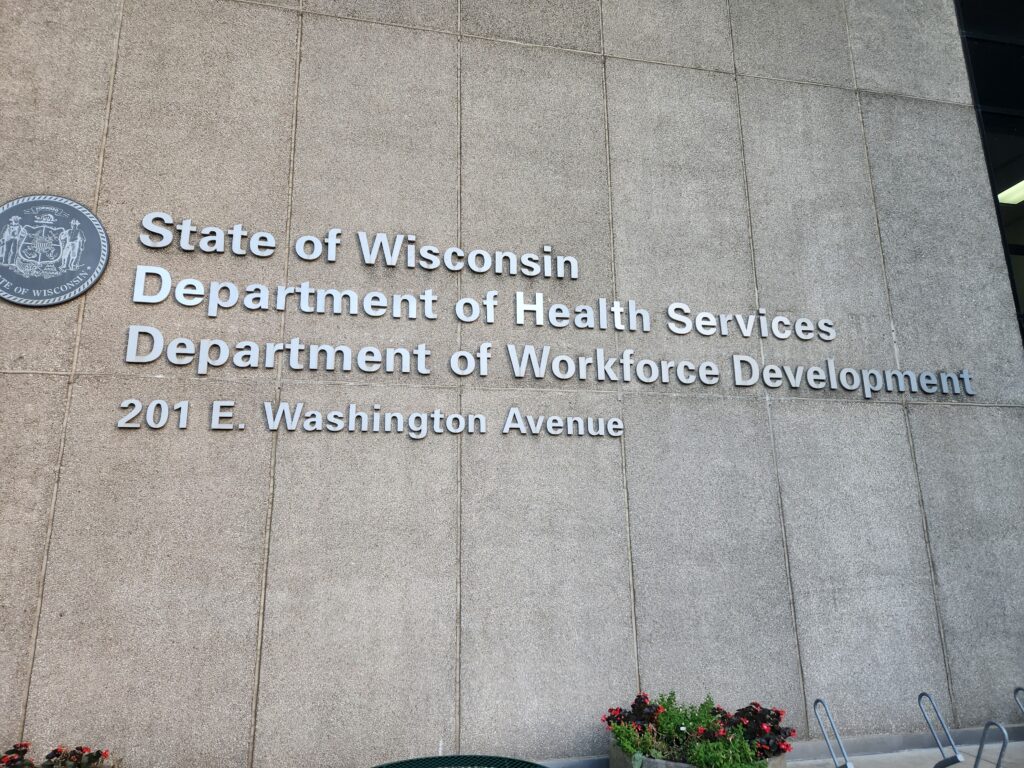
Workers compensation payments will go up under a new bill Gov. Tony Evers signed on Monday, March 30. (Wisconsin Examiner photo)
On Monday morning with a couple of strokes of his pen, Gov. Tony Evers signed an increase in Wisconsin’s workers compensation into law and repurposed $250,000 per year in state funds that have been going unused for years.
The second action would not have been possible, however, if there hadn’t been another measure — one that had actually died before reaching him.
Three bills in all were involved in the complex maneuver.
The first is AB 651 — a bill that updates Wisconsin’s workers compensation system. With that legislation, now 2025 Wisconsin Act 145, workers comp will cover post-traumatic stress syndrome in emergency medical responders, EMS providers and volunteer and part-time firefighters.
The measure had long been sought on behalf of those first responders.
“Community heroes who have given so much of themselves and need healing because of their service deserve our support, and I am excited to see this critical care extended to those to whom we owe a huge debt of gratitude,” said Sen. Andre Jacque (R-New Franken), who championed the legislation.
The same bill has a number of other provisions, including an increase in weekly compensation rates for injured workers and an expansion in access to supplemental benefits for workers whose on-the-job injuries have left them permanently and totally disabled.
Previously those supplemental benefits were only available to workers disabled before Jan. 1, 2003. The new measure covers workers disabled between that date and Jan. 1, 2020.
The new law is the product of a longstanding joint labor-management council that advises lawmakers on the state’s workers compensation system
“Today, we’re proving that we’re more committed to that legacy than ever, and I want to thank all the bipartisan partners for their support and advocacy to come to good faith agreements and get this done,” Evers said in a statement.
Partial veto and a bill that died
On the second bill Evers signed, he used his partial veto power to free up $250,000 per year in money that goes to the Department of Workforce Development.
That was made possible because of the third bill — AB 652, a revision of Wisconsin unemployment insurance law — which his office threatened to veto, and which didn’t even make it out of the Legislature.
Like the workers comp bill, the unemployment insurance bill was the product of a joint labor-management advisory council.
The bill would have raised the top weekly jobless pay benefit by $25 a week, to $390, the first increase in a decade.
But that was coupled with a number of provisions that Evers and Democrats opposed, including a penalty for unemployed workers who receive federal Social Security Disability Income. The penalty would have cut their jobless pay by 50% of the value of their federal disability income.
The bipartisan unity in favor of the workers comp bill contrasted with deep division on the unemployment insurance bill.
“The workers comp bill came out very clean, we had no issues with it,” state Rep. Christine Sinicki (D-Milwaukee) said Monday.
But drafts of the unemployment insurance (UI) bill raised alarm among Democrats “weeks before we got the UI bill,” Sinicki said. “We could not support actually reducing payments to those living with disabilities.”
Rebellion over the jobless pay bill
Since 2013, Wisconsin SSDI recipients have been disqualified from getting unemployment compensation entirely. A federal judge ruled in 2024 that the restriction violated federal laws, and in 2025 ordered DWD to stop enforcing the provision.
Under a court order, DWD has now started paying back SSDI recipients who were denied jobless pay under the 2013 law.
AB 652 not only reduced those benefits, it also contained a number of provisions erecting new barriers to jobless pay, some of which Evers had previously vetoed in bills passed with only Republican support in the state Legislature.
One of those was a requirement for DWD to undertake specific “identity-proofing” measures for jobless pay applicants to prevent fraud.
Unemployment insurance lawyer Victor Forberger wrote in a blog post July 14 that the identity-proofing provision “does nothing” that DWD wasn’t already doing.
Evers’ communications director confirmed the governor’s intention to veto the measure after it passed an Assembly committee on a party-line vote in January.
The unemployment insurance bill passed the full Assembly on a party-line vote Jan. 20. It subsequently failed to make it to the Senate floor and died as a result.
Redirecting funds
That’s where the third bill comes in — AB 650.
The bill includes funding for the workers comp program administration. Republicans added funding for the identity-proofing measures that were in the unemployment bill.
Separating funding for new policies from the bills that lay out those policies has become a regular GOP practice, in order to try to prevent Evers from using his partial veto to change policy. (In Wisconsin the governor can only use his partial veto on spending legislation.)
But this time, the action gave Evers an opening.
Because the unemployment bill had failed — but funding for one of its provisions remained in the separate bill — Evers was able to scratch out language allocating funding for the failed policy and repurpose the additional $250,000 per year the Republicans had intended for identify proofing.
To fund the identity-proofing provision, legislators had proposed a revision in an existing budget appropriation that authorizes $250,000 a year for DWD to pay for substance abuse treatment.
Under a law enacted in 2015, under former Republican Gov. Scott Walker, employers can report to DWD if a prospective new hire fails a drug test. The law disqualifies the person who flunks from receiving unemployment compensation — but also states that the individual can remain eligible by entering substance abuse treatment.
DWD is to pay for the treatment using the $250,000 that the Legislature appropriates each year.
Haley McCoy, the DWD communications director, said Monday that the provision is rarely used, and employers haven’t submitted any reports on job applicants who flunked drug tests since 2021.
In AB 650, GOP lawmakers expanded the use of DWD’s annual drug treatment appropriation, allowing the money also to be used for “costs related to identity proofing under s. 108.14 (10m) for which federal funding is unavailable.”
A funding provision with nothing to fund
The funding bill passed both houses of the Legislature unanimously. But by the time it got to Evers, the unemployment insurance bill and its identity proofing provision were dead.
On Monday, Evers pulled out his veto pen and scratched out references to “identity proofing” in the funding bill. He also crossed out additional words, turning the phrase about how the drug treatment money is to be used into “costs for which federal funding is unavailable.”
The rewritten bill became 2025 Act 144.
In Evers’ veto message, he noted that the language applying to “identity proofing” was “a reference to a statute which does not exist” and added that DWD already has tools to verify identity and prevent fraud. The department “conducts a variety of anti-fraud activities,” he wrote.
The partial veto, he wrote, gives DWD “new flexibility to access state funding in an appropriation that purports to improve the unemployment insurance system by drug testing claimants; in fact, this funding has gone unspent for several years, and drug testing only serves to create barriers for claimants to access necessary benefits in times of economic hardship.”
Evers’ veto message said the department will be able to use the “modest amount” of additional money “when the federal government fails to support state unemployment administration sufficiently.”
The veto message didn’t specify how the funds would be deployed, but the press release from the governor’s office announcing his action on the workers comp and the funding bills discussed at length the Evers administration’s project to upgrade Wisconsin’s unemployment insurance system — for which the Trump administration has terminated $29 million in previously awarded federal grants.
“He could have just cut that funding out completely,” Sinicki said Monday. “But the way he did it, I thought, was really creative by giving the department some flexibility with it.”
Evers approves workers comp increases, redirects other state labor department money was originally published by Wisconsin Examiner.