
Why A 41-Mile Pipeline Reroute In Ashland County Has International Stakes
Court fights over Line 5 now reach from tribal lands and wetlands to U.S.–Canada treaties and fuel prices across the Midwest.
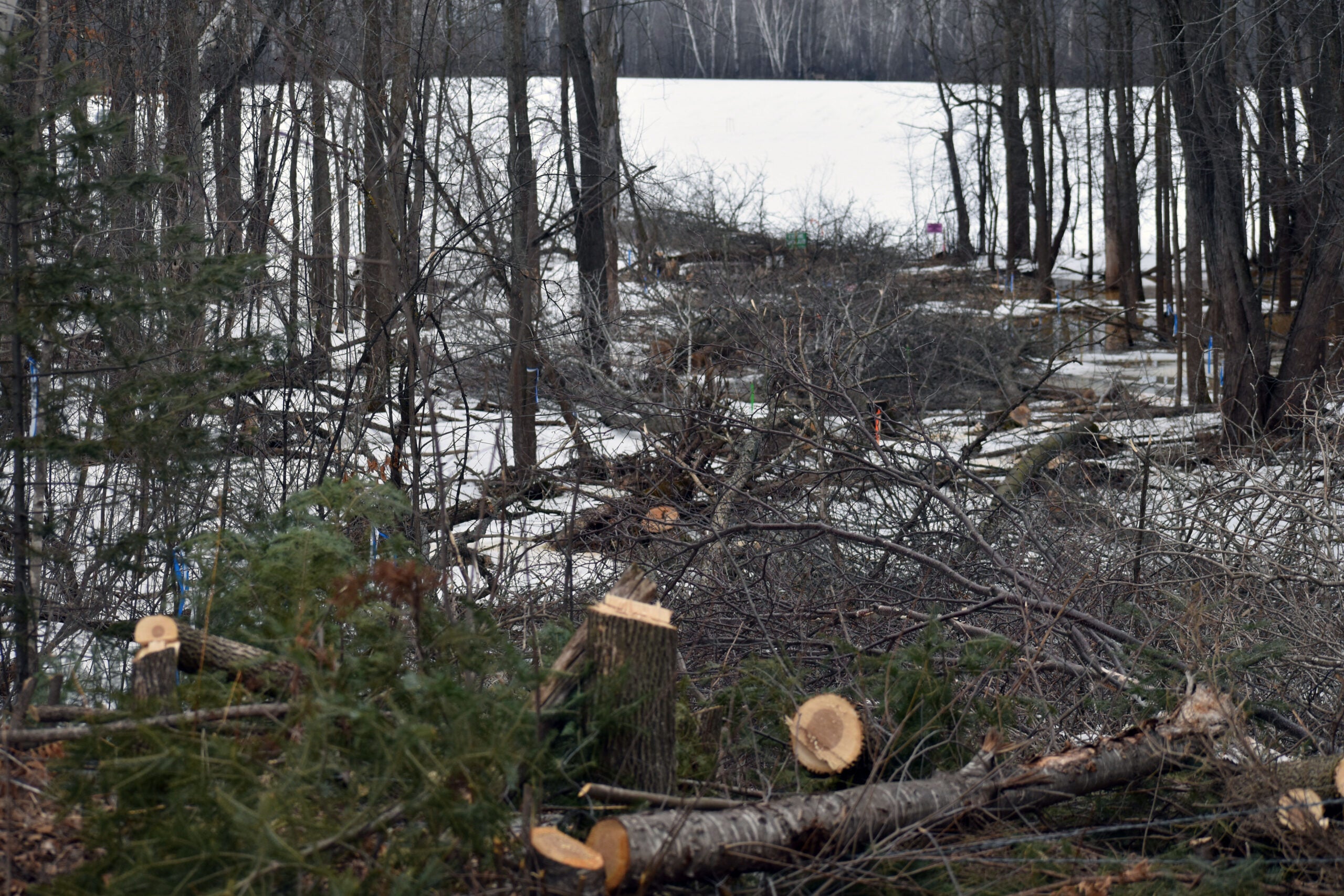
The right-of-way for Enbridge’s Line 5 reroute can be seen off Marengo River Road in Ashland County. Danielle Kaeding/WPR
Just off a state highway in northern Wisconsin, Bad River tribal member Joe Bates flies his drone over the path of the Line 5 reroute proposed by Canadian energy firm Enbridge.
“They have a big right-of-way that they’ve cut down, laid all the trees down,” Bates said.
Trees lie in a tangled heap on melting snow and green signs are staked in front of them to indicate the presence of a wetland. Along the route, signs on trees left standing warn: “NO TRESPASSING. OCCUPANT ENBRIDGE. VIOLATORS WILL BE PROSECUTED.”
In late February, after years of review and opposition, crews began clearing trees along the route of a new 41-mile segment for Enbridge’s oil and gas pipeline. Six years ago, the company first proposed the $450 million project after the Bad River Band of Lake Superior Chippewa sued Enbridge in 2019 to shut down Line 5 on tribal lands over fears it may rupture.
Centuries earlier, the Ojibwe migrated to the region from the east coast after a prophecy told the Anishinaabe, a group of Indigenous people, to go to the place where food grows on water, referring to wild rice or “manoomin.” Bates said the pipeline threatens the Great Lakes and the tribe’s homeland.
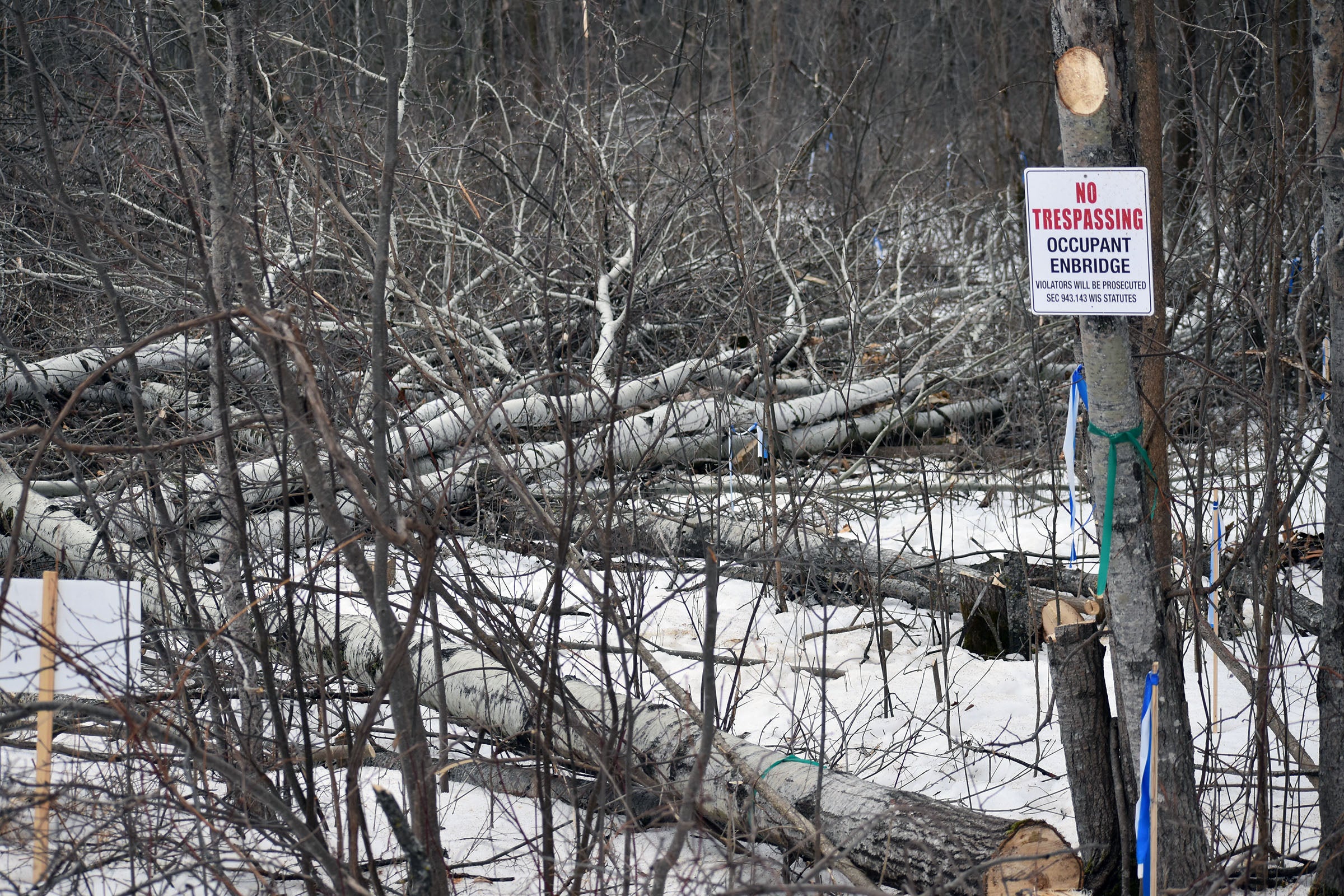
Trees have been cleared just off a road where the path of Enbridge’s Line 5 reroute runs. Danielle Kaeding/WPR
“It’s our hereditary instinct to protect what we have here, and it’s not just the manoomin. It’s everything else that our people have relied on for centuries to go out and harvest medicine right along the river,” Bates said. “That’s its namesake, the Mashkiiziibii, or “Medicine River.”
Standing at her kitchen table, Bad River tribal member Sandy Deragon shows off plants and shrubs that include Labrador tea, rose hips and sage that are used for cleansing or treating inflammation and digestive issues. She said many members also hunt deer and fish off-reservation where the Line 5 reroute runs.
“We won’t have that if there’s a spill,” Deragon said.
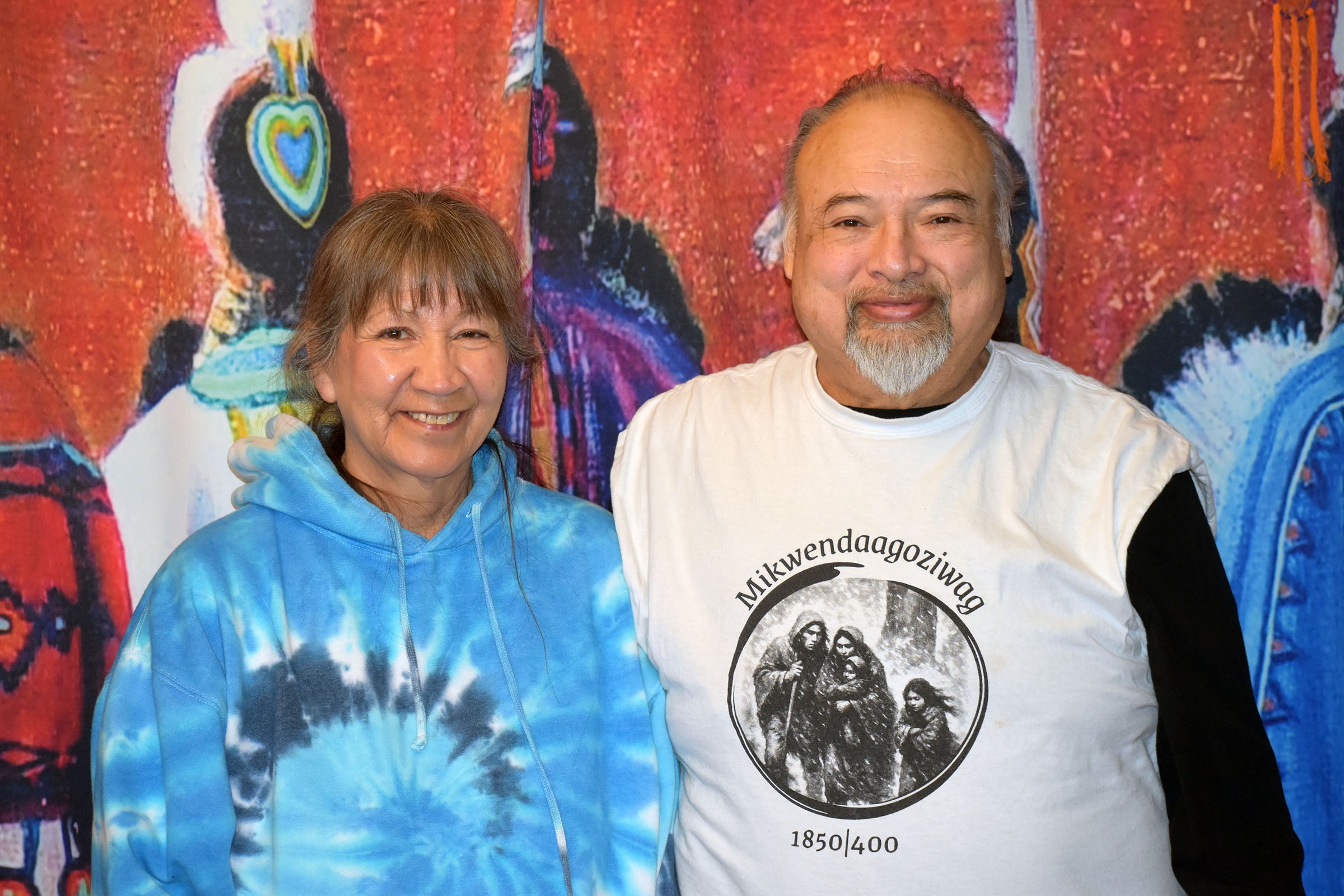
Sandy Deragon and Joe Bates stand in the kitchen of Deragon’s home on the Bad River reservation. Danielle Kaeding/WPR
The project has generated years of debate, protests, tens of thousands of comments and challenges to state permits that prompted a weekslong contested case hearing. Enbridge began work after state approvals for the project were upheld and the company secured a permit from the U.S. Army Corps of Engineers.
Now, in what some see as last-ditch legal maneuvers, the tribe and environmental groups are asking a court to overturn state permits and halt construction. They see the fight over Line 5 as one front in a larger battle over pipeline projects that often pit energy security and jobs against potential harms to the environment and tribal treaty rights.
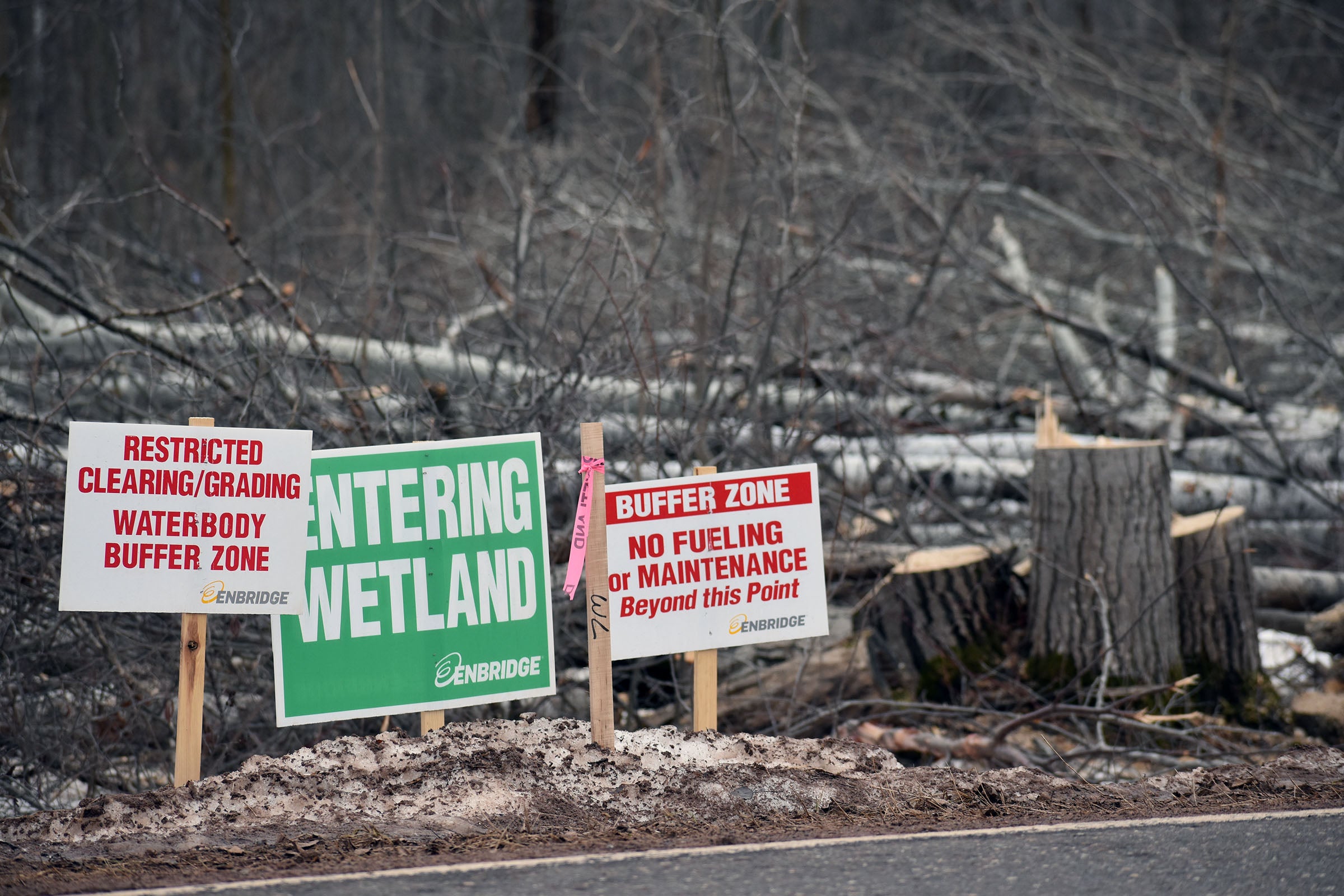
Signs show where a wetland and buffer zone for a waterway exist for Enbridge’s Line 5 reroute. Around 100 workers are clearing trees, staking the route or monitoring the project, according to a company official. Danielle Kaeding/WPR
Energy firm’s permits were upheld despite environmentalists’ objections
The Line 5 reroute is slated to cross 186 waterways and affect around 101 acres of wetlands in Ashland and Iron counties. Around 100 people have started working on the project, said Paul Eberth, Midwest region operations director for Enbridge. That work includes staking and surveying the project’s right-of-way, clearing trees and environmental monitoring.
Line 5 carries up to 23 million gallons of oil and natural gas liquids daily from Superior through northern Wisconsin and Michigan to Sarnia, Ontario. The pipeline serves 10 refineries and propane production facilities across the U.S. and Canada.
“The Line 5 relocation project is important not just to Enbridge, but to our country, to the country of Canada, (and) to the communities that the refined products that come from Line 5 serve,” Eberth said.
In 2024, the Wisconsin Department of Natural Resources issued key permits for the project, which were challenged by the tribe and environmental groups. In February, an administrative law judge, or ALJ, found they met state standards, adding the tribe “failed to provide evidence” that construction activities will violate state water quality standards.
The project has undergone years of review, and the DNR issued a waterway and wetland permit with 250 conditions to protect the environment. With permits upheld, Eberth said halting construction now would be unreasonable.

Paul Eberth, Enbridge’s Midwest region director of operations, points at a map of the company’s Superior terminal. It’s a hub for its pipelines, including Line 5. Danielle Kaeding/WPR
Attorneys for the tribe and environmental groups say the DNR violated the law by authorizing Enbridge to build the project in wetlands and place structures in waterways, as well as certifying the project meets water quality standards. They’re challenging the decision in Iron County Circuit Court, said John Petoskey, a senior associate attorney with Earthjustice who represents the tribe.
“The pipeline and ALJ’s decision go against laws that are meant to protect wetland resources, that are meant to protect water resources in perpetuity, and prevent the types of significant impacts that are happening with this project,” Petoskey said.
Construction would include excavation at about 70 waterway crossings along with blasting and drilling in some waterways and wetlands, which could take decades to restore. Beyond the project, Senior Staff Attorney Rob Lee with Midwest Environmental Advocates noted Line 5 is more than 70 years old and has leaked over one million gallons of oil during its operation.
“It’s not just about the reroute, it’s about the whole line,” Lee said.
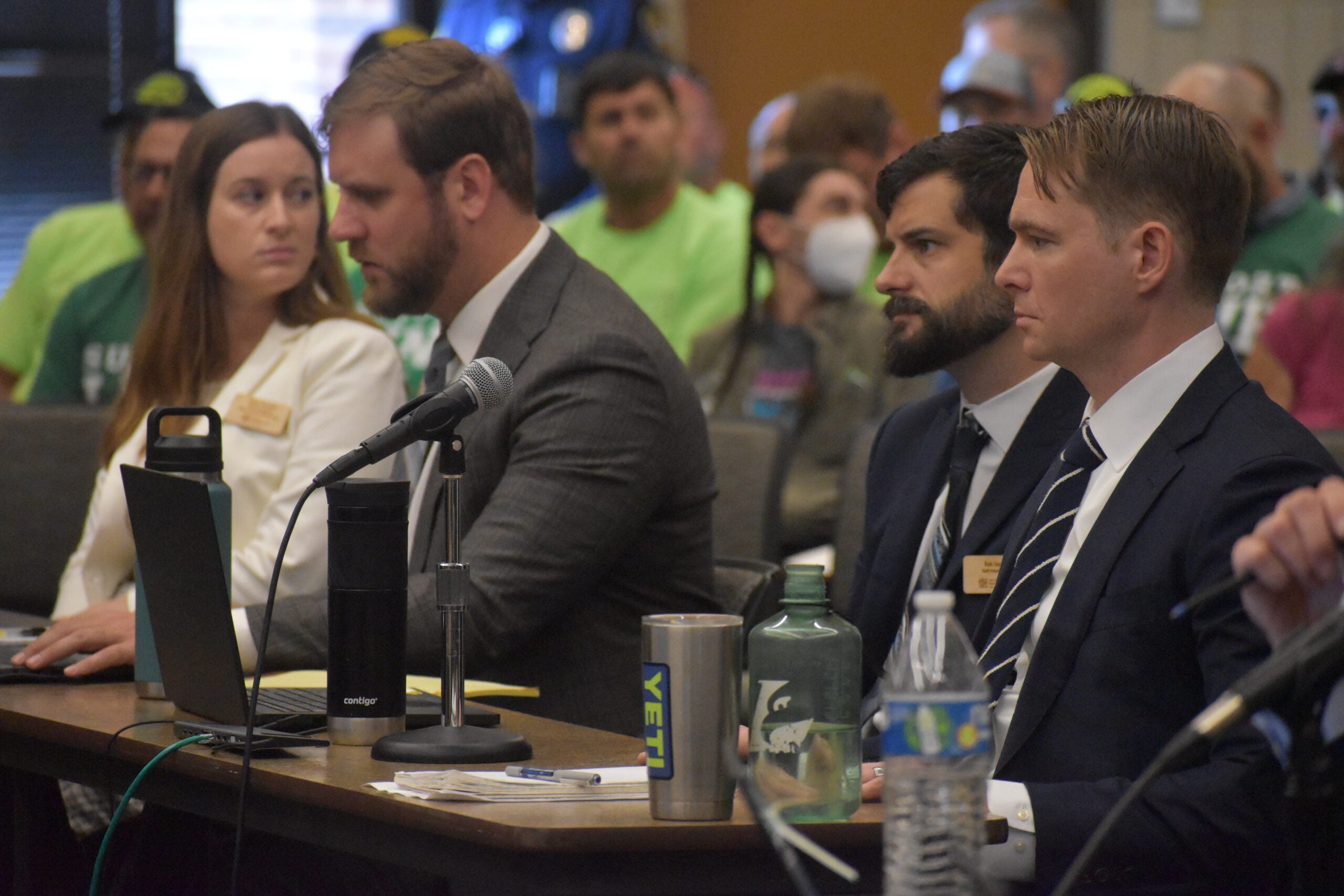
Attorneys for Midwest Environmental Advocates and Clean Wisconsin lay out their challenges to key permits for Enbridge’s Line 5 relocation project at a contested case hearing in Ashland on Aug. 12, 2025. Danielle Kaeding/WPR
Energy security, tribal autonomy and environmental impacts at stake
Enbridge is not only fighting legal battles over the pipeline’s operation in Wisconsin, it’s also facing challenges in Michigan. In 2019, Michigan Attorney General Dana Nessel sued to decommission Line 5 in the Great Lakes over the risk of a spill in the Straits of Mackinac. Last month, the U.S. Supreme Court heard oral arguments over whether that case should be heard in state or federal court, and the case has raised questions about state powers to regulate fossil fuels.
This month, Michigan’s Supreme Court also heard arguments over whether regulators properly issued a key permit for Enbridge’s proposal to reroute a 4-mile segment of Line 5 on the lake bottom through a $750 million tunnel buried under the Straits.
Enbridge is under pressure on both sides, said Dave Strifling, director of the Marquette University Law School Water Law and Policy Initiative. He said the debate over Line 5 shares similarities with other controversial pipeline projects.
“Some of these disputes, like Dakota Access (Pipeline), for example, raise some of the same themes of tribal autonomy and environmental impacts and broader debates about energy independence versus renewables, and the climate issues that are involved here,” Strifling said.
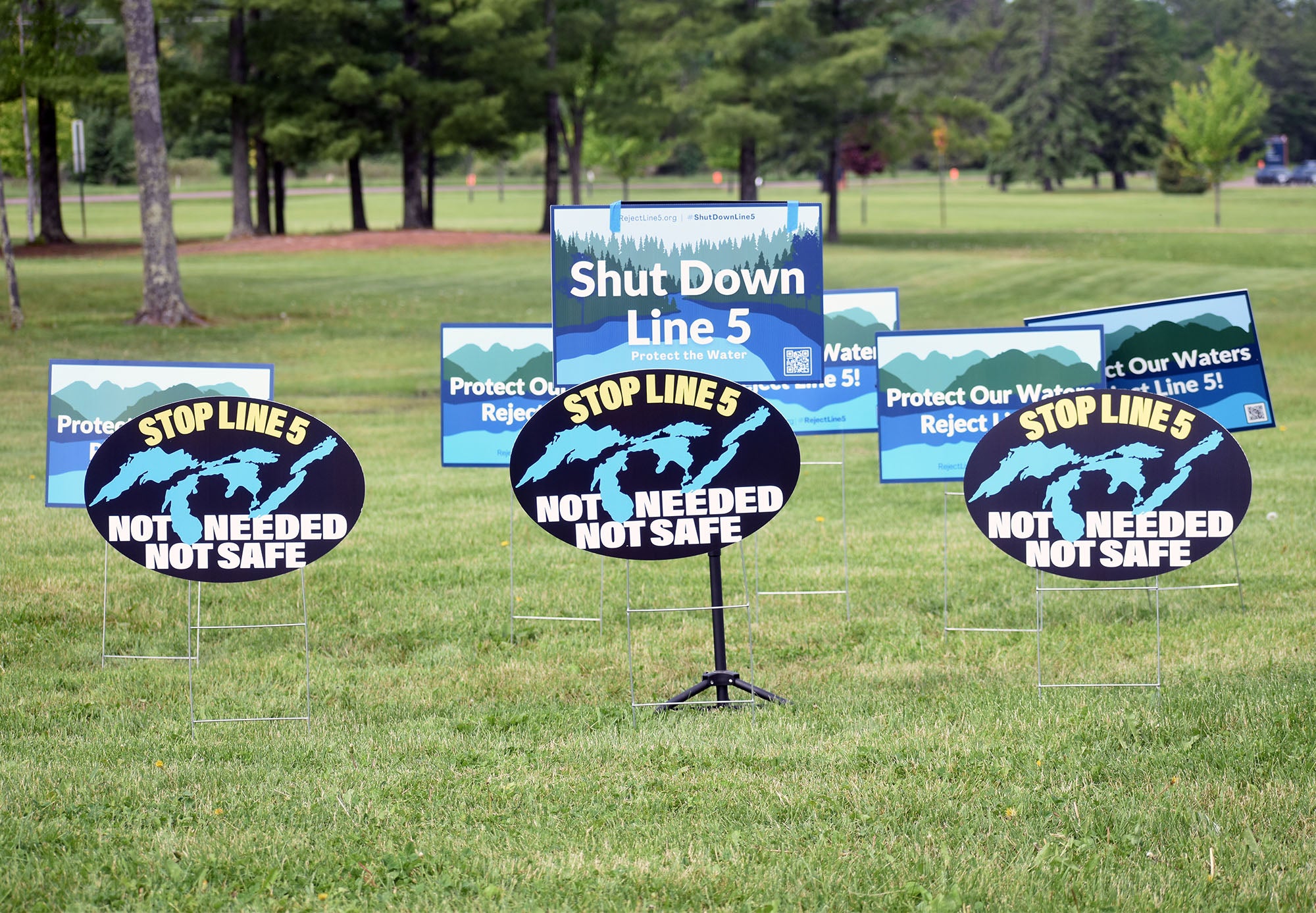
Signs read “Shut Down Line 5” and “Stop Line 5” outside the site of a public hearing in Ashland on a draft environmental assessment of Enbridge’s proposal to reroute the pipeline on June 4, 2024. Danielle Kaeding/WPR
Opponents of Line 5 say it locks in dependence on fossil fuels that account for the vast majority of heat-trapping emissions that are warming the world and fueling the climate crisis.
And the federal government’s stance on climate change and pipeline projects has shifted as administrations have changed. The Obama and Biden administrations took a more cautious approach to permitting pipelines, including temporarily halting construction of Dakota Access and revoking a key permit for the Keystone XL pipeline in the western U.S. Meanwhile, the Trump administration has sought to fast-track permitting as it seeks to maintain energy independence and security.
As evidence of climate harms from fossil fuels has grown, pipeline projects have faced intensifying opposition from celebrities, environmentalists and Indigenous groups.
“Lots of things have faced opposition, from oil pipelines to renewable energy projects. I’ve seen both throughout my career in the energy industry,” Enbridge’s Eberth said. “But we’ve also seen substantial support for energy projects as well, and I think we see this on Line 5 too.”
US and Canada warn of Line 5 shutdown effects
The governments of the U.S. and Canada have argued that Line 5 should remain in operation.
The Department of Justice under both the Biden and Trump administrations have warned that a Line 5 shutdown could pose significant implications for foreign relations under a 1977 treaty overseeing the uninterrupted flow of oil between the U.S. and Canada. Bad River argues the 1854 treaty that set aside its homeland predates that by more than a century and guarantees its power to exclude others from tribal lands.
In 2023, U.S. District Court Judge William Conley ordered Enbridge to shut down or reroute Line 5 around the Bad River reservation by mid-June this year and ordered the company to pay $5.15 million for trespassing on roughly 2 miles of tribal lands. Both Bad River and Enbridge appealed, and the company urged the judge to stay his decision ahead of the looming deadline.
Earlier this month, Conley paused the shutdown order until a federal appeals court issues a ruling, allowing Enbridge more time to build the reroute. He cited the “potential devastating impact a sudden shutdown of Line 5 would have on energy prices and local economies, as well as foreign relations with Canada.”
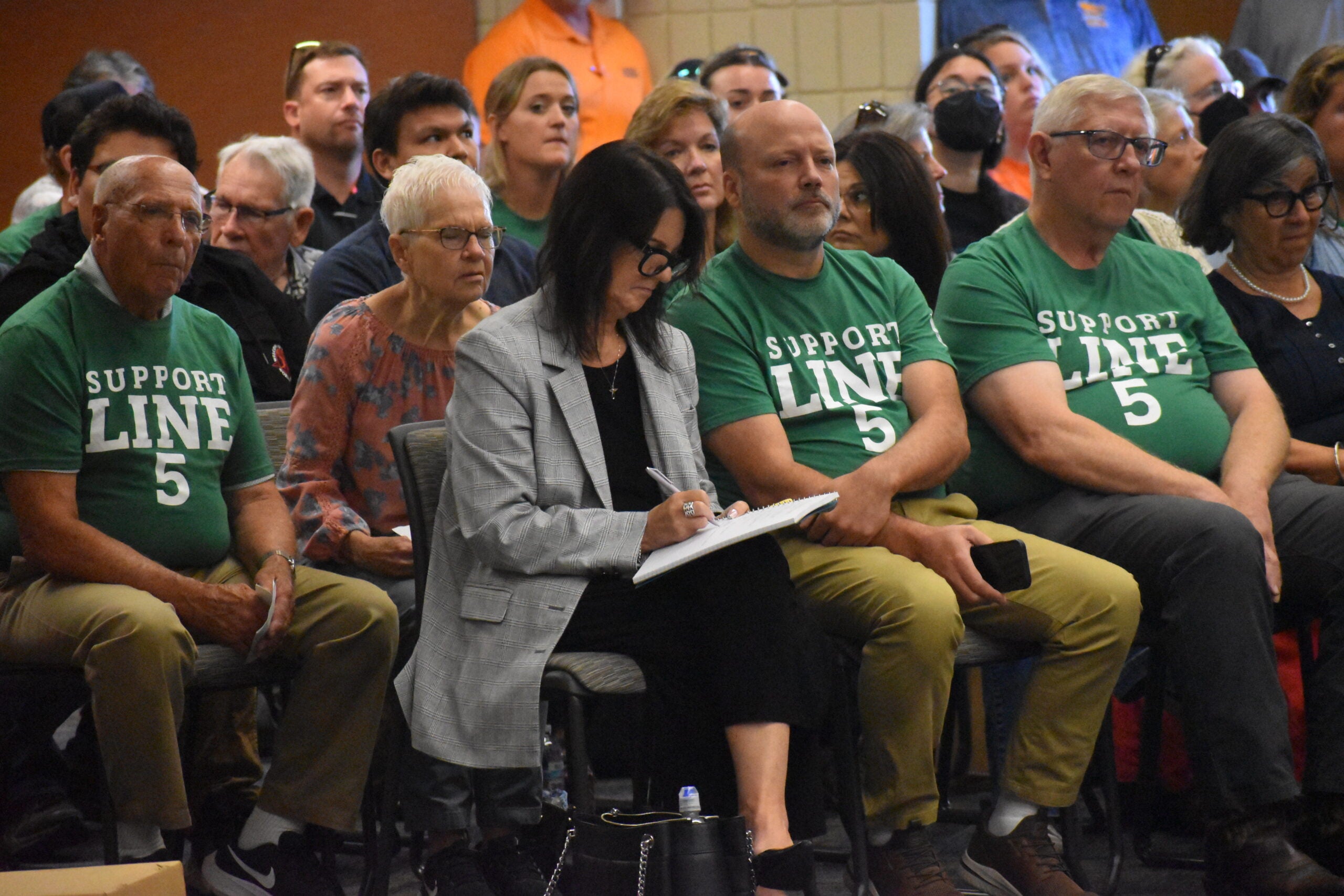
Supporters of the Line 5 relocation project listen to opening statements at a contested case hearing in Ashland on Aug. 12, 2025. The Bad River tribe and environmental groups petitioned for the hearing as part of a challenge to key permits for the project. Danielle Kaeding/WPR
Republican lawmakers, business and farm groups and labor unions have also backed the reroute. At peak construction, the project would employ 700 workers and contribute $135 million to Wisconsin’s economy, according to Washington D.C. consulting firm Capital Policy Analytics.
Neil Sickich, a business agent for the Steamfitters Local 601, was born and raised just outside of Ashland. He’s worked on Enbridge projects for more than two decades, including the Line 3 replacement.
“We got welders. We got helpers. We got journeymen that helped fit up the pipe. These jobs are not going to be temporary for me,” Sickich said. “I promise that these people, when they come on with me, it’s just the start of their career…. It’s a good union job. It’s good pay. It’s a pension.”
Some tribal members and residents have expressed fears that the influx of workers may heighten the risk of human or sex trafficking during the project’s construction. An Enbridge spokesperson said workers will receive training to promote awareness of human trafficking, adding the company won’t tolerate illegal or exploitive behavior.
Enbridge experts say a shutdown risks billions of dollars in annual losses and closure of facilities in the Midwest, as well as increased gas and propane prices. Bad River attorneys and experts argue those losses are overstated and existing alternatives could carry almost all the products Line 5 carries – though additional rail infrastructure would need to be brought online.
Bad River tribal members and environmental advocates say the risk of a spill is too great, pointing to Enbridge’s environmental track record. Bates noted state permits for the project were issued just days after a spill from one of the company’s pipelines in Jefferson County, which released almost 70,000 gallons of oil.
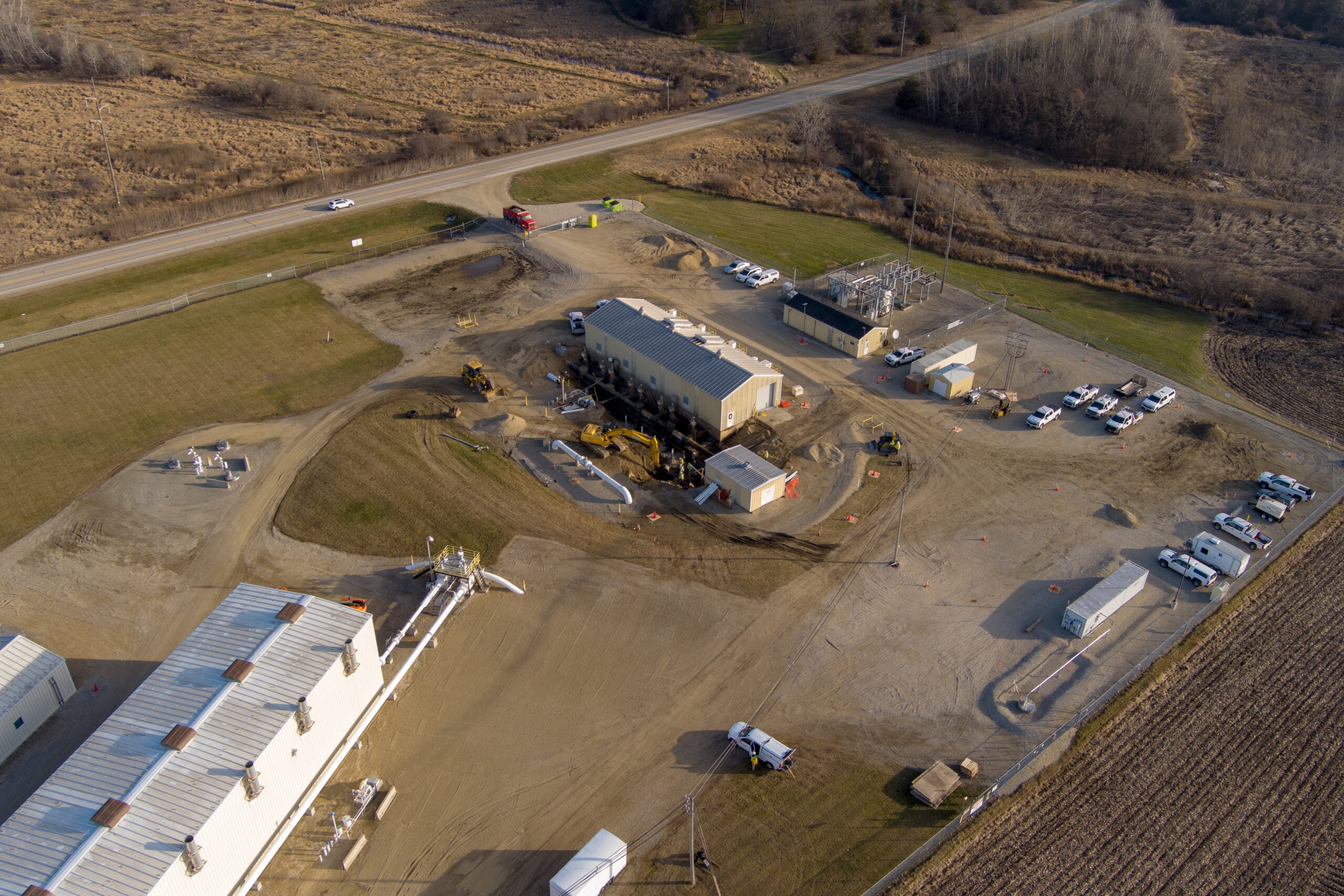
An aerial view of the pump station for Enbridge’s Line 6. Almost 70,000 gallons of oil leaked from a valve. Photo courtesy of Enbridge
Enbridge is also responsible for some of the nation’s largest inland oil spills. Hundreds of millions of gallons of groundwater were also released from aquifer breaches during construction of its Line 3 replacement project across multiple northern Minnesota counties in 2021, according to the Minnesota Star Tribune. Eberth said the company’s operations aren’t perfect, but it has made improvements to the safety of its pipelines.
“While there have been some impacts, Enbridge has been there to remediate any releases or spills that have happened out in the environment, and we’re going to continue to be there if there are any in the future,” Eberth said.
In the meantime, Enbridge is moving ahead on the project, and it expects larger construction work on installing the pipeline wouldn’t begin until May at the earliest. Next month, a Bayfield County judge will decide whether to halt construction of the Line 5 reroute as the legal fight over state approvals play out.
Strifling expects the circuit court will conduct a review similar to the administrative law judge.
“We’re not talking here about broad principles of policy or law,” Strifling said. “We’re just looking at whether the DNR correctly applied the legal standards in this case.”
Enbridge expects the permits will be upheld and construction will be complete by April of next year. But Bad River’s attorney said the tribe will never stop fighting. Bates and Deragon agreed.
“Shut it down,” Bates said. “Get it out of here.”
Work on Enbridge’s Line 5 reroute underway as legal challenges aim to halt construction was originally published by Wisconsin Public Radio.