

ACLU, County in Legal Battle Over Jail
County wants to dismiss class action lawsuit. ACLU insists jail still has problems to fix.
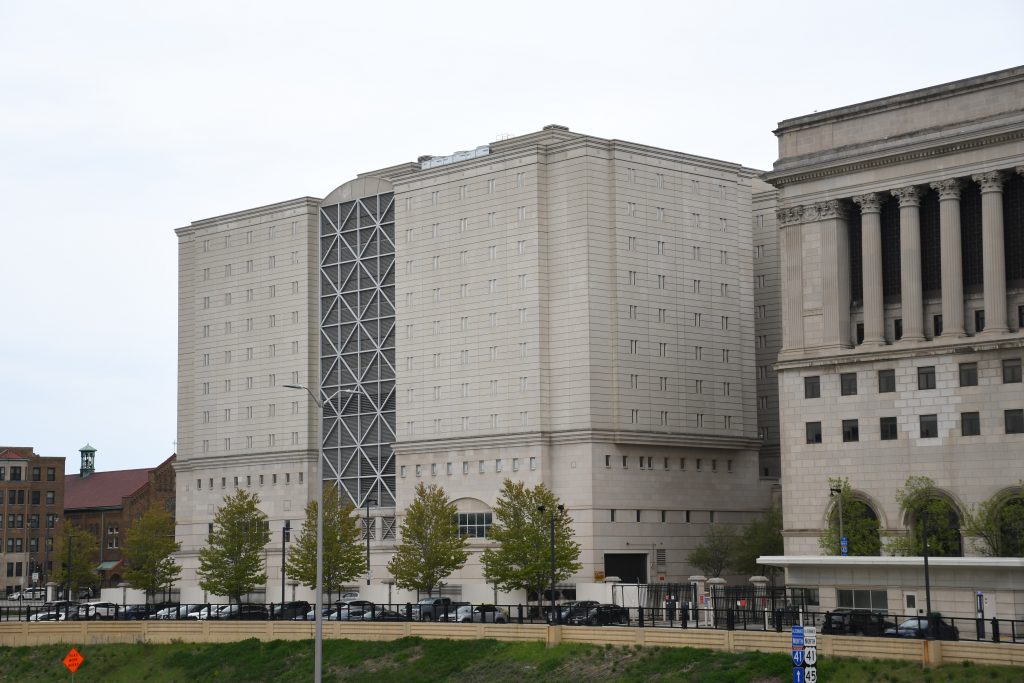
Milwaukee County Jail. Photo by Jeramey Jannene.
The American Civil Liberties Union of Wisconsin (ACLU) and Milwaukee County are duking it out in legal briefs over conditions at the Milwaukee County Jail.
Attorneys from the ACLU and the Legal Aid Society of Milwaukee are asking the court to hold the county in contempt for poor conditions at the jail, arguing the county is not complying with a court order from 2001 and is willfully disobeying it. The county, meanwhile, is asking the court to dismiss the 2001 order altogether, arguing the jail and the Community Reintegration Center (CRC) are in “substantial compliance” with court-ordered standards for staffing and health care.
The order, referred to as the Christensen consent decree, was part of a settlement for a class-action lawsuit brought in 1996 by former inmates against the county and the Milwaukee County Sheriff‘s Office for inhumane treatment at the county jail. It established a maximum population and requirements for staffing and the provision of medical care that the recent legal filing suggests are still not being met.
In October last year, attorneys Tim Muth of the ACLU and Lillian Cheesman of the Legal Aid Society filed a motion in Milwaukee County Circuit Court asking the court to hold the county in contempt for violating the consent decree by failing to meet staffing, population and medical-care requirements. It included accounts from inmates and county reports describing an inhumane facility where inmate health and well-being is threatened by substandard medical care; where unsanitary conditions leave inmates living in or covered by urine and feces; and where inmates are provided moldy food and water contaminated by sewage.
Attorney Andrew Jones, of Hansen Reynolds LLP, representing the county, responded in January with a brief opposing a finding of contempt and instead asking the court to terminate the consent decree altogether. The brief argued the county was in “substantial compliance” with the consent decree and that the ACLU was ignoring “substantial evidence of consistent, ongoing, and successful efforts on the part of the county, not only to comply with the decree but to go beyond its strict requirements” for the jail and CRC.
The county points to a 2021 report from the court-appointed monitor, the last one filed by monitor Ronald Shansky before he died in 2024, which found “substantial compliance” with the court’s requirements.
The county provided data showing the jail has sometimes exceeded the time someone can be legally held in the booking room, and failed to meet standards for timely provision of dental care. The county downplayed these violations, noting that the number of people held beyond a 30-hour limit in the booking room represents .00067% of the total number of people booked at the jail in 2024 and 2025. The county has also made efforts to staff the facility and has maintained staffing between 85% and 90% of budgeted staff.
Staffing is well below requirements established by the consent decree, even when accounting for positions shifted to private contractors. But the county points to a roughly equivalent reduction in the percentage of staff and the inmate population relative to the 2001 order.
The county charged the ACLU is relying on “information taken out of context and based on unsupported anecdotal accounts,” as well as “selective” and “misleading” references to accreditation reports by the National Commission on Correctional Health Care (NCCHC). Since 2019, the county has contracted with NCCHC to conduct quarterly assessments of the jail. The jail received accreditation in 2021 and has maintained it since. The county points to an NCCHC report from 2024 as proof the jail is in compliance.
In a response, ACLU attorneys argued NCCHC is not a court-appointed monitor and their accreditation does not prove compliance with court orders. They also argue the county has failed to address ongoing noncompliance with dental care requirements, with inmates waiting 60 days or longer for dental care, and that under current staffing levels, “The [jail] is not currently able to fully staff shifts, does not have enough staff to allow those in their care adequate time out of their cells, and on some days cannot transport people to court.”
The county has provided a comprehensive record of its jail policies, but no evidence they are being followed, the ACLU charges. “A policy may be adequate on paper, yet it is meaningless if not implemented sufficiently,” the attorneys wrote in a filing in February.
The county also cannot point to NCCHC reports to prove compliance but prevent the ACLU from using the reports to prove noncompliance, the attorneys contended.
“This contradiction is laughable, and the court should disregard the defendants’ arguments regarding health care for that reason alone and order formal discovery,” the attorneys wrote.
The county is trying to prevent discovery and deposition of county officials, arguing such actions would be part of the contempt motion that should be denied. The ACLU, meanwhile, argues discovery and testimony are necessary to reach a decision on the issues before the court, and that noncompliance with the court order could be contributing to deaths in the jail; three men died in the jail in 2025 alone.
If you think stories like this are important, become a member of Urban Milwaukee and help support real, independent journalism. Plus you get some cool added benefits.


MKE County
-
Incumbents Sweep County Board Elections
 Apr 7th, 2026 by Graham Kilmer
-
Federal Judge Won’t Vacate Dugan Conviction
 Apr 6th, 2026 by Graham Kilmer
-
Sup. Vincent Faces Challenge in Heated Race for District 11
 Apr 6th, 2026 by Graham Kilmer





















Milwaukee County Sheriff’s Dept needs to live up to terms of the Class Action Settlement.
The County Board needs to hold the Sheriff’s Dept accountable.