

Bill Would Give Local Governments Veto Power Over Solar, Wind Farms
GOP proposal would block state regulators from approving projects without local signoff first.
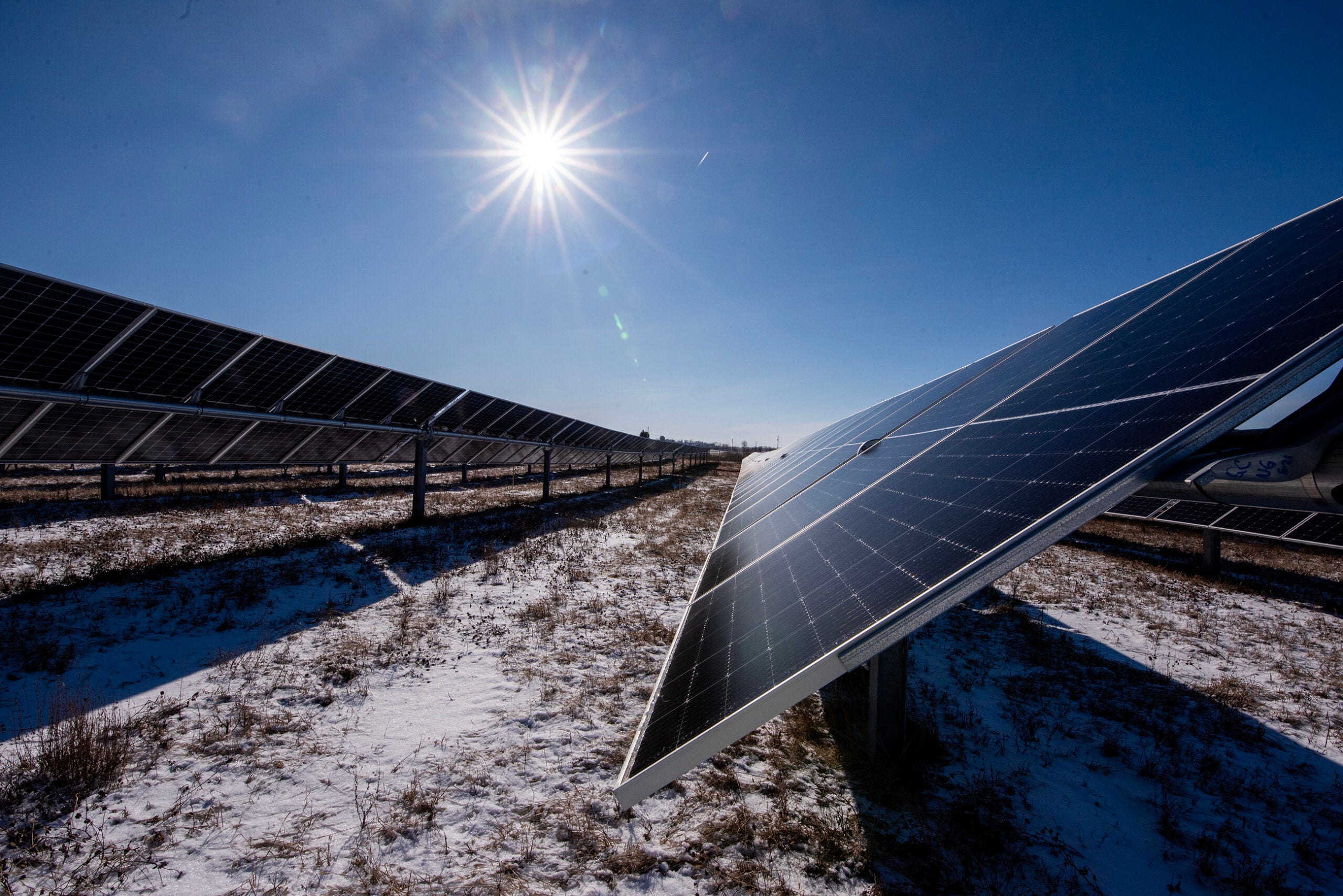
The sun shines onto solar panels at the Paris Solar Park on Friday, Jan. 24, 2025, in Union Grove, Wis. Angela Major/WPR
A bill in the state Legislature would require local governments to OK solar and wind projects before those projects can be approved by the Public Service Commission of Wisconsin.
Currently, electric facilities generating 100 megawatts or more need a certificate of public convenience and necessity from the Public Service Commission, and do not need approval from local municipalities. That applies to solar and wind farms, as well as natural gas and coal power plants.
The state Senate Committee on Utilities, Technology and Tourism held a public hearing Tuesday on a bill that would require solar and wind projects producing 15 megawatts or more to get approval from each city, village and town where the project is located.Under the bill, the PSC would not be able to approve solar or wind projects without local approval. It comes as some renewable energy projects, from Oconto County to Adams County, have been met with local pushback.
Supporters argue the bill would help maintain local control and protect farmland. But opponents argue that it unfairly targets clean energy projects by injecting uncertainty into the approval process.
State Rep. Travis Tranel, R-Cuba City, is one of the bill’s authors. During the hearing, he said solar and wind projects are “tearing communities apart” and “pitting neighbor against neighbor.” He also said wind and solar projects are taking away farmland.
“Are we willing to completely change the makeup of Wisconsin? People live in rural areas because they love open spaces,” he said. “The last thing that I think we want done is cover it with wind and solar.”
State Sen. Howard Marklein, R-Spring Green, also testified in favor of the bill. He said the bill is responding to concerns he’s received from constituents. He said it did not include natural gas or coal power plants because his constituents haven’t been opposed to those projects.“Solar and wind were the two projects that we heard about,” he said. “This bill was crafted with that in mind.”
A handful of local officials from around the state also testified in favor of the bill. That includes Brad Stevens, who serves on the Iowa County Board of Supervisors.
“I fully support this bill because I really believe that local government has to have something to say,” Stevens said. “They have to at least be part of a process, instead of just being walked over.”
Groups in favor of the bill include the Wisconsin Farm Bureau Federation, the Wisconsin Realtors Association and the lobbying arm of the conservative think tank MacIver Institute. The proposal’s opponents include environmental groups, the state’s major utilities, trade unions and the nonprofit Conservative Energy Network.
Bill Skewes, executive director of the Wisconsin Utilities Association, said in written testimony that giving local governments veto power over renewable projects “risks delaying or stopping facilities that benefit Wisconsin as a whole due to localized political opposition.”
“Other states provide cautionary examples,” he wrote. “In Ohio, similar local-approval requirements led multiple counties to ban large wind and solar projects outright — restrictions not applied to fossil-fuel plants — significantly hindering renewable development.”Jennifer Giegerich, government affairs director for the nonprofit Wisconsin Conservation Voters, testified against the bill at Tuesday’s hearing. She said it would limit clean energy development in Wisconsin, which would result in utilities relying on more expensive energy sources like fossil fuels.
Giegerich also said clean energy, especially from large-scale wind and solar, is the cheapest and cleanest source of energy the state can generate.
“We need to make sure that we are prioritizing clean energy, not only because it helps with our bills, but also because it helps make sure that we are keeping our energy choices under the control of Wisconsin and not depending on out-of-state fossil fuels to meet our needs,” she said.
In written testimony, the nonprofit Wisconsin Conservative Energy Forum said the bill would impose hurdles on renewable energy projects without applying the same barriers to fossil fuel projects.
The group argues that siting decisions for large energy projects should stay at the state level because those projects “serve statewide energy needs.”
“Allowing individual municipalities to block projects would fragment energy planning, threaten grid reliability, and complicate efforts to meet the energy needs of Wisconsin’s economy,” the Conservative Energy Forum said. “The PSC already incorporates local input via public hearings, environmental reviews, and permit conditions, while applying uniform statewide standards that balance local impacts with the broader public interest.”State bill would require solar, wind projects get local approval before state approval was originally published by Wisconsin Public Radio.
If you think stories like this are important, become a member of Urban Milwaukee and help support real, independent journalism. Plus you get some cool added benefits.




















When farmers have a chance to rent out their land for a solar farm, they often do not have to worry about declaring bankruptcy and can stay on the farm. This bill would give local governments the ability to block in small projects when local community residents could benefit from renewable energy. This is typical stance of the Republican legislators to put significant projects that can benefit State residents at the whims of a few local politicians.
“He [Howard Markelin] said it did not include natural gas or coal power plants because his constituents haven’t been opposed to those projects.”
This sounds like baloney to me.
Makes me think of the data centers going up, do local communities have a say with them??