Wisconsin Lies in Path of Nuclear Fallout, UW Research Shows
Threat of nuclear arms race reignites after US-Russia Arms Reduction treaty expires.
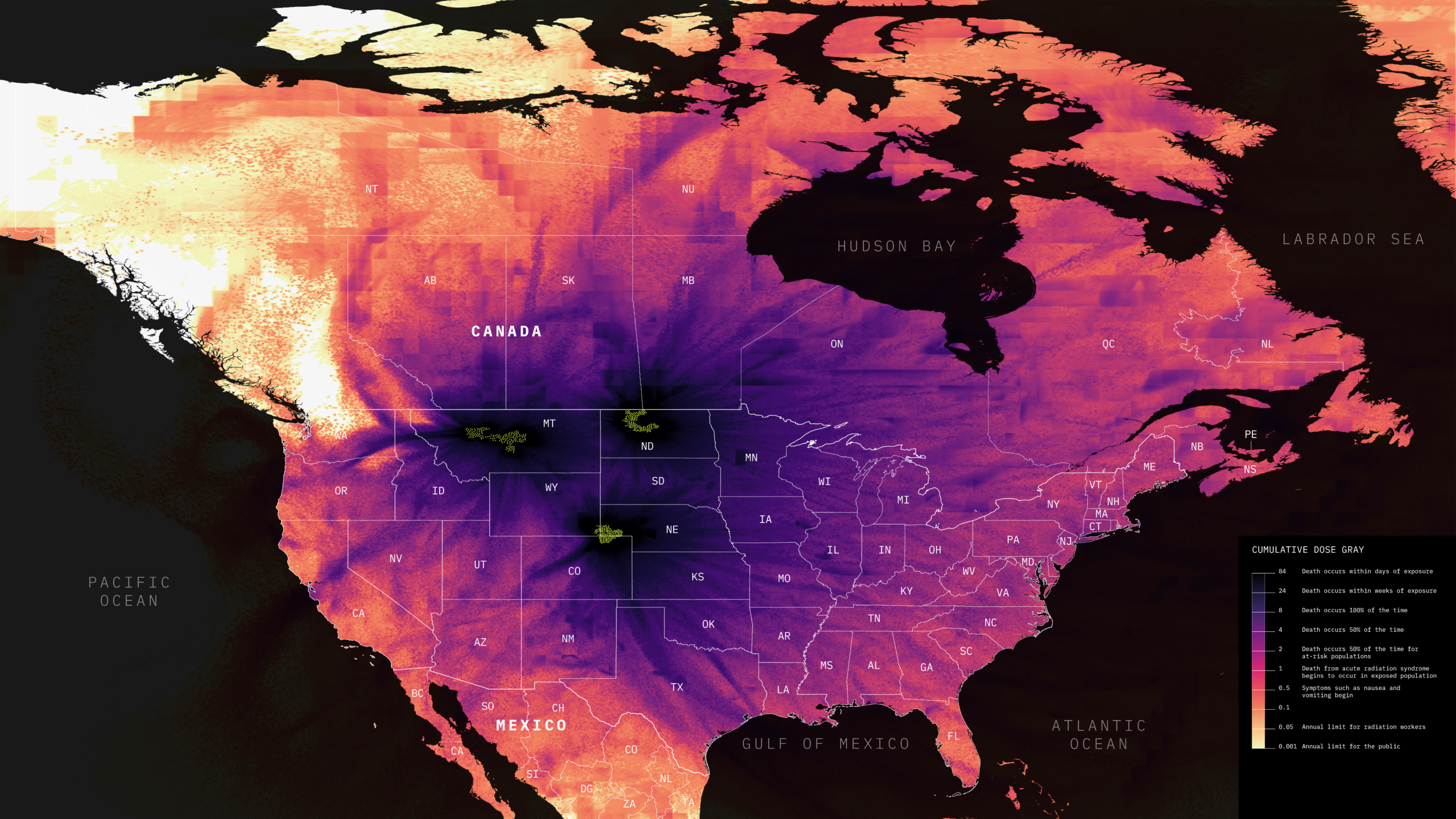
A map depicting the areas in North America at risk of receiving high levels of radioactive fallout based on simulations of nuclear attacks on silos for each day of 2021. Map by Sébastien Philippe, Ivan Stepanov and Svitlana Lavrenciuc
Wisconsin may not be the economic, political or military center of the United States. But the state would not escape the devastation of nuclear war, according to a University of Wisconsin-Madison researcher who is modeling the effects of nuclear conflicts.
On Feb. 5, the last formal nuclear weapons treaty between the U.S. and Russia expired. And Wisconsin is in the path of potential nuclear fallout from more than 400 nuclear missile silos in North Dakota, Nebraska, Wyoming, Colorado and Montana. That’s according to Sébastien Philippe, assistant professor in the Department of Nuclear Engineering and Engineering Physics at UW-Madison.The possible consequences of nuclear war are getting renewed attention since the demise of the New Strategic Arms Reduction Treaty, or New START, which went into effect in 2011. When the treaty expired, it ended decades of cooperation between the United States and Russia to reduce their nuclear weapons. It left no limits on the arsenals of the world’s two largest nuclear powers and no formal agreement to prevent nuclear war.
Last year, Philippe was appointed to the United Nations’ new independent Scientific Panel on the Effects of Nuclear War. The panel is charged with presenting the U.N. general assembly with a report on the impacts of nuclear war on the modern world. That includes projected consequences on public health, the world economy, food systems and the environment.
Philippe was named a 2025 MacArthur Fellow and was recently granted $500,000 to develop tools for modeling consequences of nuclear weapon use.
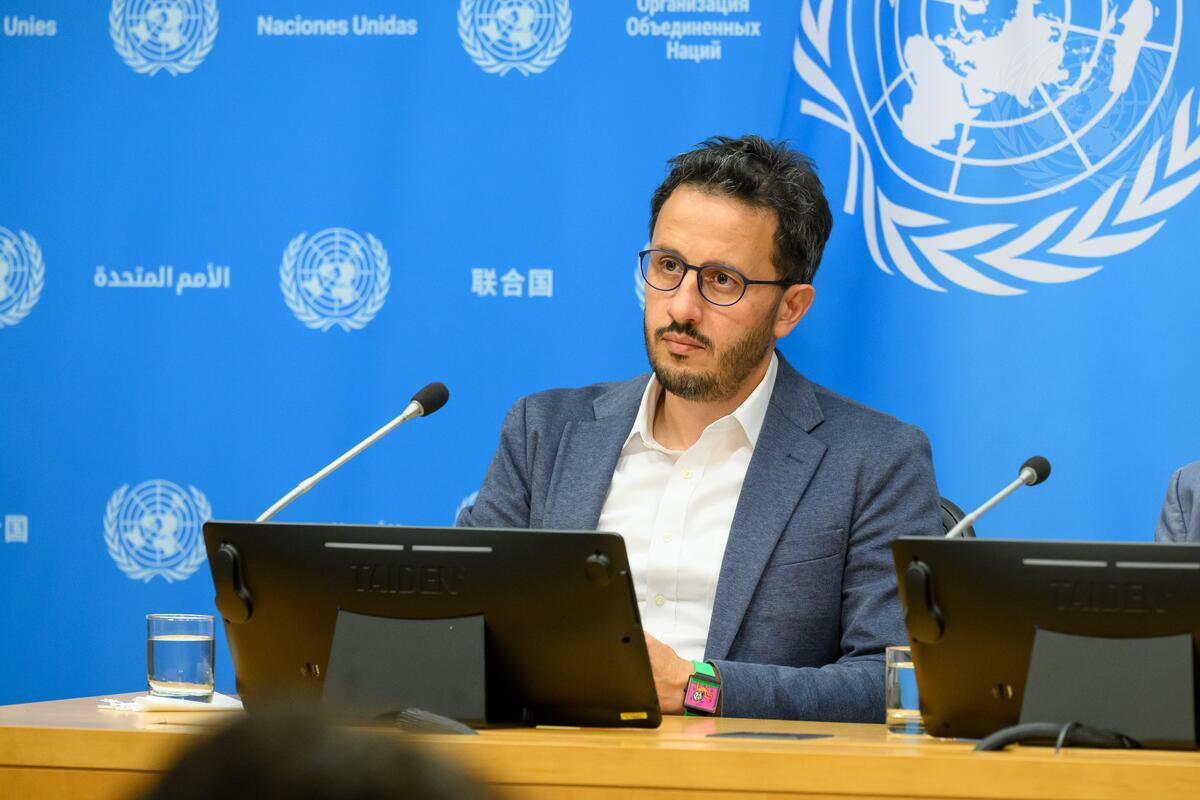
Sébastien Philippe, assistant professor in the Department of Nuclear Engineering and Engineering Physics at the University of Wisconsin–Madison, participates in the press briefing on the first meeting of the Independent Scientific Panel on the Effects of Nuclear War in 2025. Loey Felipe/U.N. Photo
“The probability of nuclear war may be small, and although it’s small, it’s probably higher than it has been in a long time,” Philippe said. “That’s still an unacceptable risk for the public, and therefore the public should know the consequences of our policy. Because our policy is to use those weapons if we need to.”
On WPR’s “Wisconsin Today,” Philippe detailed what he sees as an impending nuclear arms race, the work he’s doing to reduce the risk of nuclear war and what it would look like in today’s world — and in Wisconsin.
The following interview has been edited for clarity and brevity.
Kate Archer Kent: In the event of nuclear war involving the U.S., how would the Midwest be affected?
Sébastien Philippe: The U.S. has nuclear weapons that are stationed in land-based underground silos, and these are deployed in North Dakota, Nebraska, Wyoming, Colorado and Montana. There are about 400 of them that are armed. They’re here to raise the scale of any attack on the United States.
So, the idea is if someone wants to attack us with nuclear weapons and they want to limit damage to themselves, they’re going to have to destroy all those silos at once. It’s something that the (U.S. Air Force) called the “nuclear sponge,” and it’s kind of meant to attract those warheads.Now, what people had modeled already in the ‘70s and the ‘80s, and something I worked on two years ago was to say, “OK, given our modeling capabilities, what does a nuclear attack on those silo fields look like?” Because they’re buried underground and they’re pretty hardened.
An enemy would need to detonate nuclear weapons very close by, and typically at an altitude that would be either at ground level or very close to ground level. And when this happens, nuclear weapons generate fireballs that vaporize all this soil and concrete and everything around them, and that creates gigantic nuclear mushroom clouds that then get dispersed by the winds.
But the clouds are really tall — they go up 30,000 or 40,000 feet, and at that altitude winds are very fast, and so a few hours later, the fallout from that attack could reach pretty much any part of the country. And for Wisconsin, we’re pretty close to that place.
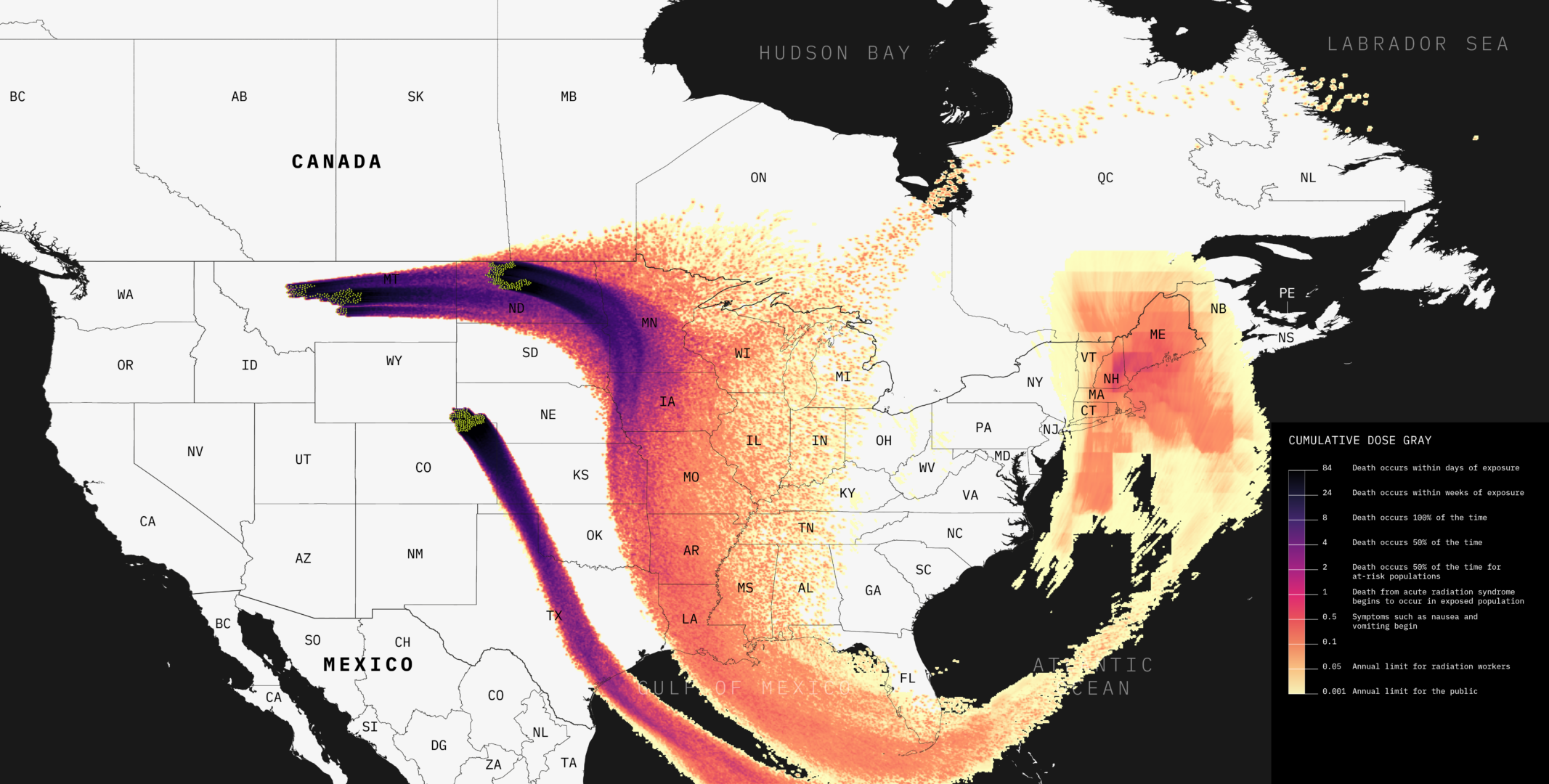
A simulation of the fallout from an attack on U.S. nuclear missile silos given the weather conditions on a specific day in 2021. Map by Sébastien Philippe, Ivan Stepanov and Svitlana Lavrenciuc
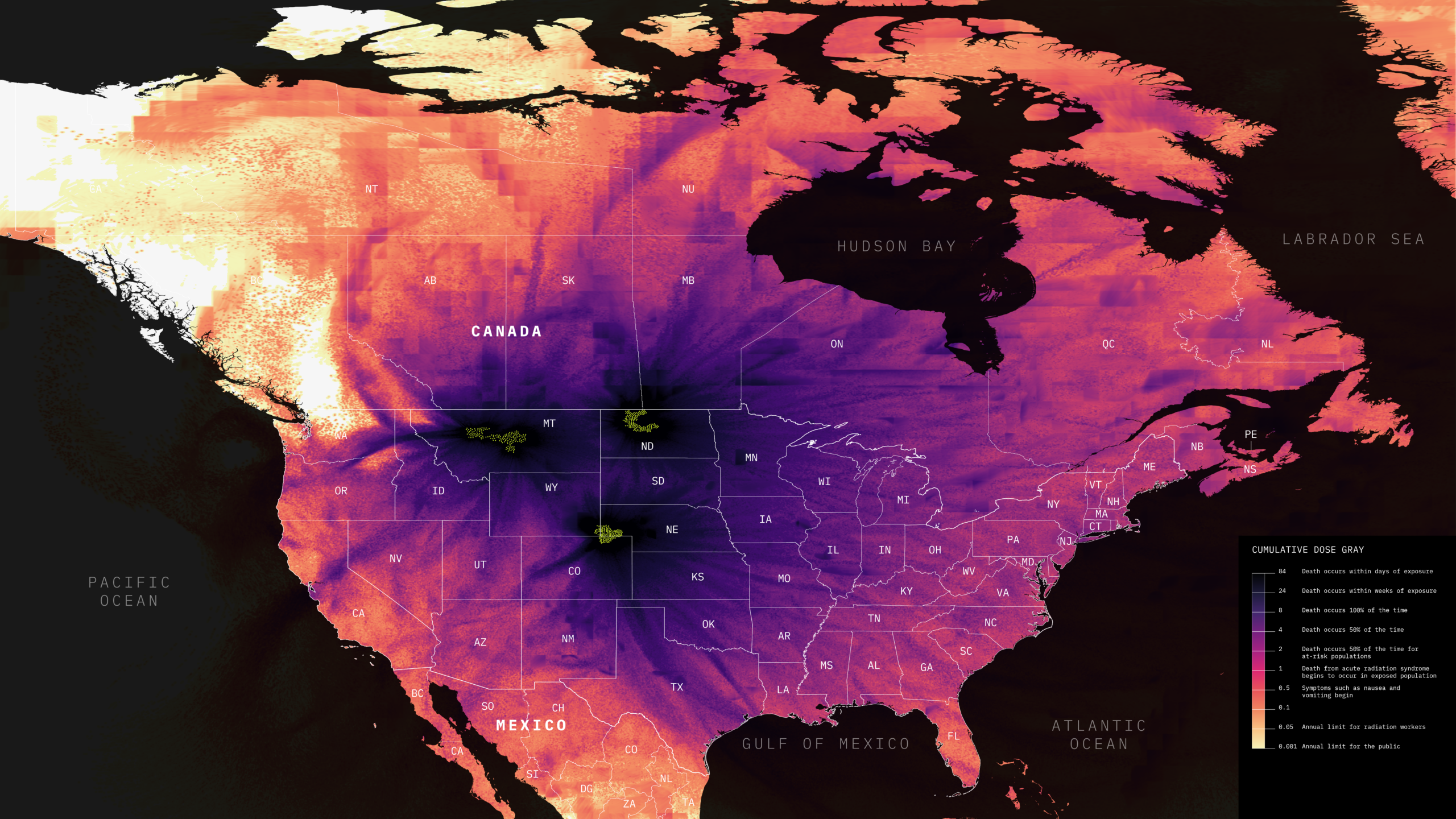
A map depicting the areas in North America at risk of receiving high levels of radioactive fallout based on simulations of nuclear attacks on silos for each day of 2021. Map by Sébastien Philippe, Ivan Stepanov and Svitlana Lavrenciuc
KAK: What does the end of New START mean for arms control between the U.S. and Russia?
SP: I think we’ve reached a new low point in the history of the two countries’ relationship. It is the first time since 1972 — over 50 years now — that we don’t have a treaty limiting or trying to reduce the size of the two countries’ nuclear stockpiles.
KAK: Without the New START treaty, do you think an arms race is on the horizon?
SP: I think it’s not on the horizon — it’s taking off. It’s unclear how fast it’s going to go, but I would expect already, as of (last) week, for the U.S. to have plans to upload more missiles on its submarines, possibly on its land-based missiles that I talked about that are in the Midwest.
The Russian arsenal hasn’t really moved much because of New START, but China has been deploying more nuclear weapons, and they actually have started building their own missile silos. And there is this kind of very basic math where, if the Chinese are deploying 300 more, we need at least 300 more because we’ll need to take those silos out. So that’s where we are. But the response from China is, “OK, why don’t we just add another 200,” and then we never get out of this until we get a treaty to calm things down.
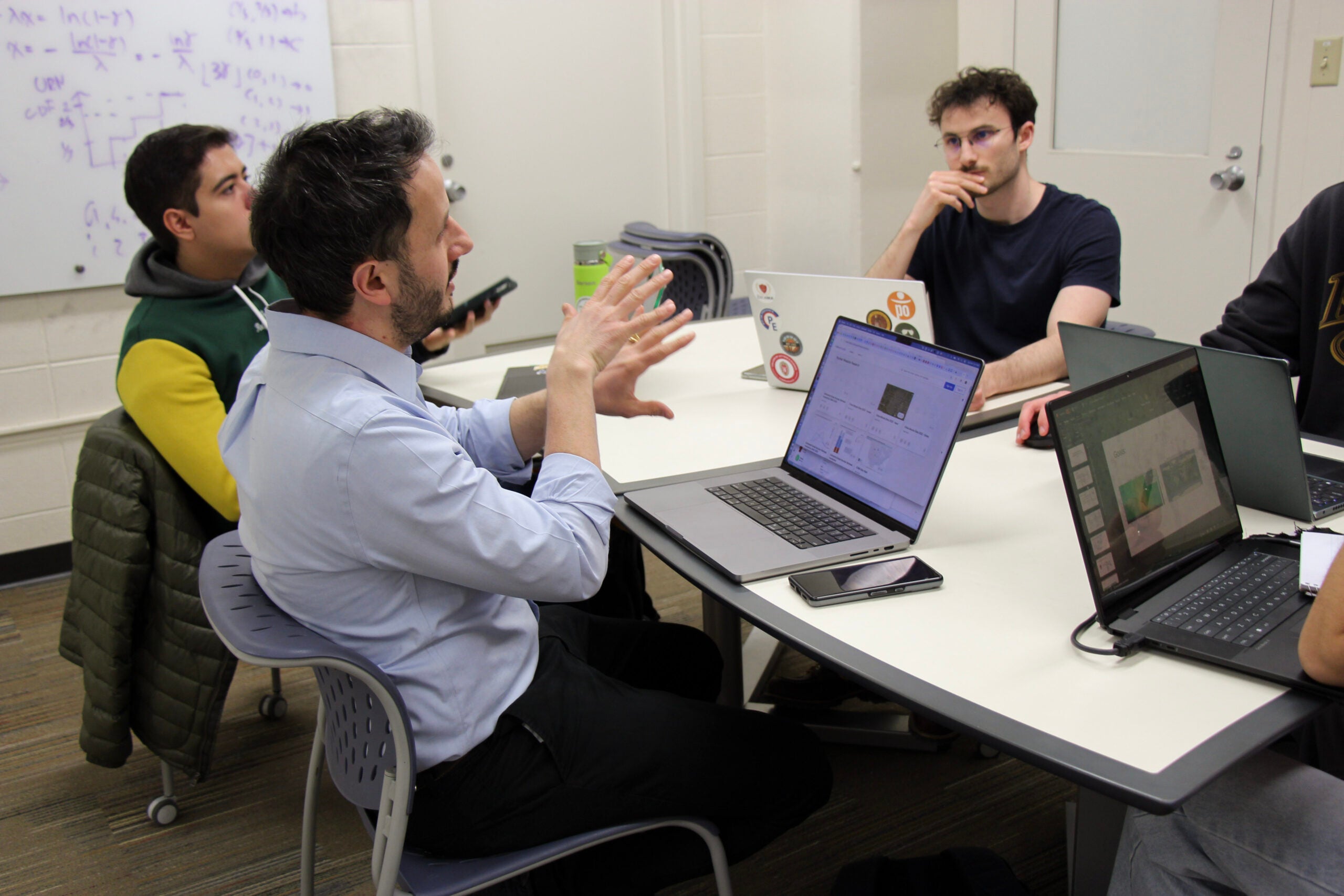
Sébastien Philippe leads a research group meeting at UW-Madison. Photo courtesy of UW-Madison Department of Nuclear Engineering and Engineering Physics
KAK: The limit New START imposed — 1,550 deployed weapons each — still seems like a large stockpile of weapons. What was the purpose of those limits?
SP: These limits started being put together beginning in the 1970s, and then it was accelerated at the end of the Cold War. In the 1990s people realized that we didn’t need an enormous amount of nuclear weapons in both countries, that the goal was to put an end to the arms race and move to a nuclear deterrence posture that would maybe be seen as more reasonable.
Something to remind everyone — the worldwide stockpile of nuclear weapons peaked in the 1980s at about 64,000 nuclear weapons. … Today we’re in a world where we still have about 12,000.
New START did not necessarily cap the total number of nuclear weapons in the world, but the total number of weapons deployed on missiles and assets that can reach other countries. So we limited the number of missiles and the number of nuclear weapons that are on those missiles that can be launched at any given moment or on short notice. It’s a way to stabilize the relationship, to provide data that is transparent and to provide access to reassure both sides that there is no secret build-up.
KAK: New START also established this system where the U.S. and Russia notified each other every time they moved a nuclear weapon. Why is that important?
SP: Especially in times of crisis, you don’t want to guess your adversary’s intentions. This became very clear recently, when Russia invaded Ukraine in 2022 and Vladimir Putin restarted making nuclear threats. There were some fears during the early stages of the war that the Russians could use nuclear weapons. And you’re trying to verify and look at any type of movements just to make sure. But you really don’t want to guess too much. You do want communication lines to make clear that some plans or ideas to use them are absolutely unacceptable.
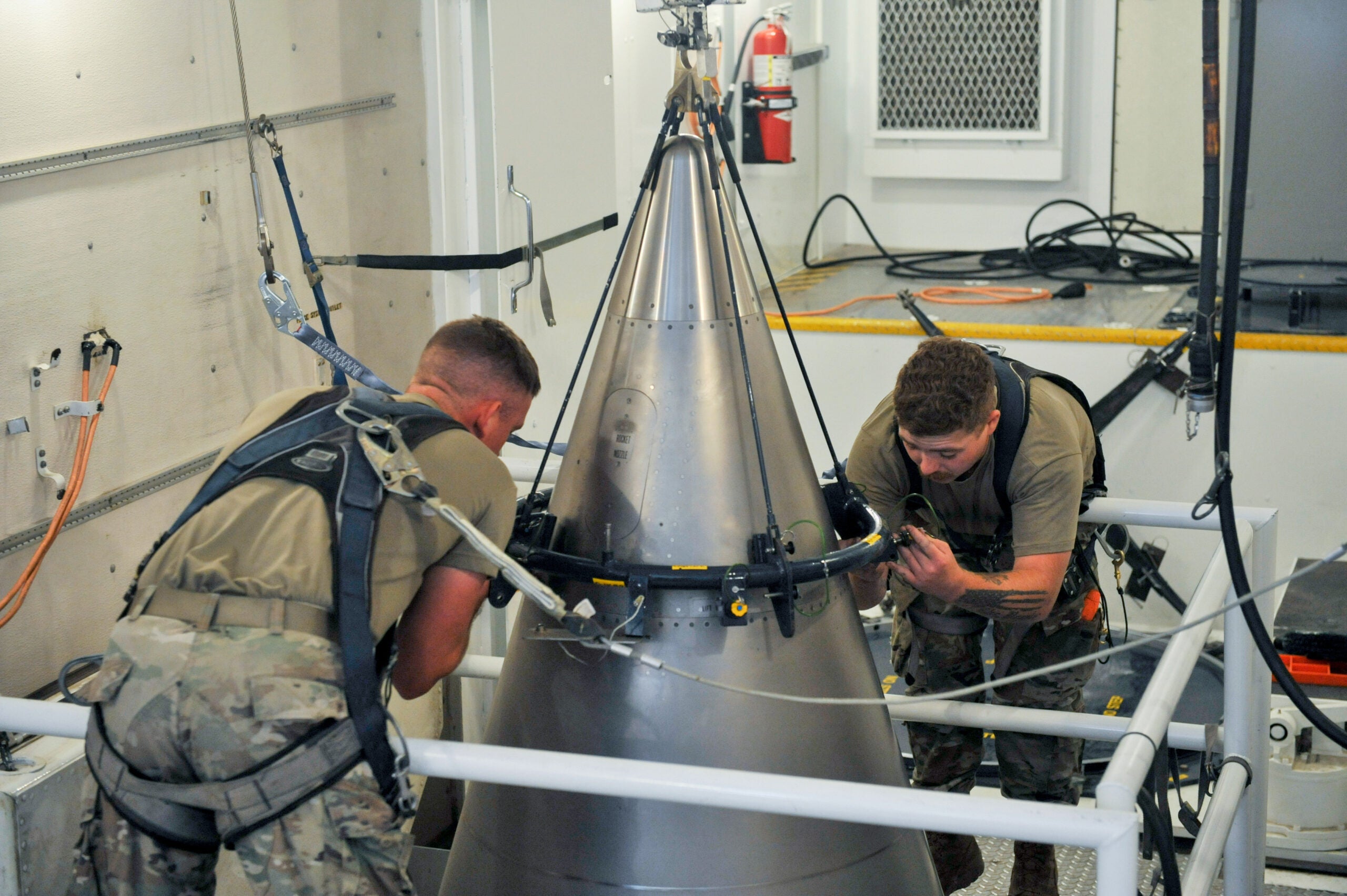
Senior Airman Jacob Deas and Airman 1st Class Jonathan Marrs secure a titanium shroud, beneath which is a nuclear warhead, at the top of a Minuteman III intercontinental ballistic missile, Aug. 24, 2023, at the Malmstrom Air Force Base in Great Falls, Montana. John Turner/U.S. Air Force via AP
KAK: What would nuclear war look like in the modern world?
SP: When you think about nuclear war, often people think about a full-blown exchange between the U.S. and Russia — which is a possibility, because the arsenals are meant to be used on that scale — and the apocalyptic results of such a war. Today, there are still uncertainties about the effects of a large-scale war, but we’re getting better and better at understanding especially the climatic effects that could result. We understand that there would be ways to get to that point where hundreds of millions of people could be killed in a nuclear exchange within the first 30 minutes or hour.
But a billion more could later die. And they would die from starvation, because the world would be very different. The temperature could drop. There could be crop failures, and you would not be able to produce enough food for everybody on the planet.But even taking a step back from that very large-scale exchange — that’s something the panel really wants to get into with a closer look. One has to realize that when countries build nuclear weapon stockpiles, they have plans to deploy and use those assets. Each weapon can be targeted in different places, and those targets can be the enemy’s nuclear weapon systems, conventional weapons, military, leadership infrastructure and communication infrastructure. But then you would want to do everything you can to make them stop the war or not be able to prosecute a war. And that means destroying energy production, oil refineries, ports, stopping trade, nodes for oil and gas pipelines, all of this stuff.
And so even if you have a short (smaller-)scale nuclear exchange … you’re going to have a tremendous effect on the global economy. That is really hard to grasp at this point. So the bottom line for me is: Nuclear war can be bad to extremely terrible, but between one nuclear weapon and 2,000 nuclear weapons being used, there is a wide range of scenarios in different places in the world. And I think we have the tools now to ask the question: What does it look like? Are our current policies in line with the type of security that we’re seeking here?
Wisconsin lies in the path of nuclear fallout, UW-Madison researcher’s modeling shows was originally published by Wisconsin Public Radio.
If you think stories like this are important, become a member of Urban Milwaukee and help support real, independent journalism. Plus you get some cool added benefits.