
Another Black History Month, Another Capitol Fight In Wisconsin
A resolution naming eight late Black Wisconsinites is the latest flashpoint in a yearslong partisan dispute.
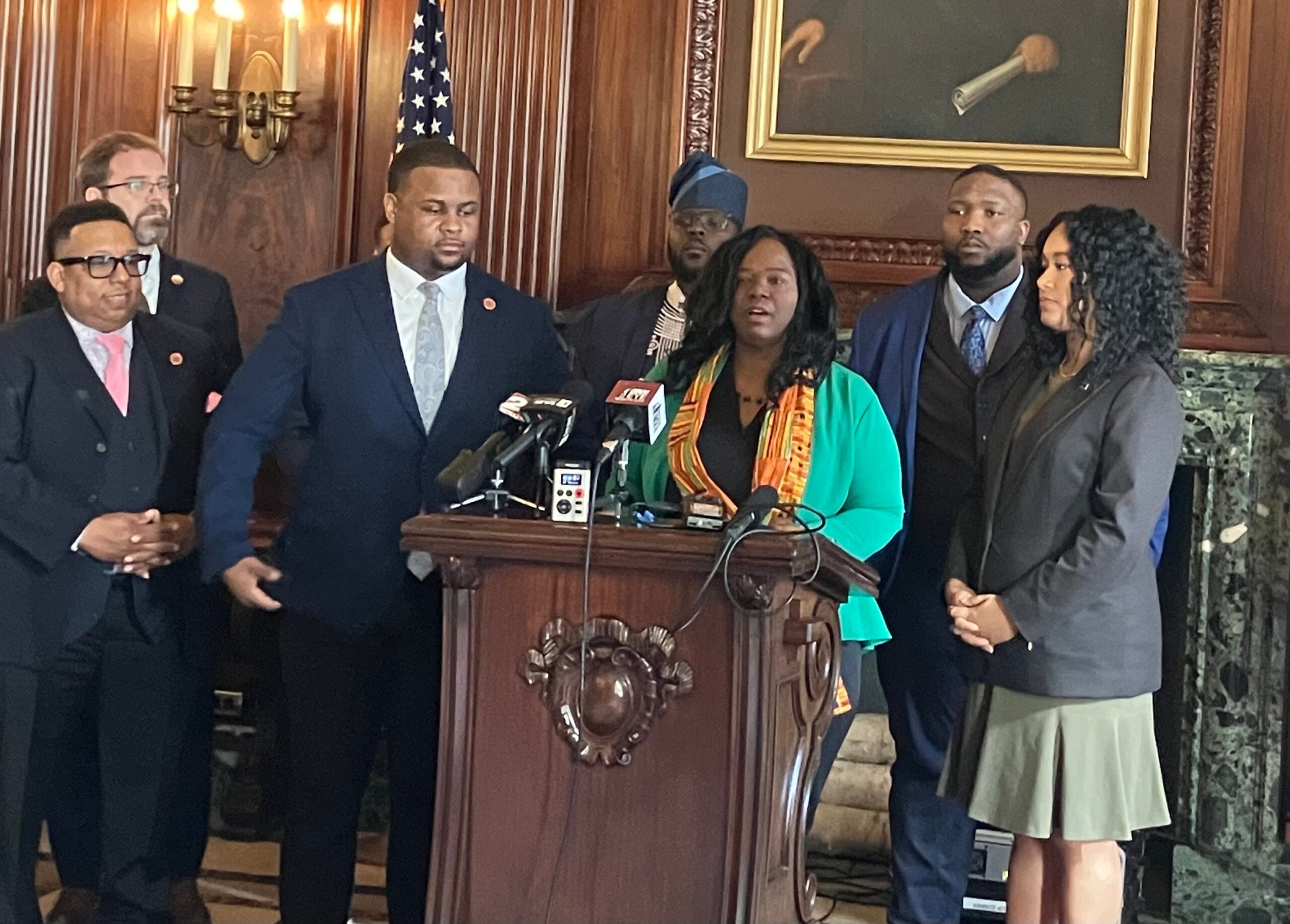
State Rep. Sequanna Taylor, D-Milwaukee, speaks at the podium as she joins fellow members of Wisconsin’s Legislative Black Caucus in calling for a vote on a resolution honoring Black History Month in 2026. State Rep. Ryan Clancy, D-Milwaukee, who is not a member of the Black Caucus, also stood with the caucus members during a news conference on Thursday, Feb. 19, 2026. Sarah Lehr/WPR
With just over a week to go before the end of Black History Month, Wisconsin’s Legislative Black Caucus is calling on the GOP-controlled Legislature to formally recognize the contributions of Black Wisconsinites.
Each year, the state Legislature passes a slew of ceremonial resolutions, recognizing people, holidays and historic events.
But, in recent years, non-binding resolutions honoring Black history have been met with controversy in Wisconsin’s Legislature.
On Thursday, Black Caucus members, all of whom are Democrats, called attention to a still-pending resolution that would recognize Black History Month in 2026. They urged the Republican-controlled Legislature to put it up for a vote in the state Assembly.
State Rep. Sequanna Taylor, D-Milwaukee, said the resolution should not be partisan.
“We should not have to fight or hold a press conference to honor those who have paved the way for us,” Taylor told reporters at the state Capitol.
The Assembly met Thursday for what was expected to be the body’s final floor session of the year. As of Thursday afternoon, the resolution was not among dozens of proposals scheduled for a vote.
The office of Assembly Speaker Robin Vos, R-Rochester has not yet responded to a request for comment. Vos announced he is not seeking re-election during a speech from the Assembly floor Thursday afternoon.
According to information provided by his office, Senate Majority Leader Devin LeMahieu, R-Oostburg, did not receive a request from the Democratic minority leader or from other legislators to put the resolution on the agenda for Wednesday’s Senate session,
“As always, the Leader will consider all requests made by members for floor consideration,” a staffer with LeMahieu’s office wrote in an email.
The proposed Black History resolution for 2026 includes the names of eight late Black leaders. That includes civil rights activist Malcolm X, who lived in Milwaukee as a child, and Marcia Coggs, the first African American woman elected to Wisconsin’s state Legislature.
State Sen. Dora Drake, D-Milwaukee, said she was told that names on the Black History resolution had to be pre-approved by Republican legislative leaders.
But, she said, that same standard has not been applied to other resolutions.
“Black Wisconsinites deserve to have their story celebrated without being filtered through partisan approval,” Drake said. “If our legislative colleagues disagree with the contributions we choose to honor, they should say so openly.”
In 2019, Republican lawmakers in Wisconsin removed the name of Milwaukee-born National Football League Player Colin Kaepernick from a Black History Month resolution, after Kaepernick gained notoriety for kneeling during the national anthem to protest racism and police violence.
Several Black Caucus members said Republican lawmakers laid bare a double standard this fall when they approved a resolution honoring Charlie Kirk, the conservative activist who was fatally shot last year while speaking at a college campus. Kirk has never lived in Wisconsin.
“This body has honored Charlie Kirk, despite multiple statements from him that disparage Black history and the legacy of our ancestors,” Drake said.
State Rep. Kalan Haywood, D-Milwaukee said he was told at the one point that the resolution could not honor living people. But, as he pointed out, that’s a non-issue with the current resolution.
“All of our honorees in this year were tied to Wisconsin,” Haywood said. “All of our honorees have since left us on this earth.”
Last year, Wisconsin’s Assembly OK’d a Black History resolution during February, although that measure didn’t clear the Senate until March, once the actual month of celebration had passed.
In 2024, a Black History Month resolution never got a floor vote. The year before that, in 2023, a resolution made it through both chambers, but not until March.
Will Wisconsin pass a Black History resolution? It’s been controversial in years past was originally published by Wisconsin Public Radio.
If you think stories like this are important, become a member of Urban Milwaukee and help support real, independent journalism. Plus you get some cool added benefits.