Senate President Confident GOP Won’t Lose Majority
'We’re going to run on the same policies we’ve always run on,' Felzkowski says.
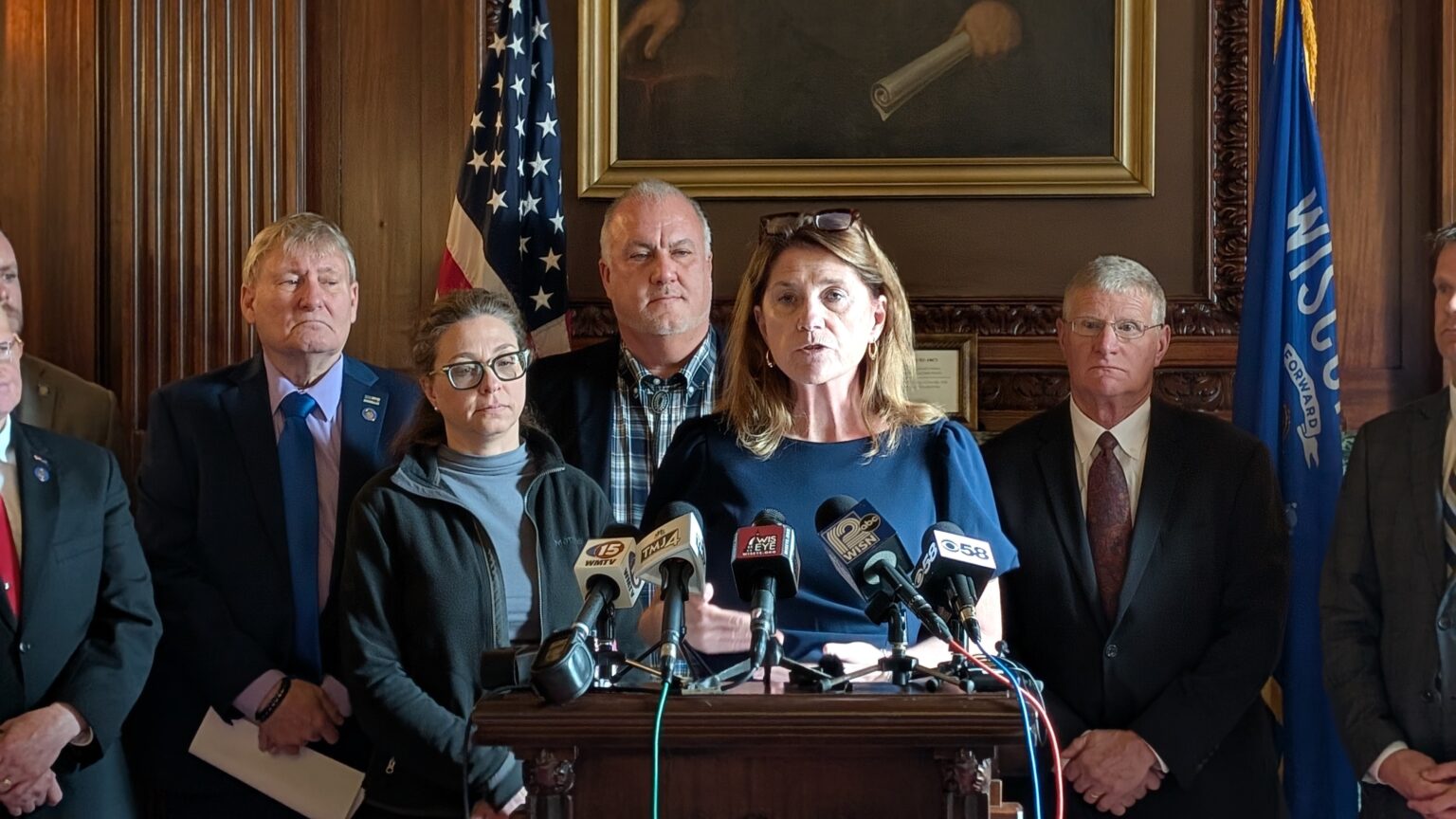
Senate President Mary Felzkowski (R-Tomahawk) said she hopes her “fellow assemblymen continue to put pressure on their leadership” to pass postpartum Medicaid expansion. Felzkowski spoke at a Republican press conference about postpartum Medicaid expansion in April. (Photo by Baylor Spears/Wisconsin Examiner)
Senate President Mary Felzkowski (R-Tomahawk) said in a year-end interview with the Wisconsin Examiner that the year has been one of “very steady growth” and top priorities for her in the remaining legislative session include passing legislation to help bring down the cost of health care, advancing medical cannabis legislation and passing additional tax cuts.
Felzkowski pointed to the state budget in which lawmakers and Gov. Tony Evers increased funding for roads and transportation costs, cut taxes including for retirees, increased special education funding and dedicated funding to mental health initiatives. She was one of four Senate Republicans to vote against the state budget, a vote she said she took because of her opposition to increasing the state’s hospital assessment without health care reforms.
A slimmed down, 18-member Republican majority in the Senate this session and several GOP senators who took a stand against a compromise budget deal gave Senate Democrats an opening to come to the budget negotiating table, and to win compromises on school funding as well as stop cuts to the University of Wisconsin system.
Felzkowski said the slimmer margins this year have been normal.
“If you look back for the last 30 years, when the Republicans are in control, we are normally at 18-15 margin in the Senate,” Felzkowski said. “When we were up to like 22, that was kind of a gift, so we are a very strong Republican majority right now.”
Felzskowski said working on health care affordability will be her top priority when lawmakers return in January. This includes working on health care price transparency and working to advance her legislation that would make changes to the regulation of pharmacy benefit managers — third-party companies that manage prescription drug benefits between health plans, employers and government programs.
Health care and prescription drugs
Felzkowski’s bill would allow patients to use any licensed pharmacy in the state without facing penalties and require benefit managers to pay pharmacy claims within 30 days.
“Our neighbors to the south in Illinois just passed their version of PBM reform,” Felzkowski said, adding that her bill has passed out of committee and lawmakers are now discussing whether it will receive a full Senate vote.
Felzkowski’s health care price transparency legislation would require hospitals to make publicly available to consumers the standard costs of “shoppable services,” which would be defined as those that can be scheduled in advance such as x-rays, MRIs and knee replacements.
“What is one thing that you buy that you have no idea what it’s going to cost? It’s health care. That’s absolutely ridiculous,” Felzkowski said. “Other states have passed it. They’re starting to see the fruition of it and it does work. There’s a reason we have the fifth highest health care costs. It’s because our Legislature has not done anything to help bring those costs down and it’s time that we actually start doing that.”
Felzkowski, who has been a longtime advocate for legalizing medical cannabis, said the Senate is “closer than ever” to having a vote on the floor on a proposal to do so, but she believes the chances of the Assembly advancing legislation remain “slim.”
Felzskowski said she hopes legislation to extend Medicaid coverage for postpartum women from 60 days after giving birth to one year isn’t dead this session. Wisconsin is one of two states in the U.S. that haven’t accepted the federal extension.
“I hope that my fellow assemblymen continue to put pressure on their leadership… Deep red states, blue states as well as purple states across the nation have postpartum care for 12 months and they’ve done it because it’s the return on investments for taxpayers as well as being the right thing to do,” Felzskowski said. “We see baby thrive, we see mom thrive, and it actually lowers the cost down the road.”
Fate of WisconsinEye
Felzkowski said Senate Majority Leader Devin LeMahieu and Assembly Speaker Robin Vos are having discussions about solutions to the shutdown of WisconsinEye, the nonprofit service that provides video coverage of legislative hearings, floor sessions and Wisconsin state government business. WisconsinEye halted its livestream and pulled down its video archive last week due to a lack of funding.
“Even if we do something temporary to get us through a session… just get through until April and then do a really deep dive on what should be the next step,” Felzkowski said, adding that that includes looking at how other states cover their state government.
“The transparency is important,” she said, adding they want to ensure people still have access to government proceedings and a record is still being kept of it all.
Felzkowski said she hopes Republicans can get one more tax cut done before the end of the legislative session next year.
New tax cuts in the works
A few of the ideas legislators are considering include eliminating taxes on tips and overtime.
“Anytime we can return money to our citizens is a good thing,” Felzkowski said, adding that state Republicans would like to align Wisconsin tax cuts with federal policy. The federal megabill approved in July included a tax deduction on tips and overtime that will be available from 2025 through 2028.
This December, Wisconsin residents are experiencing the highest property tax hikes since 2018, according to a recent Wisconsin Policy Forum report. The report explained that state budget decisions including Evers’ veto that allows school districts an annual $325 per pupil increase for the next 400 years as well as lawmakers’ decision to not provide any increase to state general aid this year have led to the hikes.
Asked whether lawmakers will look to solutions for lowering property taxes, Felzkowski said it would take a new governor.
“We have given [Evers] numerous chances to reverse that 400-year veto and he keeps vetoing the bill, so it’s on the governor’s plate right now,” Felzkowski said. “Until we get a different governor in the East Wing and we can start seriously addressing education and all the things that are wrong with it, I don’t know what to say.”
Felzkowski said that even with the state budget surplus there wasn’t enough state money for the general aid increase.
“There were a lot of mouths to feed on that budget,” Felzkowski said. “With increasing revenues all over, there was not enough money out there to backfill that $325… We would have had to have raised taxes dramatically to do that. The dollars didn’t exist.”
Felzkowski said on education that she hopes Wisconsin will opt into the new federal education tax credit program. The program would provide a dollar-to-dollar tax credit of up to $1,700 to people who donate to a qualifying “scholarship granting program” to support taxpayer-financed private-school vouchers. Evers would need to opt the state into the program by Jan. 1, 2027, but so far has said he won’t.
Confident GOP will hold Senate in 2026
Wisconsin Republicans have held control of the state Assembly and Senate since 2010, and next year will test the strength of that majority when the state’s 17 odd-numbered Senate seats will be up for election for the first time under new legislative maps adopted in 2024.
Last year when the maps were in place for the 16 even-numbered seats, Democrats were able to flip four seats. In 2026, Republicans will need to make sure Democrats cannot flip two additional Senate seats to hold control of the body.
Felzkowski expressed confidence that they will do so.
“We will come back with a strong Republican majority. We have better policies, we have better ideas and we run great candidates,” Felzkowski said.
There will be several key, competitive districts in 2026 including Senate District 5, which is currently held by Sen. Rob Hutton (R-Brookfield), Senate District 17, which is currently held by Sen. Howard Marklein (R-Spring Green) and Senate District 31, currently represented by incumbent Sen. Jeff Smith (D-Brunswick) who will face a challenge from Sen. Jesse James (R-Thorp).
“We’re going to run on the same policies we’ve always run on: lower taxes, strong freedoms, strong economies, strong education and government getting out of your way so that you can live the American dream,” Felzkowski said. “The Democrats are going to run on an anti-Donald Trump policy, more government, more influence in your life. It’s all they’ve ever run for.”
Some Democrats have taken election results in 2025 as a sign that people are unhappy with the Trump administration and are ready to elect Democrats.
Felzkowski said she didn’t think that 2025 election results in other states were going to be applicable in Wisconsin, though she said the new maps could be challenging for Republican candidates.
“Wisconsin is kind of a unique state. We’re a very purple state,” Felzkowski said. “We knew those candidates in Virginia were going to win, I mean, it’s a blue state so I mean you can’t really base us on what happened in Virginia and New Jersey… We’re going to be running in Democratic-gerrymandered seats, so we’re going to have to work very hard, but we will win.”
Wisconsin also has an open race for governor on the ballot next year. U.S. Rep. Tom Tiffany, who is considered the frontrunner in the GOP primary, and Washington County Executive Josh Schoemann, are the current Republican hopefuls.
Felzkowski said she probably won’t endorse in the Republican primary for governor, but she is looking for a candidate who is a “conservative reformer who’s willing to take on the tough issues from health care, education, and corrections, lowering taxes” as well as someone who will do “a deep dive into our agencies,” adding that she hopes they’ll work to root out “waste, fraud and abuse.”
The Democratic field of candidates is much larger including Lt. Gov. Sara Rodriguez, state Sen. Kelda Roys (D-Madison), state Rep. Francesca Hong (D-Madison), Milwaukee County Exec. David Crowley, former Wisconsin Economic Development Corporation CEO Missy Hughes, former Lt. Gov. Mandela Barnes, former Department of Administration Secretary Joel Brennan and former state Rep. Brett Hulsey.
Senate President Mary Felzkowski confident GOP will hold majority in 2026 was originally published by the Wisconsin Examiner.
If you think stories like this are important, become a member of Urban Milwaukee and help support real, independent journalism. Plus you get some cool added benefits.
Political Contributions Tracker
Displaying political contributions between people mentioned in this story. Learn more.