Lead Paint, Poisoning Still An Issue
Some city neighborhoods have higher rates of lead poisoning than found during Flint water crisis.
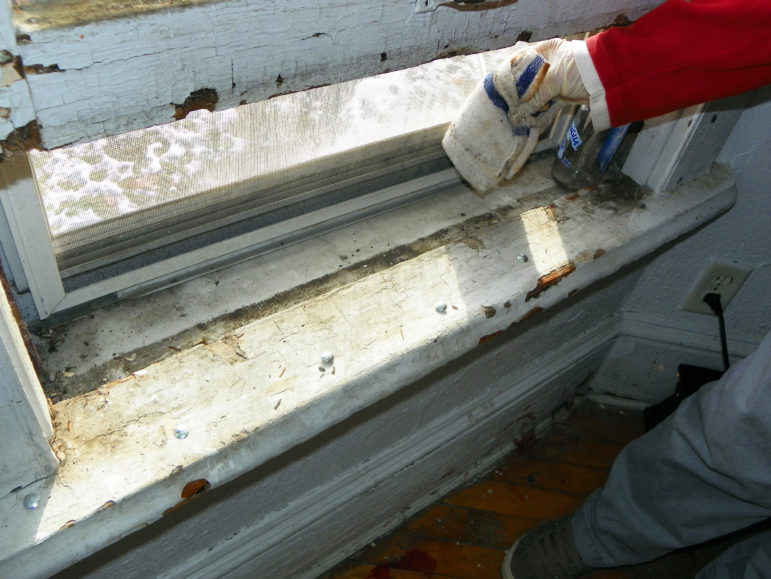
Lead paint. Photo by Matt Campbell / For the Wisconsin Center for Investigative Journalism.
Brain damage. Lower IQ. Behavioral issues. Irreversible. Permanent. When my infant son’s fingerstick came back positive for lead, these health effects of lead poisoning ran through my mind over and over. My spouse and I live in an older home and thought, what could have been the source? As a public health nurse, I considered myself knowledgeable about lead hazards and took steps to protect my family from the preventable harms. What had I missed? How would this impact my son’s future? The doctor reassured me to not worry until the result of the venous blood draw came back, as those are more accurate than the fingerstick, which are prone to false positives. When the venous result came back normal, I could breathe again.
Unfortunately, other parents in our community are not so lucky. Within the city of Milwaukee, many childhood lead tests are coming back as true positives. While the dramatic decrease in incidence of lead poisoning in the United States is considered one of the greatest modern public health achievements, some areas in the United States—including neighborhoods in Milwaukee—have recently had higher rates of blood lead poisoning than in Flint during the water crisis. Here in Milwaukee, lead does not impact all families equally. A 2020 report found that Milwaukee children residing in areas with lower home ownership, higher poverty, and non-white census tracts may be at higher risk.Milwaukee is in a backslide when it comes to lead poisoning. Local health establishments have faced several challenges that have limited timely follow-up of children with elevated blood lead levels. Recently, the COVID-19 pandemic has slowed the rate of testing. According to the city’s website, in 2016 11.6% of children had blood lead levels above 5 µg/dL (the CDC reference level for elevated lead), and 3.3 percent of children tested had levels above 10 µg/dL. Levels lower than 5 are known to cause harm, and there is NO known safe level.
Lead paint remains a scourge in homes throughout the city and is known to be one of the primary causes of childhood lead poisoning. In Milwaukee and elsewhere in the United States, despite banning the use of lead paint 43 years ago, children, through no fault of their own, are still reaping the toxic effects of what we have sewn. While families living in houses at risk for chipping lead paint and leaded dust can take certain precautions such as wet mopping and frequent wiping of surfaces, it does not eliminate the risk, and it does not help if the parent hasn’t been made aware of the risk in a meaningful way.
As reported by the CDC, to prevent lead poisoning in all kids born in 2018 would have required a federal investment of $80 billion, but an estimated $83.9 billion in societal benefits would be expected in return (or a 5% return on investment). As the removal of lead would also protect future cohorts of children, we would reap the return on investment again and again. $80 billion is a lot. But it is not out of our reach. Until our country summons the moral fortitude and commits the funds to end this problem for good, we need to take small steps to protect our own community.
One such step is to advocate for renters to be made more aware of potential lead hazards. Currently, landlords who are renting a home that was built prior to 1978 are required to give the tenants an informative brochure from the EPA, to inform them of any “known” risks, and have them sign in the lease that the brochure was received. But is this enough? In real estate, plausible deniability of a hazard (one can’t know if there is a lead hazard if it is never tested for) may allow landlords to provide the brochure (of little use to families with lower literacy levels or those who don’t understand well the language the brochure is provided in) and give the issue little other thought.When it comes to lead, ignorance is not bliss. In Milwaukee, we can advocate for our local government to create and uphold regulations that hold property owners responsible for being actively aware of lead hazards in their properties, and require thorough testing of properties. Landlords, once aware of any hazards in their properties, should provide renters with meaningful and concrete information regarding all hazards that exist in their potential home, and how to avoid them. We should support landlords with the knowledge and, when appropriate, finances, to be aware of, disclose, and abate lead risks in their properties. Most importantly, we ought to support families living in older homes to recognize any risks, take preventative measures, and when needed assist families with small children or pregnant women in moving to safer properties if lead in their own home cannot or has not been abated.
Joanna Balza is a mom, nurse, and graduate student in public and community health in the Milwaukee area.
More about the Lead Crisis
- Why Milwaukee’s Lead Pipe Program Is Cheaper, Faster — And Still At Risk - Jeramey Jannene - Jun 1st, 2026
- EPA Announces $94 Million for Wisconsin to Replace Lead Pipes - Danielle Kaeding - May 20th, 2026
- New Documentary Exposes Federal Funding Cliff at the End of 2026, Wisconsins Push to Replace All Lead Pipes - Wisconsin Conservation Voters - May 5th, 2026
- Gov. Evers Signs New PFAS, Lead Regulations - Danielle Kaeding - Mar 2nd, 2026
- City Receives $400,000 Grant For Lead Screening - Sophie Bolich - Feb 24th, 2026
- Rep. Madison Proposes Restoring Local Control Over Lead Inspections - State Rep. Darrin Madison - Jan 6th, 2026
- $43 Million Later, MPS Says Classrooms Are Safe From Lead Dust - Corrinne Hess - Dec 18th, 2025
- MPS Buildings Cleared of Lead-Paint Risks after 10-Plus Months of Work - Milwaukee Public Schools - Dec 17th, 2025
- Wisconsin Moves to Require Lead Service Lines Replaced By 2037 - Danielle Kaeding - Dec 11th, 2025
- Gov. Evers, DNR Announce More Than $159 Million to Ensure Clean, Safe Drinking Water for Wisconsinites in 29 Municipalities - Gov. Tony Evers - Dec 10th, 2025
Read more about Lead Crisis here


Op-Ed
-
Wisconsin’s Utility Energy Crisis
 Mar 1st, 2026 by Isaiah Ness
-
Pete Buttigieg Comes to La Crosse
 Jan 20th, 2026 by Ruth Conniff
-
Trump Administration Has Abandoned Local Governments
 Dec 28th, 2025 by Sup. Jack Eckblad