Evers Is Strategic in Commuting Prison Sentences
Results of months-long process not announced until after November election.
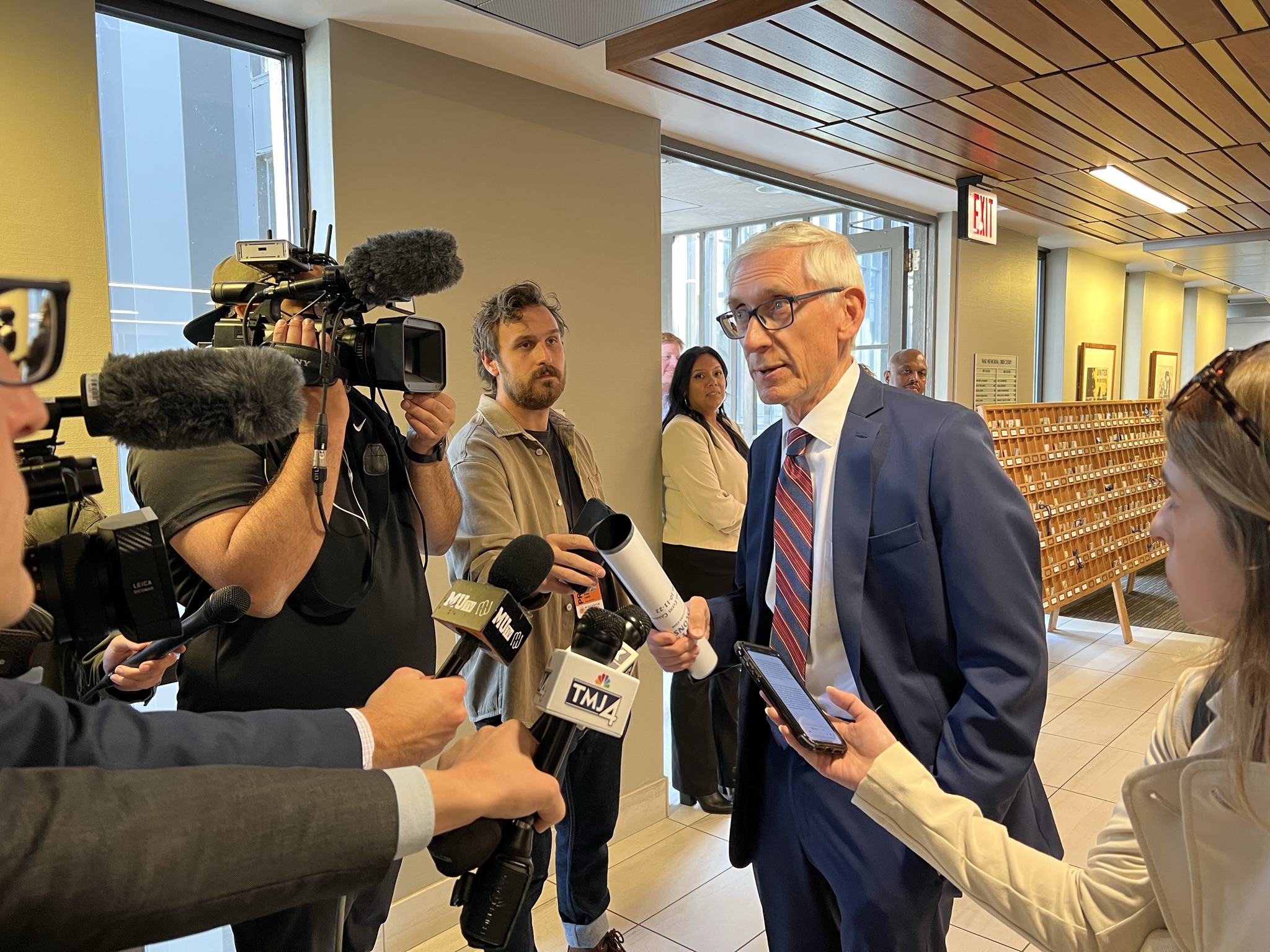
Governor Tony Evers in a media scrum on Oct. 11, 2022. File photo by Jeramey Jannene.
Commuting a prison inmate’s sentence — by allowing an inmate’s immediate release or ordering a Parole Commission review of their potential release — is one of the most politically dangerous and controversial actions a governor can take.
If someone who committed a violent crime decades ago, even as an impulsive teenager, hurts or kills again after their sentence is commuted, the public outrage becomes part of a reelection debate that threatens the career of that governor.
So timing matters. Democratic Gov. Tony Evers, who will leave office in January, announced the commutations on Nov. 13 — 10 days after the election for governor won by Democrat David Crowley. They were the first commutations granted since 1995.
Asked about those 14 commutations by a Wisconsin State Journal reporter, Evers said, “We have to get people ready to come back into society, and that’s hard work, and [those 14] have got a long way to go.”
In April, when he announced the commutation process, Evers also set these limits on who could and could not file applications with the new Commutation Advisory Board: Inmates must have served at least 50% of their term (or 20 years of a life sentence), have over a year remaining on their sentence, and have had five years with no misconduct reports. Those convicted of sexual assault, child abuse, human trafficking, or on the sex offender registry could not apply.
The first 24 appeals heard by the advisory board resulted in 14 commutations and 10 denials. The board is scheduled to hear eight more appeals Dec. 11.
According to the governor’s office summary of the first commutations:
– The 14 have served an average of 29 years in prison; the range is between 11 and 36 years.
– Seven of the 14 were convicted of murder as teenagers and sentenced to life in prison. Two killed when they were 15 years old. Those seven have served an average of 31 years in prison.
– One of them, Amanda Weaver, who had been in prison for 17 years for joining others in stealing cash and other items from churches and a restaurant in 2007 and 2008, will be released immediately. She was serving a 30-year sentence.
– Others given commutations must still serve three or four more years in prison, while others had their parole eligibility dates moved up.
– Nine of the 14 will have their potential release decided by the three-member Parole Commission, which is chaired by Melissa Roberts, a former senior Department of Corrections official. The other two commissioners are Regina Beloungy and Jennifer Kramer.
The commutations will not change the practice of Parole Commission staffers going to prisons to hear the appeals of adult inmates who were sentenced before the truth-in-sentencing law that eliminated the possibility of parole after January 2000 took effect.
The Parole Commission can deny appeals, grant them or defer them by setting a new hearing date and conditions to be met before the next hearing. In the first nine months of this year, the commission reports that 559 appeals were heard, with seven granted, 29 denied and 523 deferred.
Republican Sen. Van Wanggaard, a retired Racine police officer, criticized the commutations.
“These aren’t ‘nonviolent offenses’ that Evers commuted. They killed people. They traumatized victims, families and communities. They were prosecuted by elected district attorneys and sentenced by elected judges,” Wanggaard said in comments reported by the MacIver Institute.
“Instead, lame-duck Governor Evers and his unelected cronies think they know better than the people involved. It’s disgusting,” Wanggaard added.
The Republican Crowley defeated, U.S. Rep. Tom Tiffany, had said he would not issue any commutations if elected. Crowley has said he plans to keep the commutation process, although he must decide whether to change it and what resources to give it.
Commutation applications must include criminal records and transcripts of court hearings that resulted in prison sentences. Comments are solicited from prosecutors, judges and victims or their families. Those materials are gathered and reviewed by Evers aides and forwarded to Commutation Advisory Board members, who choose which applications to hear. Board members then make recommendations to the governor.
On Dec. 11, the board will hear the appeal of Brendan Dassey, who was given a life sentence for assisting his uncle Steven Avery in the 2005 murder of Teresa Halbach.
Wisconsin residents should “buckle up,” Wanggaard warned.
Steven Walters started covering the Capitol in 1988. Contact him at stevenscotwalters@gmail.com
If you think stories like this are important, become a member of Urban Milwaukee and help support real, independent journalism. Plus you get some cool added benefits.
Political Contributions Tracker
Displaying political contributions between people mentioned in this story. Learn more.


The State of Politics
-
Assembly Democrats’ Recruiting Of Educators Pays Off
 Nov 16th, 2026 by Steven Walters
-
For First Time in 18 Years, Democrats Control Budget Process
 Nov 9th, 2026 by Steven Walters
-
2026 Election Has Parallels with 1982
 Nov 2nd, 2026 by Steven Walters