Brahms, Beethoven And The Clarinet
Clarinetist Todd Levy — 'one of the best in the world' — performs with Frankly Music.
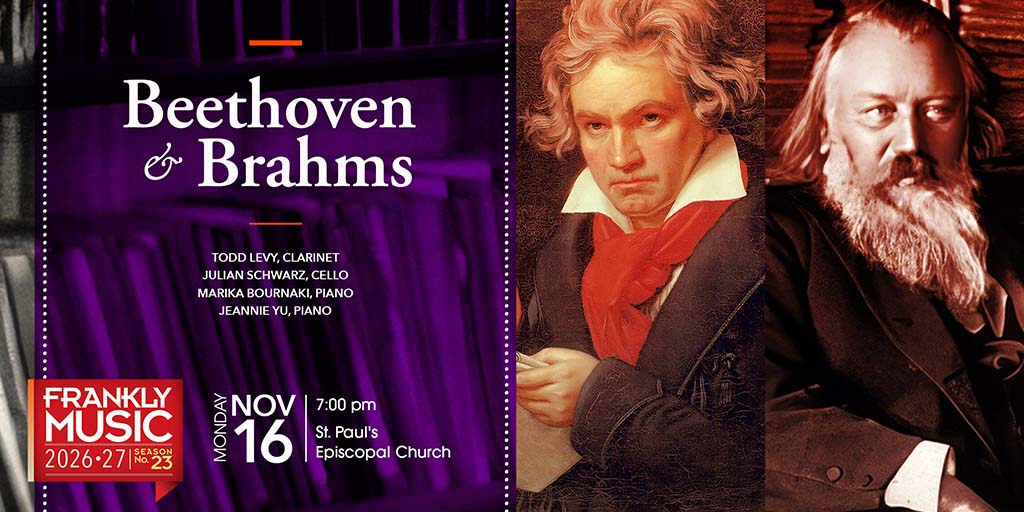
Frankly Music Nov 16 2026 concert
Two chamber trios written almost a century apart will frame Frankly Music’s second concert of the season. Beethoven’s early Trio in B-flat major and Brahms’s late Trio in A minor share an unusual combination—clarinet, cello and piano—and offer contrasting views of two composers at very different points in their careers.
The concert features clarinetist Todd Levy, who retired this spring after 26 years as principal clarinet of the Milwaukee Symphony Orchestra. He serves as Frankly Music’s artist in residence this season, continuing his long musical relationship with violinist Frank Almond, former Milwaukee Symphony Orchestra concertmaster and Frankly Music’s founder and artistic director.
“Todd is probably one of the greatest clarinetists I’ve ever heard,” Almond said. “I believe he’s one of the best in the world.”
The original program included Bartók’s Contrasts, a trio for clarinet, violin and piano. When Almond injured his arm in a fall shortly before the concert, he replaced the Bartók with Brahms’s Clarinet Sonata in F minor. Almond plans to be performing again in early 2027.
The change brings pianist Jeannie Yu into the concert. She and Levy have performed the Brahms sonata together frequently. Almond has often worked with Yu as well. “Jeannie’s spectacular,” he said.
Yu is a soloist, chamber musician and recording artist who has appeared as a keyboardist with the Milwaukee Symphony. A Juilliard graduate with a doctorate from the Peabody Conservatory, she is also the pianist of the Florestan Duo.
Cellist Julian Schwarz and pianist Marika Bournaki, partners both at home and in performance, will join Levy for the two trios, as originally planned. Returning Frankly Music guests, they met as students at the Aspen Music Festival, later studied at Juilliard and began performing together in 2014. The duo won first prize at the Boulder International Chamber Music Competition’s Art of Duo in 2016. Both also maintain active individual careers.
Beethoven wrote his Piano Trio in B-flat major, Op. 11, in 1797-98, when he was establishing himself in Vienna. Although conceived for clarinet, cello and piano, it was also published with an alternative violin part. Its finale transforms a popular tune from a comic opera by Joseph Weigl into a set of variations, giving the piece its nickname, Gassenhauer, or “street song.” (The works can be previewed by selecting the links for each composition.)
Almond hears the young Beethoven drawing on the traditions of Haydn and Mozart while finding a voice of his own. “Beethoven was already kind of carving out his own really individual language, to me,” he said. “It was very, very different than what everybody else was writing.”
The original clarinet version is, in Almond’s words, “charming and inventive.” Listen for the contrast between the bold opening statement and its quiet answer, and for the slow movement’s melody passing from cello to clarinet. In the finale, Beethoven gives the piano a variation to itself before letting clarinet and cello play one as a duet.
Brahms composed his Clarinet Trio in A minor in 1891. He knew Beethoven’s achievements intimately and spent much of his career working with the weight of that inheritance. He also developed a musical language of his own: rich sonorities, closely woven instrumental lines and the capacity to draw a wealth of ideas from a small musical phrase.
By 1890, Brahms had declared that he was finished composing. Then he heard Richard Mühlfeld, principal clarinetist of the Meiningen court orchestra. Mühlfeld’s playing drew him back to work, inspiring the Clarinet Trio and Clarinet Quintet in 1891 and two clarinet sonatas in 1894.
Almond is fascinated that one performer could inspire a composer of Brahms’s stature to return to work. “The guy was done,” he said. “And then he hears this one thing, and he comes back with this whole other level of genius.”
In the A-minor trio, the cello opens alone and the clarinet answers. Their lines continually exchange and blend, with the piano an equal partner. Brahms’s friend Eusebius Mandyczewski admired the combination, writing that it was “as though the instruments were in love with each other.”
The Brahms Clarinet Sonata in F-minor, Op. 120, No. 1 brings clarinet and piano into a partnership of their own. The piano begins the musical thought, which the clarinet carries forward. Though written only a few years apart, the sonata and trio are “very, very different pieces,” Almond said.
Four musicians exploring great works together promise an evening of chamber music at its best. Almond will still be on hand to introduce the music with his familiar humor and insight.
Frankly Music’s “Beethoven and Brahms” concert begins at 7 p.m. Monday, Nov. 16, at St. Paul’s Episcopal Church, 914 E. Knapp St., Milwaukee. Tickets and further details are available on the concert page.

Existing members must be signed in to see the interactive map. Sign in.
If you think stories like this are important, become a member of Urban Milwaukee and help support real, independent journalism. Plus you get some cool added benefits.


Preview
-
New Holiday Musical Will Warm Spirits in the Third Ward
 Nov 10th, 2026 by Lauren Hafeman
-
Plenty of Treats, No Tricks
 Oct 29th, 2026 by Michael Holloway
-
Present Music Is 45 And Feisty As Ever
 Oct 26th, 2026 by Michael Barndt