
Bach Chamber Choir Travels World in Song
Concert Sunday includes Korean, British and American compositions and a Mexican lyricist.
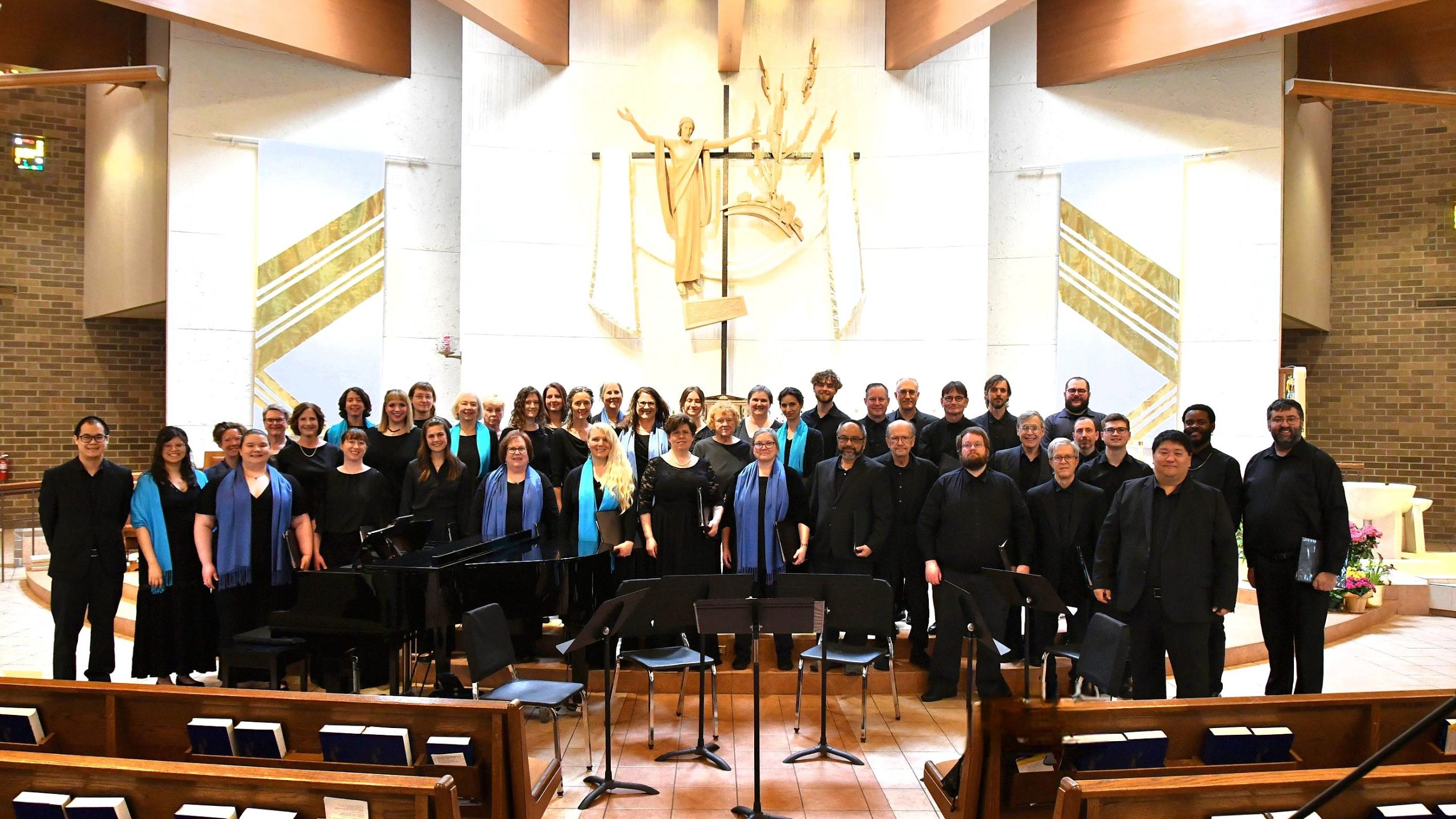
Provided by Bach Chamber Choir
The Bach Chamber Choir has crafted a 2026-27 season of international music it’s calling “Latitude & Longitude: A World in Song.” Jonathan Kim is artistic director of the ensemble, which was founded in 1969. Joshua Chandra serves as collaborative pianist.
Director Kim has selected multicultural repertoire ranging from music written by British composers Edward Elgar (1857-1934) and Gustav Holst (1874-1934) to arrangements based on Hungarian, Mexican and Korean folk songs. The 40-voice choir will sing in English, Spanish, Hungarian, Korean and German, and the program offers a rare opportunity to hear traditional Korean drumming.
The opening concert on Sunday, Oct. 25, is titled “Global Tapestry: Universal Harmonies.” The program opens with Edward Elgar’s “From the Bavarian Highlands,” a set of six songs inspired by Elgar’s 1894 holiday in Upper Bavaria with his wife, Alice. Alice wrote the English lyrics in Bavarian folk song style, recalling scenes including a local hunting festival; a prayer in a country church; a lullaby sung to a child as “Far-away zithers play”; and even a bit of yodeling. Elgar’s melodies “certainly catch a whiff of mountain air in these pieces,” says conductor Howard Arman, who recorded “Highlands” with the Bavarian Radio Choir. “But he wasn’t trying to imitate folk music; he created something new — something entirely his own.”
The second half of the concert includes compositions based on folk songs, sung in their native languages. For several, the significance of the songs goes well beyond a straightforward reading of the text. Take, for instance, “La Martiniana,” arranged by David Conte (b. 1955). The Spanish lyrics were written by Andrés Henestrosa, who was both a poet and a politician representing his native state of Oaxaca in the Mexican legislature. He devoted his career to researching and preserving pre-Columbian Zapotec culture.
“La Martiniana,” which memorializes Henestrosa’s mother, begins, “Little girl, when I die don’t cry over my grave. Sing me a beautiful song, oh mother, sing to me ‘La Sandunga.’” Why “La Sandunga”? It is a popular Oaxacan folk song about the death of a Zapotec woman. The song was used in the mid-19th century to promote the independence of the Isthmus of Tehuantepec from Mexico; it’s the unofficial anthem of the area and is celebrated with an annual festival.
The choir also will sing “Arirang,” a Korean folk song arranged by Hyo-Won Woo (b. 1974). With a history going back more than 600 years and recognized by UNESCO as a part of Korea’s Intangible Cultural Heritage, “Arirang” is much more than the simple love song its lyrics suggest. During the Japanese occupation of Korea between 1910 and 1945, the song was banned because Japanese authorities believed it contributed to “disturbance of public order.” Today, Kim said, “It is almost a national anthem for the movement of Koreans who are reclaiming their heritage.” Percussionists Deokhwan Kim and Juho Kim of the Korean Performing Arts Institute of Chicago will join the choir for this spirited piece, which closes the program.
The Bach Chamber Choir will perform “Global Tapestry” at 2 p.m. Sunday, Oct. 25, at North Shore Congregational Church, 7330 N. Santa Monica Blvd., Fox Point. Tickets are available online.

Existing members must be signed in to see the interactive map. Sign in.
If you think stories like this are important, become a member of Urban Milwaukee and help support real, independent journalism. Plus you get some cool added benefits.


Preview
-
The Relic Ensemble Will Play Peruvian Period Music
 Oct 20th, 2026 by Michael Barndt
-
Boo at the Zoo, Pow Wow at the Baird Center
 Oct 15th, 2026 by Michael Holloway
-
Frankly Music Explores The Soul of a Nation In Season 23 Kickoff
 Sep 26th, 2026 by Martha Brown