
In Wisconsin’s 1st District, After Easy Wins, Steil Faces Tough Challenge
Former corporate lawyer faces attacks on his record by ER nurse Mitchell Berman.
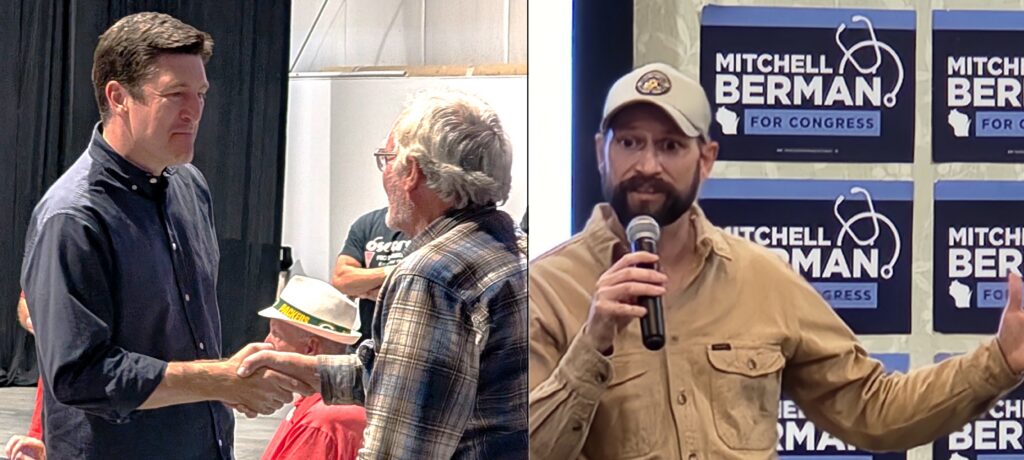
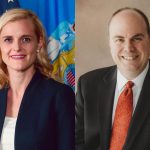
On the left, U.S. Rep Bryan Steil greets a voter at a rally in Waukesha Tuesday, Oct. 13. On the right, Steil’s Democratic challenger, Mitchell Berman, speaks to supporters in Milton, also on Oct 13. (Wisconsin Examiner photo illustration. Steil photo by Baylor Spears, Berman photo by Erik Gunn)
In front of a friendly crowd at a small-town community center last week, Democratic 1st Congressional District candidate Mitchell Berman launched into the pitch he’s made countless times in the last several months.
“Growing up in rural Wisconsin, I never saw running for Congress on my bingo card,” Berman told the room full of supporters in the Rock County community of Milton.
The son of a roofing contractor and a foundry worker, a first-generation college graduate and an emergency room nurse, he wove together stories from his daily work and his own family’s experience grappling with the healthcare system.
Berman ticked off a litany of priorities he’ll pursue in the House of Representatives if he is elected and if Congress returns to a Democratic majority in November. Those included restoring funds cut from federal healthcare programs, supporting union organizing, raising the minimum wage and taking steps to shore up Social Security in the face of threatened cuts in less than a decade.
“Well, we only have 21 days to go. We are in the final stages of this race,” Berman said. “We have always looked at this district as having an opportunity. But right now we’re one point up in the polls.”
A cheer and applause burst from the crowd.
“We are continuing to build momentum,” Berman said. “We are filling rooms like this across the district because people are sick and tired of the partisan politics. They are ready for people to go to Washington and actually get things done.”
Berman is the latest in a string of Democrats who have hoped to turn the 1st CD back to a Democratic seat after decades of Republican representation, including by U.S. Rep. Bryan Steil (R-Janesville) for the last eight years.
Steil is a former corporate lawyer and one-time aide to his popular predecessor, former House Speaker Paul Ryan. When Ryan gave up the seat in 2018 after two decades, Steil easily topped the Democratic challenger, union activist Randy Bryce, whose candidacy drew national attention.
While the margins have narrowed in the ensuing three reelection campaigns, Steil has continued to maintain a solid advantage — leading the Cook Political Report to label the district “likely Republican” for most of the current term, until recently shifting it to the less-definitive “lean Republican.”
In 2026 Democrats are leaning harder into their campaign to wrest the district from its long-time GOP dominance.
Berman’s campaign sees in the polling trends and the Cook Political Report shift evidence that the seat is winnable thie year. The Democratic Congressional Campaign Committee added Wisconsin’s 1st District to a list of races targeted for special attention — and some party spending — this fall.
U.S. Rep Mark Pocan, who has endorsed Berman and spoke at the Milton rally, says this year’s cycle has changed the dynamic of the district, and the race.
In his previous terms, Steil “did his very best to be as flavorless as possible,” Pocan says. “He wasn’t upsetting anyone and he’s a nice guy but he didn’t have positions.”
Steil joins Tiffany rally
Steil’s campaign declined to make him available for an interview despite repeated requests over the last week. The campaign also declined to respond to a list of questions about criticisms that have been lodged against him in the race.
Steil has continued to cultivate an upbeat presence in the district, documented on his office’s social media with visits to local fire departments, healthcare facilities and factories.
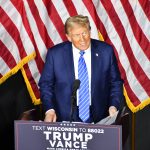
He also joined last week’s Waukesha County rally with Republican candidate for governor Tom Tiffany, sponsored by the GOP-aligned Hunter Nation organization, whose members are lobbying for passage of legislation that would create a controversial sandhill crane hunt.
Taking his turn at the podium, Steil excoriated “how radicalized the Democratic party has become, where they are going after all aspects of our culture” — zeroing in on controversies over whether trans girls should be allowed on girls’ sports teams.
“They want to come after our hunting rights,” Steil said, although not spelling out specifics. Steil also condemned “higher taxes on the Democratic side.”
“This is not your grandfather’s Democratic party anymore,” Steil said. “This is a radicalized, activist socialist party that we are seeing on the left.”
Drilling home the Tiffany rally’s get-out-the vote message, Steil urged the crowd to “run on the assumption that the Democrats are going to vote in full strength in the liberal core cities in Wisconsin.” To counter that, he said, “We need to get that message out to our friends, our family, our neighbors, our coworkers, folks in church on how important this election is and how important it is that people like us get out and vote.”
Pocan interprets the shift in Steil’s profile during his latest term as an attempt to advance within the Republican party. “So instead of quietly rubber stamping Donald Trump, he’s now doing it more vocally,” Pocan says.
Drawing a contrast
While Steil has emphasized an image of Democratic radicalism, Berman’s campaign is drawing a contrast between the Democrat’s working-class background and the Republican incumbent’s history as a corporate lawyer and his voting record in Congress.
“My dad owned a small roofing business that he built from the ground up,” Berman told the Milton crowd. “My mom, she worked long hours in the foundry. But they instilled in me the values of hard work, perseverance, and they taught me to always stick up for the little guy.”
He pointed to a resume that included working part-time at UPS — a union job — to help make ends meet in college, working off student debt after he graduated, and then making a career in healthcare, including 11 years as a Veterans Administration nurse — a job he had to quit because he couldn’t run for political office as a federal employee.
It was at the VA “where I started to recognize that a lot of these issues that we were having didn’t stem from me and my coworkers not having the capability to deliver the type of care that patients deserve,” Berman said. “But we were being handcuffed at the bedside by bad policies that were trickling down from Washington.”
Cuts to the VA health system early in President Donald Trump’s second term exacerbated those issues, he said. “That’s when I realized it was going to take somebody from the ground floor, from the bedside, standing up and fighting for change if we actually wanted to succeed.”
Berman said an insurance company denied his mother a colonoscopy in her late 40s despite a doctor’s recommendation because she wasn’t yet 50. At 49 she got the procedure in an emergency, he said, and was diagnosed with late stage colon cancer.
“So that same insurance company that denied that preventive procedure then began increasing our premiums,” Berman said. “At that point they could no longer afford insurance. Medicaid was the safety net that caught my mom.”
The massive tax and spending bill — the One Big Beautiful Bill Act — that Trump and the Republican majority in Congress enacted in mid-2025, with its cuts amounting to nearly $1 trillion over the next 10 years to Medicaid, along with other provisions, are a key talking point for Berman, who points out that Steil voted for the cuts.
The war in Iran that has driven up gasoline and diesel fuel prices and tariffs that have hobbled farmers also contribute to escalating difficulty for families in the 1st District, the state and across the country, Berman told voters in Milton.
He blames Steil for not voting to block the tariffs or end the war.
“You know, I don’t think it’s too much to ask for all representatives to be in Washington working for us, making Washington work for working people, because that’s what they should be doing,” Berman said. “So, while he’s making it more difficult for us, we’re here at home, struggling, trying to put food on the table, trying to make rent.”
Spotlight on Steil’s record
With increasing tenure, Steil has advanced to new leadership roles, expanding his opportunity to advance his legislative priorities. His higher profile has also made him a bigger target for Democrats.
In January, as chair of the Committee on House Administration, which oversees federal election-related policies, Steil introduced the Make Elections Great Again Act.
Federal law generally delegates election administration to the states, minimizing the authority of the federal government. The Steil legislation would impose new national requirements on states, including mandating photo IDs in all states and setting new restrictions for what qualifies as a legal ID.
Among many other requirements, the bill would also compel states to check every 30 days on whether existing registered voters are still eligible. It would “improve voter confidence, bolster election integrity, and make it easy to vote, but hard to cheat,” Steil said when he introduced the legislation.
The bill has not advanced. The Trump administration and Republican leaders instead focused on the SAVE America Act, which included similar requirements for voter citizenship verification and other limits. The SAVE America Act stalled in the U.S. Senate after passing the House.
Voting rights groups condemned the SAVE Act and also rejected Steil’s bill.
“Election officials — including in Wisconsin — have shown again and again that elections are secure,” said Samuel Liebert, Wisconsin state director for All Voting Is Local, when Steil introduced his measure. “Codifying suspicion into law doesn’t strengthen democracy; it undermines public confidence and puts election workers in harm’s way.”
Oversight, votes and campaign donations
Steil also chairs the House Subcommittee on Digital Assets, Financial Technology, and Artificial Intelligence — a panel that, among other things, oversees the crypto currency industry.
Earlier this month, the crypto PAC Fairshake launched a pro-Steil ad in the Milwaukee media market, reserving $735,914 in airtime for the ad, WisPolitics reported. According to Tech Influence Watch, an independent organization that tracks tech political spending, crypto interests have spent $1.3 million to support Steil in the 2026 election, a mix of campaign donations and independent spending.
In a post on X earlier this month, Steil wrote approvingly of a Commodities Futures Trading Commission announcement of advanced rulemaking on regulations for crypto transactions and crypto asset markets.
Steil “advocates for clear digital asset regulations, emphasizing consumer protection. His support may influence regulatory frameworks moving forward,” reported the outlet Coinfomania, which covers the crypto industry.
Steil’s campaign did not respond to a question about what his call for “clear regulations emphasizing consumer protection” would mean in concrete terms.
He is one of a bipartisan group of 21 lawmakers who cosponsored legislation on regulating the crypto industry that the industry had sought. After passing the House, the bill foundered in the Senate, in part due to Democrats’ objections over President Donald Trump’s profiteering from crypto transactions, HuffPost reported.
At Berman’s Milton rally, however, Pocan suggested the outcome of the proposed legislation would be looser regulation for crypto businesses — “making sure they don’t have enough regulation so they can continue to operate in that dark realm.”
The Milwaukee Courier linked Steil’s votes to campaign donations from interested industries. The bills involved were not enacted. The donors included Blackstone, a corporate owner of rental housing nationwide, which made its contribution around the time Steil voted on bills cutting rental assistance and increasing mortgage fees; banking and credit businesses around the time of a vote to reduce regulations including on banking firms; and mortgage companies around the time of a vote that would have raised fees for borrowers.
Steil’s campaign did not respond to a question about the donations and bills identified in the Courier reports.
The Berman campaign has highlighted the findings. A TV ad also highlighted earlier reporting on Steil’s votes for federal tax breaks for data centers and donations totaling $300,000 to his campaigns from related industries.
Curbing Congressional stock trading
Besides the issue of the crypto industry’s pro-Steil ads, the Berman campaign has targeted the spot’s message, crediting Steil with writing a bill “banning members of Congress from trading stocks.”
A measure Steil authored, the Stop Insider Trading Act, prohibits members of Congress and their families from buying new stocks and hikes the penalties for violating an existing law against failure to disclose stock purchases and insider trading.
After passing the U.S. House, Steil’s bill stalled in the Senate when it failed to clear 60 votes to move forward to a vote in the chamber. In a Facebook post, Steil blamed Democrats for blocking the bill.
But Pocan says that when Steil’s bill was introduced, it effectively halted the momentum for a stronger, bipartisan measure banning members and their families from buying, selling or owning stock.
Their bill was on a trajectory to garner enough support to force a House vote on the measure, Pocan says. That stalled after Steil introduced his bill, which would allow members to continue to own or sell stock and included a provision that allowed them to buy stock if they were reinvesting dividends.
“That is the opposite of a stock ban bill, but he’s taking credit for it,” Pocan told the crowd in Milton.
Even in the face of repeated Democratic disappointments in the district that go back decades, Pocan contends the 2026 race offers a new context. Voters’ disenchantment with Trump is part of that, but Democrats are also betting on a message that highlights the incumbent’s record in terms that resonate with people this year.
“I think those are all stances in a year that corruption is a big issue,” Pocan says. With his status as an outsider rather than a politician, “I just think Mitchell Berman in many ways is the right candidate right now.”
Lilly Goren, a political scientist at Carroll University in Waukesha, sees too many unknowns to offer a clear prediction.
“I think the potential things that could make a difference — and I don’t know if they will — are that the map is slightly different, and whether the Blue Wave, if it comes to pass, will be sufficient to bring an upset to such a consistently Republican district,” Goren says.
There have been anecdotal reports that Trump supporters are ignoring survey calls, which could mean pollsters aren’t hearing from voters who could make a difference in the result.
On the other hand, Trump’s record-low approval ratings “suggest that Republican support is not necessarily out there and enthusiastic,” Goren adds. “The question becomes, also, whether people come out and vote, or whether they stay home.”
Baylor Spears contributed to this report.
In Wisconsin’s 1st District, after easy wins, Steil faces a challenge on his record was originally published by Wisconsin Examiner.