
ACLU Wisconsin Sues Over Warrantless Use of Flock cameras
Seeks state Supreme Court ruling on camera surveillance of all citizens driving their cars.
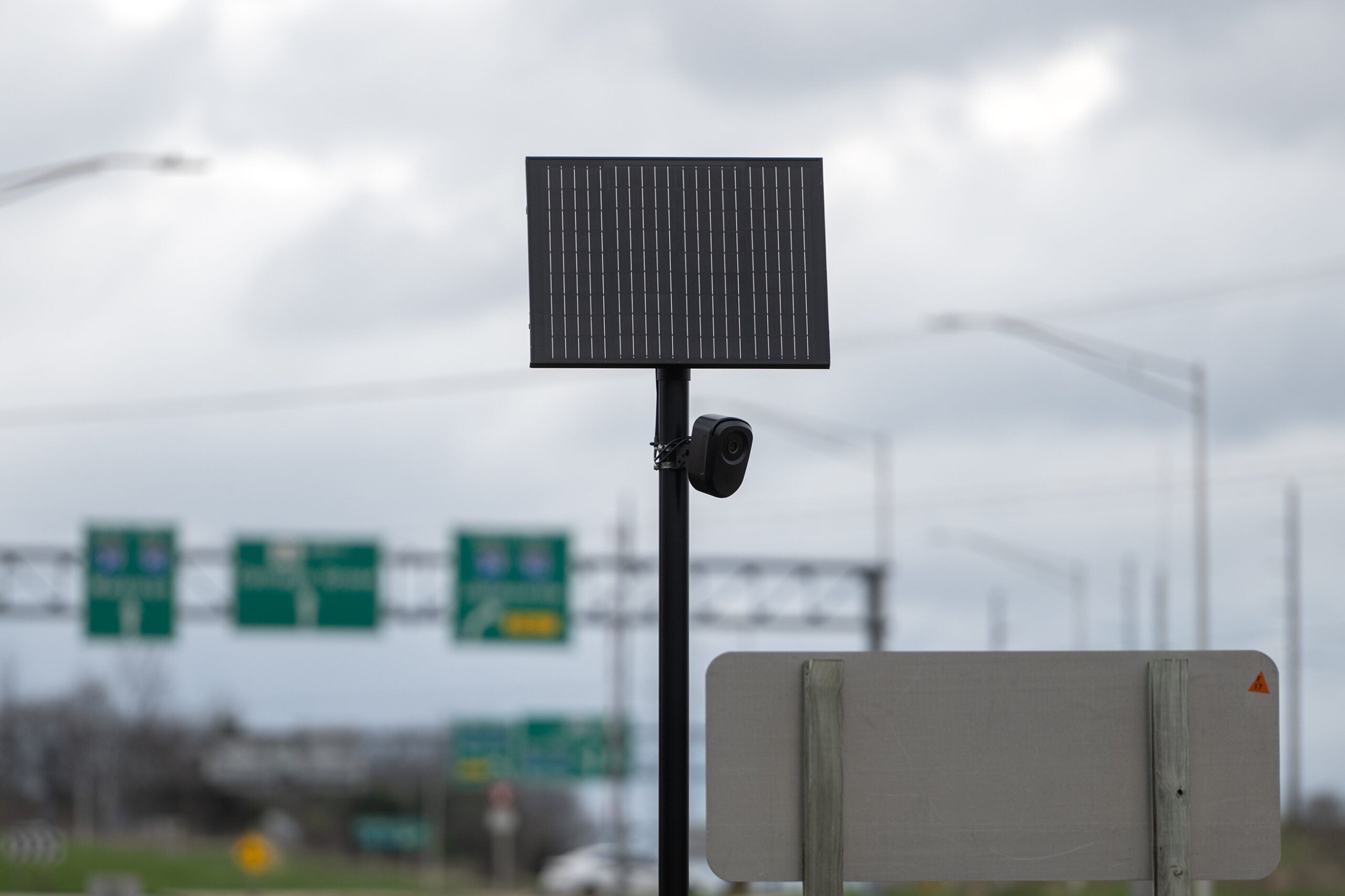
A a Flock Safety camera is aimed toward traffic traveling near a gas station Wednesday, April 15, 2026, in Stoughton, Wis. Angela Major/WPR
The American Civil Liberties Union of Wisconsin is latest group to challenge law enforcement’s use of Automated License Plate Reader cameras.
The group filed a petition last week, asking the Wisconsin Supreme Court to take up its case directly.
Across Wisconsin and the country, police departments use ALPR cameras, which are made by companies including Flock, Axon and Gentec. Those cameras capture images of every vehicle that passes by, including images of license plates, bumper stickers and other identifying features. That data is often shared with other law enforcement agencies.
“Placed along neighborhood streets, highway corridors, and city centers, ALPR cameras create inescapable surveillance chokepoints,” the ACLU’s petition says. “Residents navigating Wisconsin roads cannot conduct ordinary daily errands, attend medical appointments, visit places of worship, attend political protests or meetings, or travel home without being repeatedly photographed and logged into a centralized repository.”
When they access that data without a warrant, the lawsuit alleges, police are executing an illegal search. According to the ACLU, that violates a provision in Wisconsin’s Constitution, which prohibits “unreasonable searches and seizures,” and is nearly identical to the 4th Amendment to the U.S. Constitution.
The ACLU brought its suit on behalf of the Wisconsin Council of Churches. That’s because people have a reasonable expectation of privacy when they’re driving to those places of worship, ACLU attorney Wes Haslam said.
“Churches do things like 12-step recovery programs, for example, Alcoholics Anonymous, Narcotics Anonymous,” Haslam said in an interview with WPR. “They do programs to assist victims of domestic violence. Some churches do political gatherings.”
The suit names the cities of Milwaukee, Green Bay, Racine and Kenosha as defendants. Officials with those cities have not provided comment on the suit in a response to an inquiry from WPR.
Across the state, a slew of enforcement agencies have recently ended their contracts with Flock, the most well-known ALPR provider. Others have pledged to add safeguards to prevent misuse. In Wisconsin, multiples officers have been charged with or convicted of using ALPR databases to stalk their exes and romantic partners.
Across Wisconsin, Haslam says the approach to ALPR use has been varied. That’s part of why he says intervention from Wisconsin’s Supreme Court is needed.
“What we have is … a piecemeal of various solutions throughout the states,” he said. “None of which meet the the constitutional requirements of conducting a search.”
Law enforcement leaders have said that ALPR cameras are invaluable when solving crimes. But Haslam notes that the ACLU’s lawsuit is not seeking to outlaw the cameras entirely.
Rather, the group argues that, if police want to access a driver’s location history through one of those databases, they need to get a judge to sign warrant. Or, if they can’t get a warrant in time, they need to prove that there are emergency “exigent” circumstances at play, the lawsuit argues.
The Wisconsin Institute for Law and Liberty, a conservative group, made similar arguments in a lawsuit that it filed in Waukesha County last month.
WILL is arguing that warrantless searches of Flock and other ALPR databases violate the U.S. Constitution.
ACLU Wisconsin sues over warrantless use of Flock cameras was originally published by Wisconsin Public Radio.
If you think stories like this are important, become a member of Urban Milwaukee and help support real, independent journalism. Plus you get some cool added benefits.