Why Most Wisconsin Write-In Votes Do Not Count
That includes votes for Francesca Hong, who is asking voters not to write her name in.
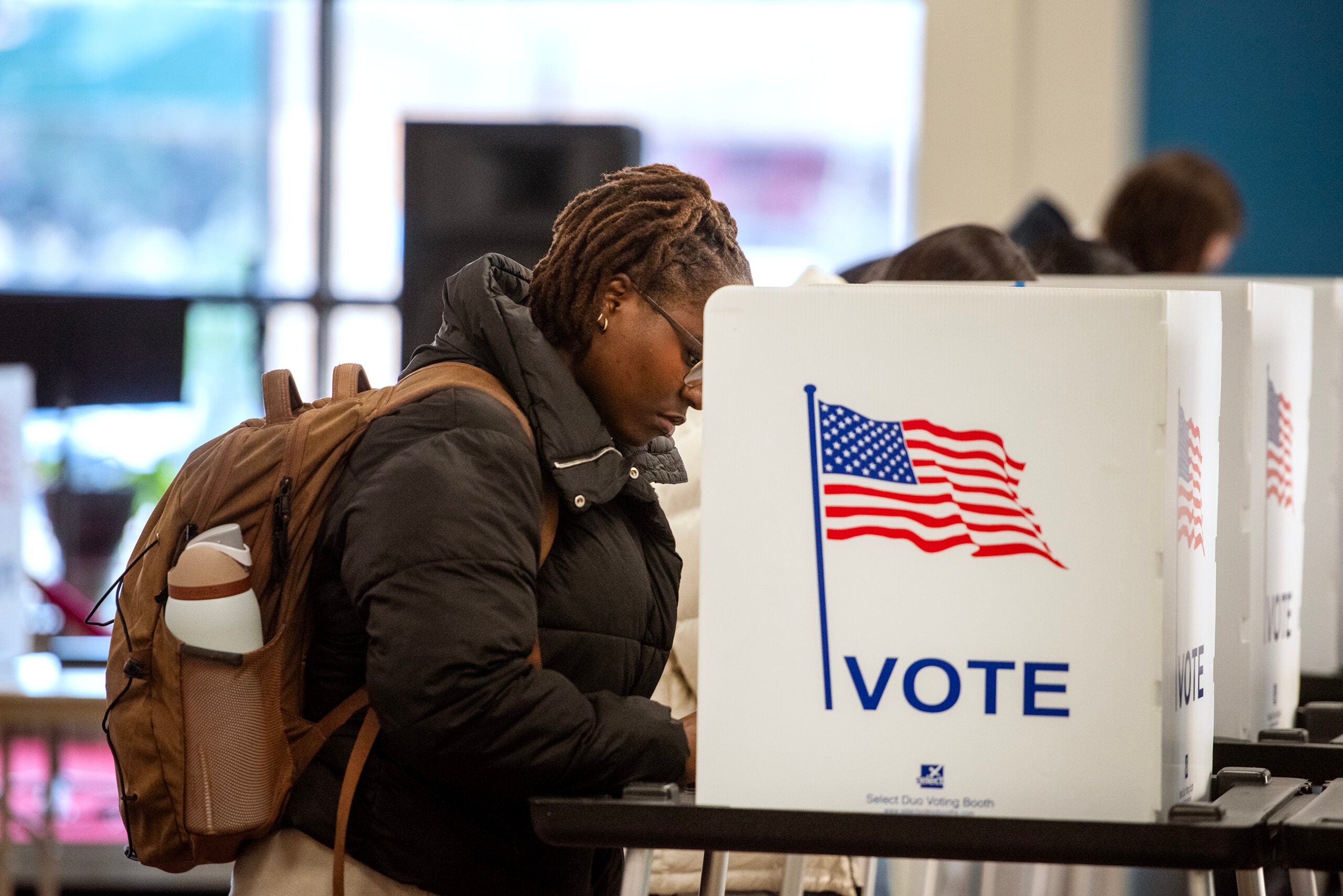
Madison residents fill out ballots Tuesday, April 1, 2025, at the Madison Senior Center in Madison, Wis. Angela Major/WPR
“Please do not write me in or vote for me.”
That’s what Francesca Hong told a room full of supporters over the weekend, during the first stop of a statewide tour backing Democratic candidates.
The state representative from Madison fell about 3,700 votes short of winning the Democratic nomination for governor in August. Ultimately losing by less than half of a percentage point, she conceded quickly to Milwaukee County Executive David Crowley.
If her impassioned supporters are disappointed, Hong told those assembled at a Milwaukee brewery on Saturday, they can channel their feelings toward trying to flip the state Legislature from Republican control to Democratic.
But any write-in vote for Hong would be moot. For more than a decade, Wisconsin state law has required that any write-in candidate be officially registered, unless there are no other certified candidates on the ballot.
That means if voters aren’t excited about Crowley, or his Republican opponent, U.S. Rep. Tom Tiffany, filling in the blank for Mickey Mouse instead won’t count.
“If you vote for other candidates throughout the rest of your ballot, that would still be counted, but the vote for Mickey Mouse just wouldn’t be tallied, if Mickey Mouse has not registered,” said Bryna Godar, a staff attorney with the State Democracy Research Initiative at the University of Wisconsin Law School.
To run as a write-in candidate in Wisconsin, a person must file a registration statement by noon the Friday before the election.
That’s the process that Nathan Kalmoe has followed in his write-in campaign against Senate Minority Leader Dianne Hesselbein, D-Middleton. Kalmoe registered in late August — two weeks after the primary election — and formally announced earlier this month that he’d challenge her on a progressive platform.
On his campaign website, Kalmoe argues that his candidacy is an answer to noncompetitive primaries.
Rep. Sylvia Ortiz-Velez, a Milwaukee Democrat who fell out with her party and subsequently lost a primary challenge in August, has said she’ll mount a write-in bid for her seat.
And at least one person, Milwaukee pastor David King, is formally registered as a write-in option for governor.
According to Godar, write-in campaigns are extra challenging, because a person doesn’t just have to earn a checked box on a ballot. Their voters also need to remember them well enough to write out their names.
Still, the process offers an option to candidates who don’t clear other hurdles, like party primaries or even circulating nomination papers.
“To the extent that a candidate has difficulty getting on the ballot via those processes, write-in options allow candidates an alternative pathway,” Godar said. “It can benefit people who don’t have the same connections to existing political parties, or people who lost in party nomination processes and nevertheless want to run the general election ballot.”
Wisconsin used to require all write-in votes to be counted. In 2014, then-Gov. Scott Walker signed a bill to end that requirement, and implement a registration requirement for write-ins instead.
And Wisconsin isn’t the only state that restricts write-in campaigns. Some states bar them outright while others require write-in candidates to hit a minimum threshold of votes to win.
Sometimes write-in candidates do win. U.S. Sen. Lisa Murkowski, R-Alaska, was an incumbent when she lost a primary campaign during the Tea Party wave of 2010. She mounted a write-in campaign in the general election, and retained her Senate seat.
Anyone hoping Hong could have a shot at doing the same saw those hopes put to rest on Saturday.
“I’m no longer a candidate,” Hong said.
In Wisconsin elections, write-ins are frequently wrong was originally published by Wisconsin Public Radio.
If you think stories like this are important, become a member of Urban Milwaukee and help support real, independent journalism. Plus you get some cool added benefits.
Political Contributions Tracker
Displaying political contributions between people mentioned in this story. Learn more.