Nefertari African Dance Company Performs at Holiday Folk Fair
The fair's theme this year is traditional dance. Milwaukee dance group has done this since 1968.
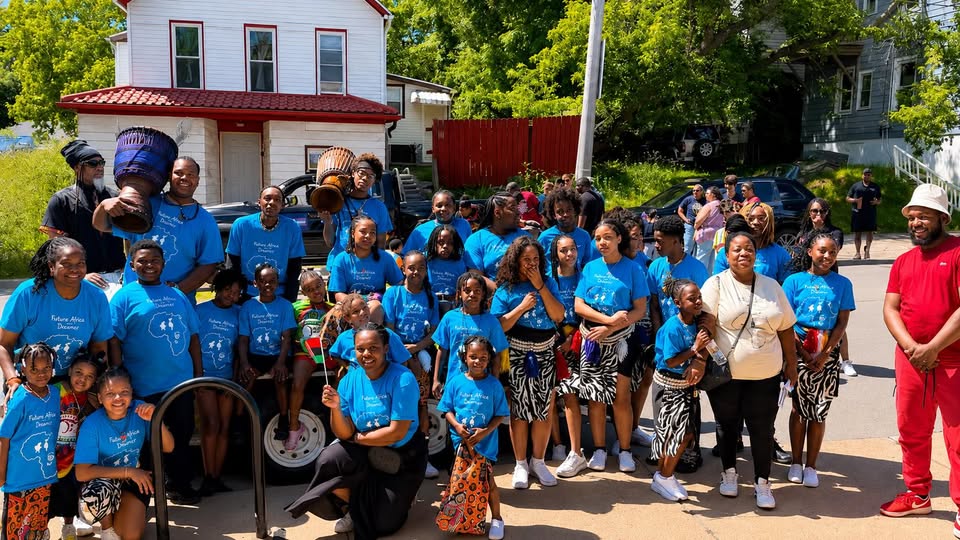
Nefertari African Dance Company. Courtesy of Nefertari African Dance Company.
Inside the Wisconsin Black Historical Society, West African drumming patterns echo across the walls. Marilynn Douglas greets a few youngsters and helps them tie on their dancing skirts. Once secured, the young dancers hurry excitedly to the center of the room and wait for their rehearsal to begin.
Douglas is the director of Nefertari African Dance Company, one of Milwaukee’s oldest cultural dance institutions. On this day, the company was rehearsing for its upcoming performances at the Holiday Folk Fair, which returns Nov. 20-22 at the Wisconsin State Fair Park Exposition Center in West Allis.
In its 83rd year, Holiday Folk Fair is a multicultural, multiethnic festival of food, art, music and dance that celebrates the diversity of Milwaukee and surrounding communities. More than 90 participating groups and individuals will represent 53 cultures at this year’s festival, which has been dedicated to traditional dance.
“I am excited the fair’s theme is dance this year,” Douglas said. “Everybody should come experience it.”
For Douglas, dance carries stories across generations. Through gestures, steps, sequences and rhythms, Nefertari passes history along in two major ways, she explained.
First, Nefertari performs traditional dances that originated in West African cultures, particularly those rooted in present-day Senegal, Mali and Guinea. Douglas described how these dances have survived not only the passage of time but also the transatlantic slave trade, hundreds of years of Africans’ enslavement in America, Reconstruction, Jim Crow, the civil rights era and attempts to erase Black Americans’ connections to their African ancestry.
“I always try to explain to young people that dance has a history,” Douglas said. “I ask, ‘Where do you think dance came from?'”
Though Nefertari has developed some original compositions, much of its repertoire consists of traditional dances associated with harvests, celebrations and, sometimes, enslavement.
“In the slave dance, we start out slow and you see the struggle. We’re stepping with our hands behind our backs and it marks the enslavement period,” Douglas said. “But then we get to the fast part, and that’s the celebration of when slaves were freed. The hope is that it says something, that it shares a story.”
“If you have it up here,” Douglas continued, gesturing to her head, “nobody can take it away from you.”
The company’s second way of preserving history, as Douglas explained, has less to do with dances’ origins and more to do with their place in Milwaukee.
Nefertari started as a group in 1968 at North Division High School, which Douglas joined as a student there. In 1997, she took over the group and opened it up for dancers across the community.
“Some of the dances they’re doing now are the same dances I did when I was in high school. If I meet somebody who was in the group in the ’70s and say, ‘We are going to do Greetings,’ they would remember it and know the steps,” she said.
Teaching the same dances throughout time, she said, has created lasting connections between generations of Nefertari dancers, and roots them to a cultural tradition that has taken on a distinct shape in Milwaukee.
“It’s about being able to share with younger people,” she said, noting that many of Nefertari’s adult instructors today joined the company as youth dancers.
Together, Nefertari’s youth and adult groups are scheduled to perform more than 15 times throughout the Holiday Folk Fair weekend. A full schedule can be found on the fair’s website.
Holiday Folk Fair is put on by the International Institute of Wisconsin (IIW), a Milwaukee nonprofit dedicated to promoting mutual understanding across cultures and ethnicities. Alongside the Holiday Folk Fair, it offers interpretation, naturalization and other community services.
In a conversation with Urban Milwaukee, Paul Trebian, IIW’s president and CEO, echoed Douglas’ thoughts on traditional dance:
“One of the fun things about Holiday Folk Fair is you get to see one dance after another. When you see the differences between them, you see identity, and that’s the real key because that’s where mutual understanding begins,” he said. “Everybody has a unique identity, and dance is able to tell that story.”
Learn more about the Holiday Folk Fair and admission on its website.
Existing members must be signed in to see the interactive map. Sign in.
If you think stories like this are important, become a member of Urban Milwaukee and help support real, independent journalism. Plus you get some cool added benefits.


Dance
-
Concert Features Unique Pairing of Brazilian Music and Dance
 May 26th, 2026 by Martha Brown
-
Fred Astaire Moving Its Studio
 Jan 7th, 2026 by Jeramey Jannene
-
Milwaukee Ballet Brings Back Orchestra
 Jul 14th, 2025 by Bruce Murphy