

Report Says No State Tax On Tips, Overtime Would Cost Wisconsin $2.7 Billion
Forward Analytics finds big savings for workers, big revenue loss for the state over 10 years.

U.S Flag and money. (Pexels license)
Eliminating state income tax on tips and overtime could cost Wisconsin $2.7 billion in revenue over the next decade, with eligible workers seeing an equal savings over the same period.
That’s according to a new report from Forward Analytics, the research arm of the Wisconsin Counties Association.
President Donald Trump campaigned on eliminating taxes on tips and overtime in 2024. The One Big Beautiful Bill Act, which passed last year, included federal income tax deductions on tips and overtime.
Gov. Tony Evers vetoed a no-tax-on-tips proposal in April because it would’ve expired in 2028, arguing for permanent tax relief. In May, a proposal permanently eliminating state income taxes on tips and overtime was included in a failed bipartisan budget surplus bill, negotiated by Evers and top Republican lawmakers.
Both candidates running for governor, Republican U.S. Rep. Tom Tiffany and Democratic Milwaukee County Executive David Crowley, have said they would sign a bill to end state income tax on tips and overtime if one reached their desk.
The report from Forward Analytics aimed to explore the potential impacts of such a policy becoming law.
The report found the proposal would reduce state income taxes for Wisconsin workers who earn tips and overtime by a combined $2.76 billion between 2028 and 2037 — meaning the state would lose that amount in revenue over that period.
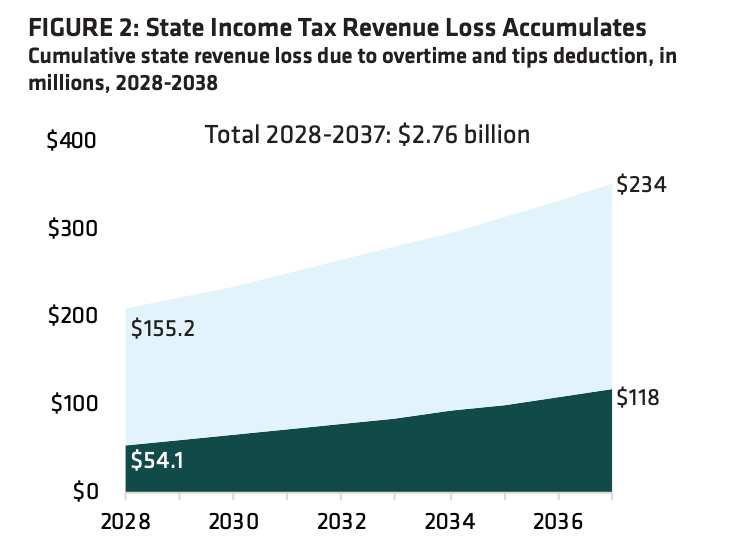
This graphic shows projected state revenue losses from a policy eliminating state income taxes on overtime and tips. Courtesy of Forward Analytics
“It is a real cost to the state — alongside a real benefit to workers — and it should be something that’s considered when this policy is being debated,” said Jacob Anderson, a research analyst for Forward Analytics. “If we do this, yes, we are benefiting a lot of workers, but at the same time we’re creating a cost for the state over the next decade.”
According to the report, under the proposal, two workers earning the same total amount of money could pay different amounts in taxes.
A waiter and an administrative assistant may both earn $40,000 in income annually. But the report notes that if $15,000 of the waiter’s income comes from tips, it would significantly reduce that worker’s tax burden.
Anderson also said the policy wouldn’t result in a weekly benefit to a tipped or overtime worker’s paycheck. Rather, they’d see the benefit when they file taxes.
“When you’re going back at the end of the year filing your taxes, you’re essentially able to eliminate that overtime income from your taxable income,” Anderson said.
The policy’s tax benefit would also vary across income levels, with workers making between $85,000 and $132,000 annually seeing the biggest benefit, according to the report.
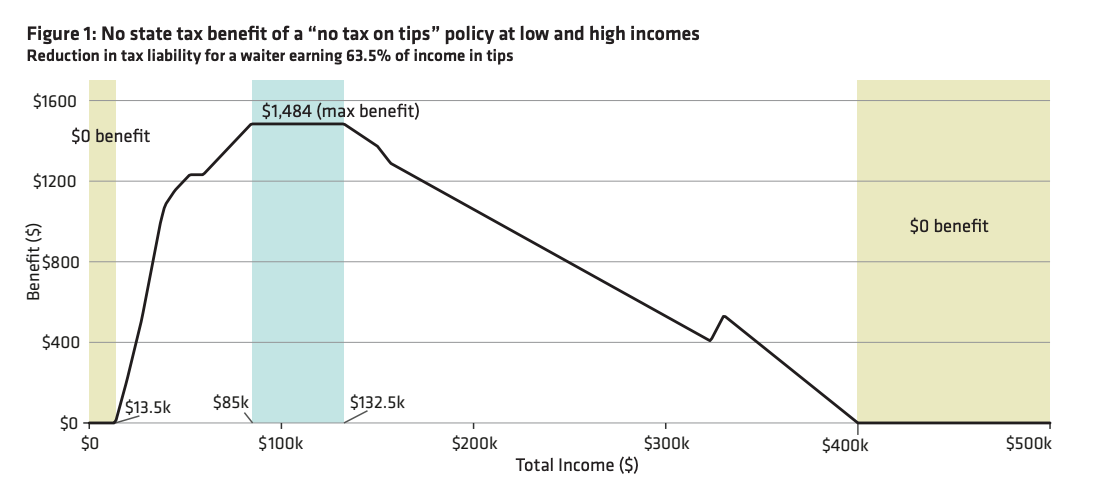
This graphic shows how the benefit of a policy eliminating taxes on tips and overtime changes at different income levels. Courtesy of Forward Analytics
Both candidates for governor signal support for no tax on tips
While the major party candidates have vastly different views on how to address affordability and a host of other issues, they have both expressed support for eliminating taxes on tips and overtime.
In a statement, Tiffany said state government continues spending money while working families struggle to make ends meet. With a roughly $3 billion budget surplus, he says the state can afford to let workers save $2.7 billion over the next decade.
“More money in workers’ pockets means more money spent in our communities, supporting small businesses and growing Wisconsin’s economy,” Tiffany said in a statement. “Wisconsin workers need bigger paychecks, not bigger government.”
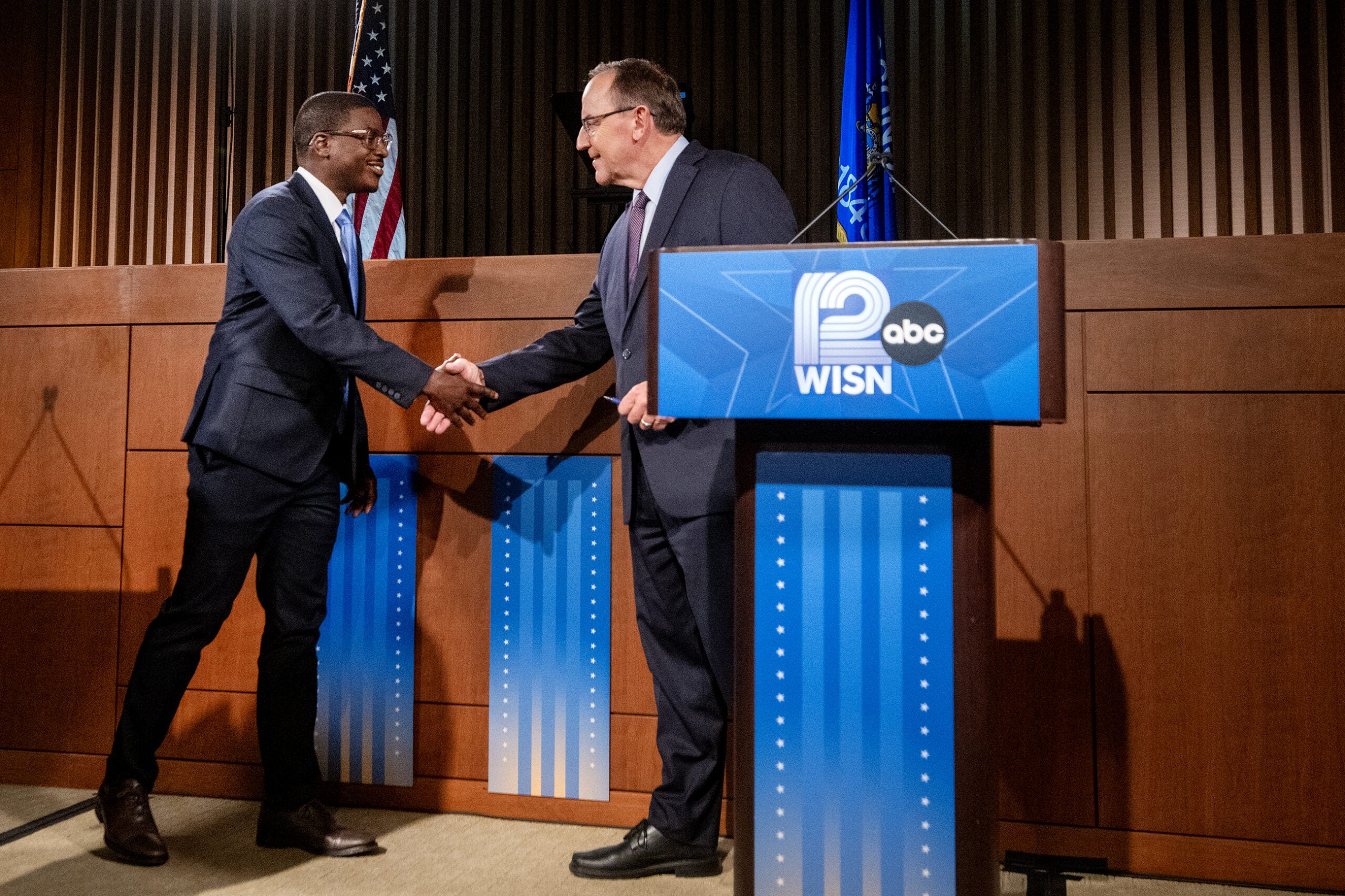
Wisconsin gubernatorial candidates Milwaukee County Executive David Crowley, left, and U.S. Rep. Tom Tiffany, right, shake hands before debating Wednesday, Oct. 21, 2026, at Marquette University Law School’s Eckstein Hall in Milwaukee, Wis. Angela Major/WPR
A spokesperson for the Crowley campaign said the Democratic candidate would sign a bill to end taxes on tips and overtime if such a bill passed the state legislature.
“Working people should keep more of what they earn,” the Crowley campaign spokesperson said. “As governor, he’ll fight for tax relief that treats every working family fairly, while Congressman Tom Tiffany’s tax plan would mean either deep cuts to our schools and services or nearly tripling the state sales tax.”
Anderson, the Forward Analytics researcher, said both candidates throwing support behind the policy underscores its popularity with voters across party lines.
“Even though it came up in the last year and a half, it has really caught the public’s eye and is something that people generally support,” he said.
Eliminating state income tax on tips, overtime could cost Wisconsin $2.7B over a decade was originally published by Wisconsin Public Radio.
Political Contributions Tracker
Displaying political contributions between people mentioned in this story. Learn more.