Fake Car Dealership Scams Rising in Wisconsin
Scammers lure luxury and sports car enthusiasts to cloned car dealership websites.

Row of cars (CC0 1.0 Universal).
The next time you browse for a car online, double check that you’re actually viewing a legitimate dealership. Online scammers are now duplicating car dealership websites, and unsuspecting buyers can find themselves paying a hefty price tag for a car they’ll never drive.
Last year alone, Wisconsinites were cheated out of $1.2 million in these scams. Michelle Reinen and Michael Domke of the Wisconsin Department of Agriculture, Trade and Consumer Protection spoke with WPR’s Lee Rayburn about how consumers can protect themselves against a new wave of online scams called “dealer cloning.”
On the surface, these fake sites can look identical to real ones. But scammers don’t stop there, Domke said, “They’re using the same promotions. They’re using that real business’s name, their signage, their address. Sometimes using, you know, AI to generate images that look like the dealership or cars.” Scammers even use social media ads to route would-be buyers to their bogus websites.
The scams often seem to target vintage, sports or luxury vehicles over large franchise brands. And they hook potential buyers by posting prices that are well below the car’s fair market value, Domke said.
The too-good-to-be-true prices should be the first red flag. Domke advises shoppers to look out for a few other signs the deal might not be legit.
- Longstanding businesses have a web history. Does the site or social media page look too new? Are there posts from months or years past?
- Legitimate businesses have a professional web presence. Does the site or social media page have errors in spelling, sometimes even of the dealership’s name?
Fraud is on the rise
Data from the Federal Trade Commission show that in 2025, people lost a staggering $2.1 billion in online scams originating on social media. People reported clicking on ads that sent them to unfamiliar websites or cloned websites offering steep discounts. From 2020 to 2025, losses from social media driven scams increased eightfold according to the FTC.
The proliferation of AI has made it easy for hucksters to quickly create fake websites and social media pages, and people across the age spectrum can be tricked. The FTC’s Consumer Sentinel Network found that people aged 20-29 reported losing money to fraud more often than people aged 70-79. However, the older age group handed over larger sums, on average.
Sometimes the people behind the scam are themselves being taken advantage of. Earlier this year, the BBC reported on large-scale scam centers in South East Asia where people unable to find work in their home countries were lured by phony job ads, trafficked to centers and forced to become scammers too.
The cost to Wisconsinites
This year alone, the Wisconsin Department of Transportation has received at least one complaint of a fake online car dealership every week. Some people have lost over $100,000 trying to buy luxury or vintage cars from fake dealerships, Domke said.
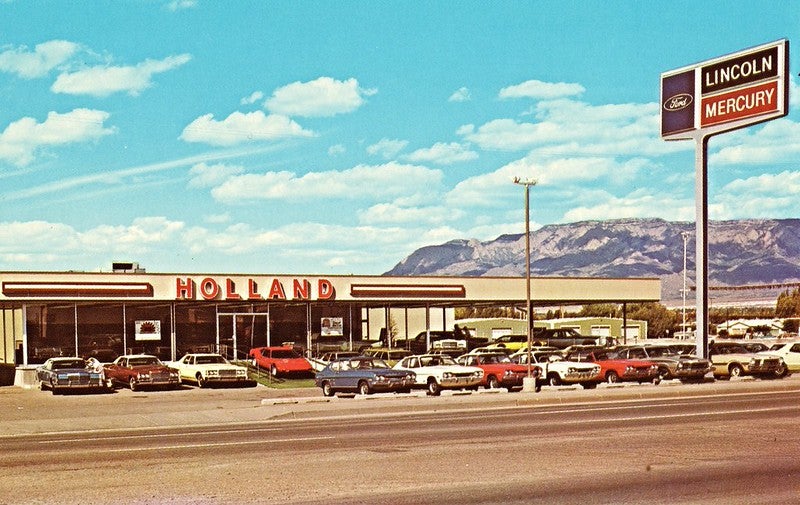
Photo of the Holland Lincoln-Mercury dealership in Albuquerque NM, from 1973. Alden Jewell/Flickr (CC BY 2.0).
Reinen offered a few practical tips on how to avoid getting scammed by a dealership clone.
- Research your dealership ahead of time. Find their contact information and verify it.
- Never pay with a gift card, cryptocurrency or any method of payment that can’t be reversed.
- Verify that the dealership you’re looking at has licenses and titles in the state of Wisconsin. Then, verify those licenses and titles because scammers can make fake documents.
- Get it in writing. If the dealer refuses to offer you a contract, ask why. In Wisconsin, a Motor Vehicle Purchase Contract is required by law.
“Let there be red flags. Use some skepticism when you are in search. You know if it’s too good to be true. Let those spidey senses activate, and allow yourself the ability to question something,” Reinen said.
File a complaint
If you’ve been scammed, don’t stay in the dark, advised Reinen. Though it might be embarrassing to admit to the situation, you can help other consumers out by filing a complaint.
“We need to know how they paid, how much they paid, when they paid, where they paid and to whom if they can,” Reinen said.
A complaint will trigger an investigation by DATCP and the FBI and, hopefully, shut down the fraudulent site.
At the end of the day, Domke said that the best way to buy a car is still in person while looking at an actual vehicle.
To learn more about consumer protections or report a scam, visit DATCP’s Bureau of Consumer Protection website or call their hotline, 1-800-422-7128.
Fake car dealership scams rising in Wisconsin was originally published by Wisconsin Public Radio.
If you think stories like this are important, become a member of Urban Milwaukee and help support real, independent journalism. Plus you get some cool added benefits.