

Not Just Governor, Three Constitutional Amendments on The Ballot
GOP-led amendments will appear on ballots alongside partisan races.
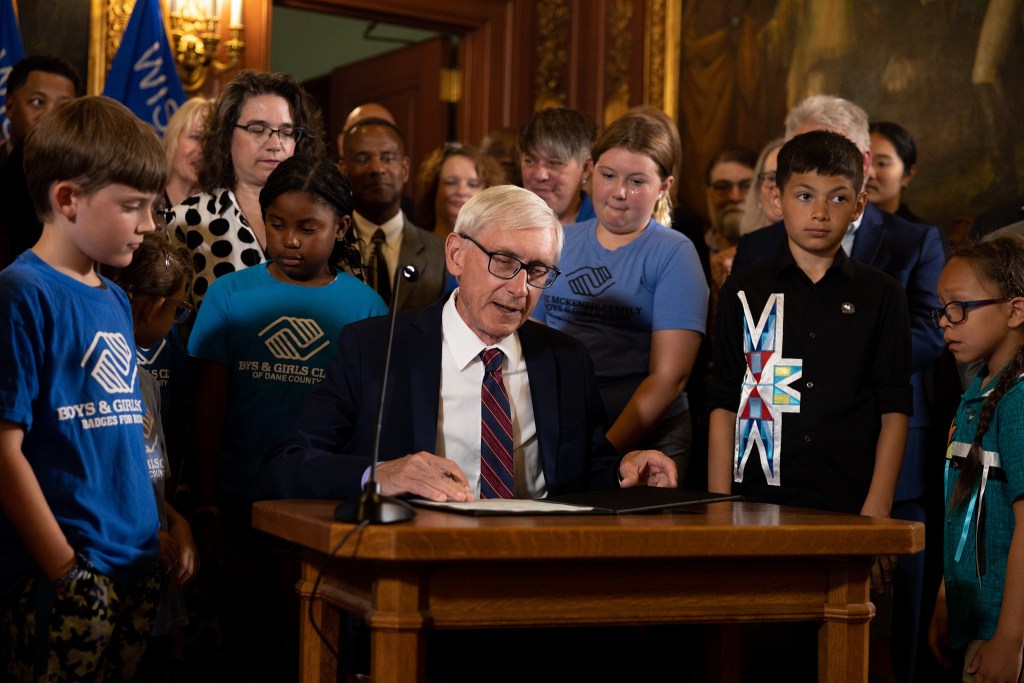
Gov. Tony Evers is photographed signing the Wisconsin 2023-25 biennial budget on July 5, 2023, in the Wisconsin State Capitol building in Madison, Wis. (Drake White-Bergey / Wisconsin Watch)
Wisconsin voters on Nov. 3 will decide whether to approve three Republican-led state constitutional amendments that GOP lawmakers say would limit government overreach and Democrats describe as unnecessary.
The general election referendums would limit the governor’s use of the partial veto to raise taxes and fees, prevent the government from stopping religious gatherings during future emergencies and ban discrimination by state and local governments and public education institutions.
To amend the state constitution, lawmakers must sign off on identical language during two consecutive two-year legislative sessions before putting the question to voters. Under Democratic Gov. Tony Evers, Republicans have often turned to constitutional amendments as a way to advance their priorities without confronting the governor’s veto pen.
State Rep. Dave Murphy, R-Hortonville, who led the ballot question on prohibiting government discrimination, said he sees a distinction between the types of issues addressed through legislation, which could reach the governor’s desk, and “fundamental” questions brought in a constitutional amendment. Murphy, who was first elected to the Assembly in 2012, is not running for reelection this year.
“There are lots of things that I would do that Tony Evers would have vetoed. There are very few things that I would bring as a constitutional amendment to try to get around that,” Murphy said. “I’m glad that I can take this to the people for a signing rather than to Gov. Evers because I think the people will support this, but I think he maybe would have vetoed it.”
Including the three this year, GOP lawmakers have put 12 constitutional amendments to voters during Evers’ nearly eight years as governor. Voters have approved seven of them. Nearly 63% of voters approved the most recent referendum in April 2025 on requiring photo identification to vote.
Evers is encouraging voters to reject the Republican-led referendums.
“I think they’re all frankly off base, and I’m encouraging people to say no,” Evers told Wisconsin Watch. “I mean, if we want our legislators to look like that and do stupid things like that, then vote yes. But I think most people are fine with what it is.”
Milwaukee County executive and Democratic gubernatorial nominee David Crowley is also splashing cold water on the amendments. He said he would “absolutely not” vote for the governor’s veto amendment. He said the DEI amendment threatens government efforts to help older adults, veterans, people with disabilities and “individuals of all races, genders and religions.” On the amendment to allow religious gatherings during emergencies, he said “under extreme circumstances, leaders must make difficult decisions for the greater good of our state.”
“But let’s be clear: This is a bad faith argument from far-right extremists to distract from the fact they caused an affordability crisis for Wisconsin families,” Crowley said.
Republican nominee and U.S. Rep. Tom Tiffany said he plans to support all three questions.
“No governor, Republican or Democrat, should have unchecked power to raise taxes or fees with the stroke of a pen, especially for the next 400 years. While David Crowley wants to preserve that power, I support ending it regardless of who holds the governor’s office,” Tiffany said. “I also support constitutional protections for places of worship. Our constitutional rights should never be conditional, and our government should never be allowed to discriminate.”
Here is what you need to know about the three constitutional amendments.
The governor’s partial veto
Text on the ballot: “Shall section 10 (1) (c) of article V of the constitution be amended to prohibit the governor, in exercising his or her partial veto authority, from creating or increasing or authorizing the creation or increase of any tax or fee?”
The background: Republicans advanced this question as a constitutional amendment after Evers used his veto pen during the 2023-25 budget to raise school revenue limits by $325 a year for the next 400 years. The Wisconsin Supreme Court’s liberal majority in 2025 sided with Evers in a lawsuit that challenged the constitutionality of the 400-year veto.
Sen. Chris Kapenga, R-Delafield, who led the ballot question through the legislative process, said voter approval will reset the separation of powers between the Legislature, the executive branch and the courts.
“It’s always about separation of powers,” Kapenga said in an interview. “This is a mechanism put in place specifically for this reason, so that if we feel that those other two branches breached their authority in that separation, we say we’re going to go directly to the people and let them make that decision.”
Republicans running for office this year have claimed incorrectly that the veto raises property taxes for the next 400 years. The veto actually raises annual revenue limits, not a specific tax or fee.
The revenue limit caps how much school districts can receive in revenue from a combination of general state aid and property taxes. Local school boards decide how much property taxes to raise and are not required to levy the maximum allowed amount, though historically most have. Under the revenue limit, the Legislature and governor can reduce local property taxes by significantly increasing general state aid to schools, but that rarely happens.
What groups support it? Groups including the Wisconsin Property Taxpayers, Americans for Prosperity, the Wisconsin Realtors Association and Wisconsin Manufacturers and Commerce all registered in support of the resolution during the 2023 and 2025 legislative sessions.
Who is opposed? State lobbying records show the Wisconsin Education Association Council, the state’s largest teachers union, and the League of Women Voters registered in opposition to the question.
Crowley told reporters in August he would be willing to use the partial veto if elected.
“They want to eliminate the power of the governor, and so what they’re trying to do is just rig the system,” Crowley said. “This is not about rigging the system. This is about listening directly to constituents and figuring out how we can deliver on their behalf.”
Gathering in places of worship during emergencies
Text on the ballot: “Shall section 18 of article I of the constitution, which deals with religious liberty, be amended to prohibit the state or a political subdivision of the state from ordering the closure of, or forbidding gatherings in, places of worship in response to a state of emergency, including a public health emergency?”
The background: When the COVID-19 pandemic hit Wisconsin, the Evers administration’s “Safer at Home” order limited what businesses and activities could remain open in an effort to curb the spread of the virus.
The order limited religious gatherings to fewer than 10 people. It categorized liquor stores as essential businesses allowed to remain open, which state Rep. Ron Tusler, R-Harrison, said sent a bad message to Wisconsinites.
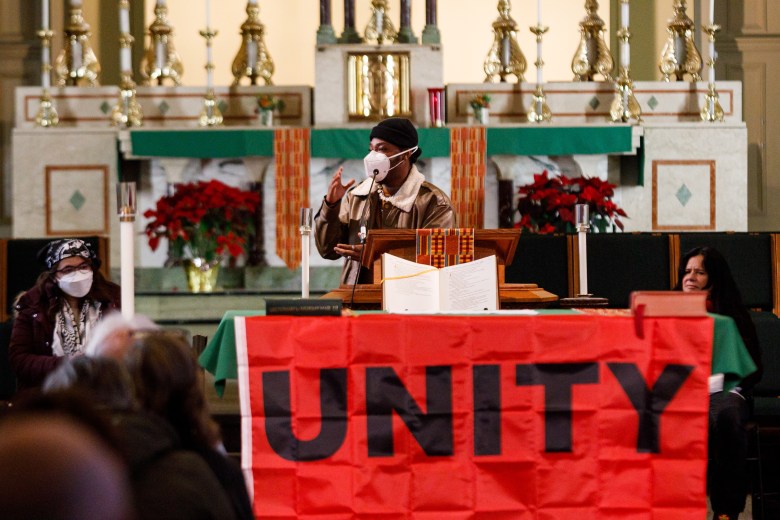
A constitutional amendment on the November ballot would prohibit the government from closing churches during health emergencies. Yante Turner of Sun-Seeker MKE is shown speaking to the crowd as dozens of community members attended the 24th annual Martin Luther King Jr. Justice Program on Jan. 20, 2025, at the St. Francis of Assisi Church in Milwaukee. (Julius Shieh / Milwaukee Neighborhood News Service)
The Wisconsin Supreme Court in 2020, under a conservative majority at the time, struck down Evers’ “Safer at Home” order. But Tusler, who led the question during the 2025 session, said a constitutional amendment would prevent the government from controlling people’s access to places of faith in the future.
“Many of us, you know, dedicate our entire lives toward our faith, and in a situation like COVID, there’s a lot of fear, and there’s a lot of uncomfort, and there’s a lot of strangeness, things we’re not used to,” Tusler told Wisconsin Watch. “When we’re in a situation like that, people of faith need their faith at that moment more than ever, and to deprive people of it is a particularly heinous sin that our government shouldn’t commit.”
What groups support it? Pro-Life Wisconsin and Wisconsin Family Action, Inc. registered in support of the ballot language during the 2023 and 2025 legislative sessions.
Who is opposed? The League of Women Voters opposed the constitutional amendment, according to state lobbying records.
“Closing places of worship does not prevent any person from worshipping God, as such worship can and is practiced on an individual basis in one’s own home during an emergency,” the organization wrote.
Prohibiting DEI in government
Text on the ballot: “Shall section 27 of article I of the constitution be created to prohibit governmental entities in the state from discriminating against, or granting preferential treatment to, any individual or group on the basis of race, sex, color, ethnicity, or national origin in public employment, public education, public contracting, or public administration?”
The background: Murphy, the Republican state representative from Hortonville, said the idea for the ballot question stemmed from the U.S. Supreme Court’s 2023 ruling in Students for Fair Admissions vs. Harvard, which found considering race in admissions to higher education institutions is unconstitutional. Murphy said he saw an opportunity for a broader question that covered discrimination and giving preferential treatment to certain populations across all levels of government and education.
“I’m just very much of a supporter of the idea that when people put government in charge of something, they want it to be the best it can be,” Murphy said. “One of the ways to do that is not to put a bunch of things that get in the way of picking based on merit.”
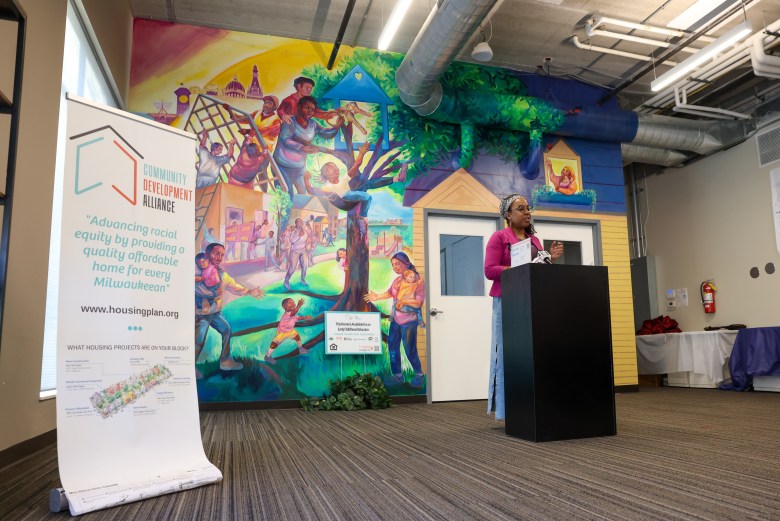
Republicans are supporting a constitutional amendment on the November ballot that would end government programs with preferential treatment by race. In this photo, Tia Richardson speaks in front of the mural she painted during a mural unveiling at the Community Development Alliance on Feb. 18, 2026, in Milwaukee. (Jonathan Aguilar / Milwaukee Neighborhood News Service / CatchLight Local)
Responding to criticism that the referendum could end programs that help disadvantaged groups in Wisconsin, Murphy said governments and schools can continue those efforts as long as everyone is able to participate.
“People that are disadvantaged are disadvantaged,” Murphy said. “If programs help disadvantaged people, then they will still be helped. It can’t exclude anybody.”
What groups support it? The Wisconsin Institute for Law and Liberty won a case before the state Supreme Court, which found an undergraduate financial aid program for minority students was unconstitutional.
The case was decided unanimously by the liberal-controlled court, though liberal justices broke from conservatives to point out that the country’s history of racial discrimination continues to be entrenched in societal outcomes. The case advanced to the court as lawmakers were considering putting the constitutional amendment before voters.
The conservative law firm registered in support for the constitutional amendment during the legislative process. WILL Managing Vice President and Deputy Counsel Dan Lennington said the referendum will “end discriminatory DEI programs throughout Wisconsin and ensure our government serves all citizens equally.”
Who is opposed? Opponents have claimed the amendment would limit opportunities for disadvantaged groups. The American Civil Liberties Union of Wisconsin and the League of Women Voters opposed the constitutional amendment during the legislative process, according to lobbying records.
The League said the amendment intends “to weaken the individual rights and liberties of Americans who have been guaranteed protection by the Civil Rights laws of our country.”
This article first appeared on Wisconsin Watch and is republished here under a Creative Commons Attribution-NoDerivatives 4.0 International License.
Political Contributions Tracker
Displaying political contributions between people mentioned in this story. Learn more.





















thank you for this article. as per usual, the referenda are worded in an interesting way.. these are difficult questions and i’m wondering if a constitutional amendment, now, is the way to deal with it. i think government entities should be able to make decisions regarding the congregation of people during a pandemic. this amendment seems to say okay, you all can gather and infect each other and everyone else that comes in contact with you. well, i think the community is more important in that situation then a person’s right to gather in a religious building. all tough issues.