
Will Congress’ Big Housing Bill Really Help Wisconsin’s Shortage?
State needs up to 140,000 new homes by 2030, but analysts see only incremental gains from the bill.
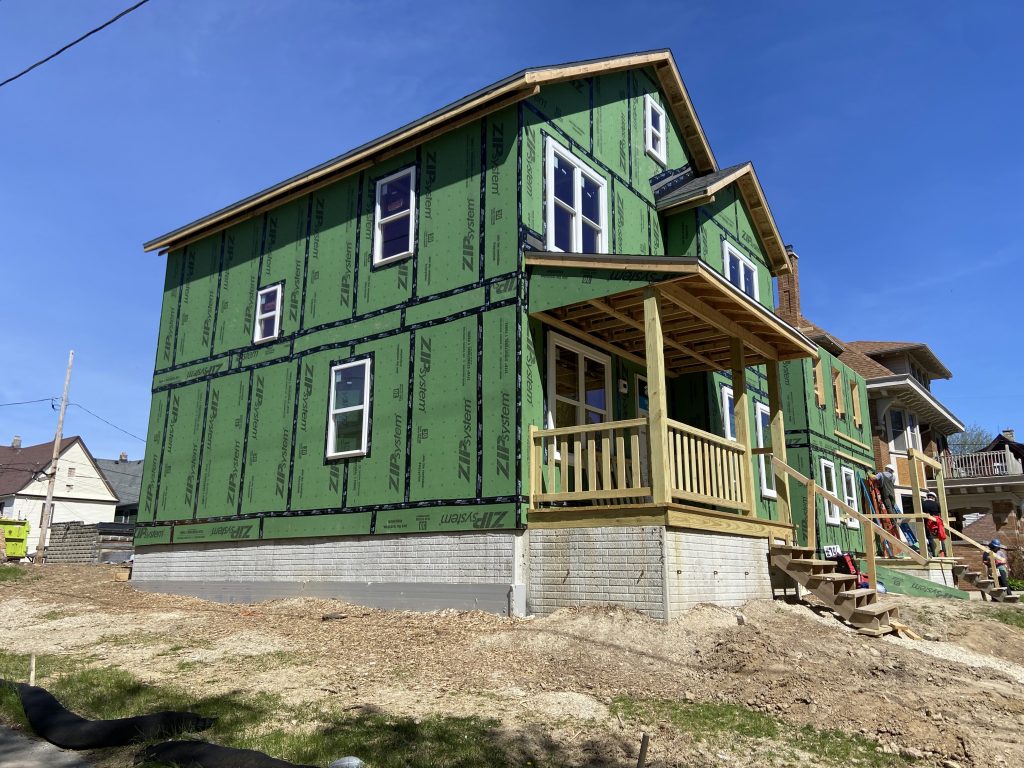
Home construction by Habitat for Humanity on N. 23rd St. Photo taken May 14 by Graham Kilmer.
A sweeping bipartisan housing bill passed through Congress earlier this week, with provisions aimed at making it easier to build new houses and rezone communities.
The bill comes as Wisconsin faces a shortage of tens of thousands of units of housing. And unusually, the bill united Democratic and Republican members of Wisconsin’s congressional delegation in the final vote.
It faces a hurdle as President Donald Trump withholds his signature — and housing experts caution that, even if it eventually becomes law, by itself it won’t solve the U.S. housing crisis.
“I think absolutely it’s a big deal,” said Paul Aylesworth, director of affordable and sustainable housing development at the University of Wisconsin-Madison, on “Wisconsin Today.” “This is a bill that’s trying to crack the big nut that is increasing housing supply in our state, which most folks agree is the main contributor to the high housing costs.”
“Stimulating housing demand is a tricky thing, because it often takes a lot of small fixes, and often takes a lot of time, and this bill certainly is reflective of that,” Aylesworth added.
Research varies about the scale of Wisconsin’s housing shortage, but according to the think tank Forward Analytics, the state needs somewhere between 84,000 and 140,000 new units of housing by 2030 to keep up with population demand.
“Which is a short time period,” said Kurt Paulsen, who teaches and researches affordable housing finance and policy at UW-Madison.
The “21st Century Road to Housing Act” seeks to address those gaps nationwide. Composed of dozens of proposals knit together, the package includes loosening of regulations on building new houses, incentives to communities that change their zoning and land-use policies and a series of pilot projects that would shift how development projects are financed.
The bill also includes a ban on private institutions buying more than 350 single-family homes, with a goal of using more of the housing stock as housing, rather than as investments.
But none of these components on their own will do much, and even pieced together, change will be incremental, said Paulsen.
“It walks this very bipartisan line by providing a study here, a report there, a recommendation, an incentive, a little pilot project,” he said. “Taken together cumulatively, if implemented, (it) could possibly bend the supply and cost curves in the long run. But no single provision in this bill is going to do too much on its own.”
But that’s how major policy passes, he added.
“It shows you that in order to get bipartisan consensus, you kind of have to water it down to the lowest common denominator — which is not a bad thing,” he said. “This is how legislation works. It’s a bipartisan reflection that we have a huge housing affordability crisis and we need to do something about it.”
Politics of bipartisan bill upended by Trump
Indeed, despite overwhelming support for the bill, the politics behind it are complicated. Of Wisconsin’s delegation, U.S. Sen. Ron Johnson was the lone no vote. He was one of just five senators to vote against it.
And all Wisconsin U.S. representatives, Republican and Democrat, voted for the package — except for Rep. Tom Tiffany, the leading Republican candidate for governor, who did not vote. In all, just 32 representatives voted against the bill, all Republicans.
But the many years of vote-whipping efforts to find bipartisan consensus on the issue were stalled when Trump on Wednesday abruptly canceled a planned signing ceremony for the bill. He said he will not sign the legislation until Congress passes a controversial package he is backing, the SAVE Act, which would impose restrictions on mail-in voting and voter registration.
As of Thursday, Trump had reportedly not been formally presented with the bill. That presentation would kick off a 10-day timeline, during which Trump would need to sign it or veto it. If he takes no action in that window, it would pass without his signature.
If Trump does veto it, the bill would return to Congress for an override. And while it passed with a veto-proof majority the first time, Republicans this time around would need to decide whether to publicly buck Trump on the issue.
Housing is largely a local issue
While the bill is among the most significant pieces of federal housing legislation in years, many of its mechanisms are highly localized. That’s because housing regulation — things like zoning, land use and permitting — is largely an issue of local control, according to Stephen Malpezzi, a professor emeritus in the Department of Real Estate in the Wisconsin School of Business.
“Most of the action in improving housing supply, and hence affordability, will remain at the local level,” he wrote in an email.
Advocates say that the legislation does little for the lowest-income households, most of whom are renters and face increased barriers to housing stability. Instead, it’s aimed at driving new housing creation, particularly in the wake of the Great Recession, which slowed new construction for years.
Where new construction is the goal, experts say, those units won’t be accessible to low-income people. They also point out that construction costs are also unlikely to be alleviated by these kinds of policy changes, at a time that material prices are especially high.
Sweeping federal housing bill won’t be a magic bullet for Wisconsin affordability, experts say was originally published by Wisconsin Public Radio.
If you think stories like this are important, become a member of Urban Milwaukee and help support real, independent journalism. Plus you get some cool added benefits.