WisconsinEye CEO Jon Henkes Hoping for Legislative Special Session
Without action he warns of 'possible permanent shutdown of the network.'
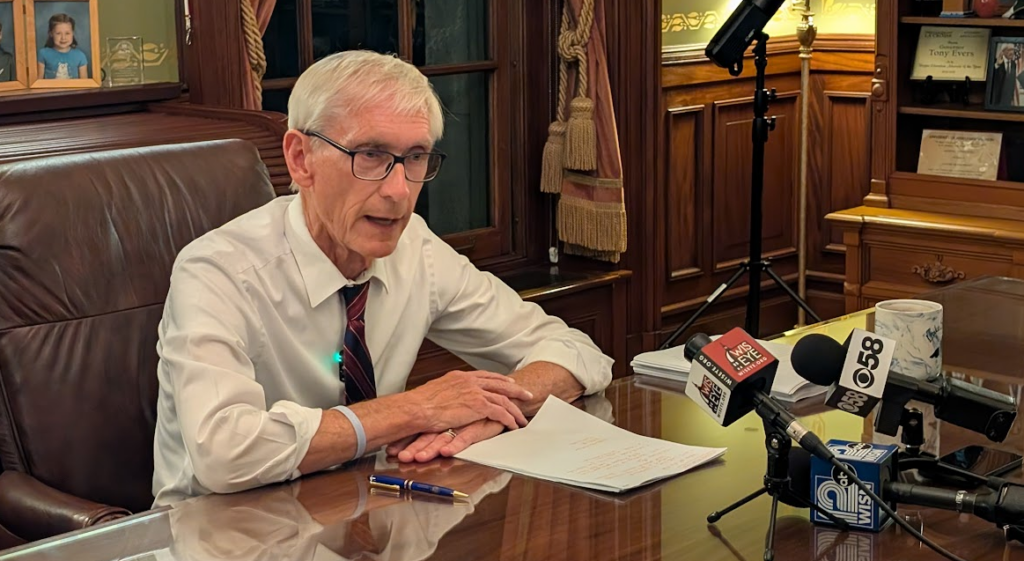
“Bringing their good intentions across the finish line can still happen but it’s going to take an extraordinary or special session of the legislature, and the support of Governor Evers to come through for us,” WisconsinEye President Jon Henkes said. WisconsinEye was among the news organizations covering Gov. Tony Evers when he signed the 2025-27 state budget in July. (Photo by Baylor Spears/Wisconsin Examiner)
Wisconsin lawmakers agree on the importance of providing public access to state government meetings through livestreams, but they finished their work this year without an agreement on a short-term or long-term plan to fund the Capitol livestreaming service WisconsinEye. The nonprofit organization faces an uncertain financial future. Jon Henkes, president and CEO of WisEye, now says the organization is hoping for further action in a special or extraordinary session.
Henkes, who was not available for an interview, said in a statement that WisconsinEye “remains hopeful of some level of support from the state, but right now that’s a big question given both houses of the legislature adjourned without agreement on a plan to be supportive.”
WisconsinEye was started as an independent nonprofit in 2007 to livestream and archive government meetings and legislative sessions. For most of its history, WisconsinEye has relied on donations and is run independently from the state Legislature, but since the pandemic, Henkes has said the organization has had trouble raising funds for its operations. It has a budget of about $900,000 a year.
The organization, which shut down it operations and pulled its archives offline for several weeks in December and January, turned to state lawmakers for help at the end of last year, but the path to a solution reached a halt as lawmakers deadlocked on what to do.
On March 23, WisconsinEye released a public statement saying that “access to the WisconsinEye archive may be curtailed to facilitate needed preparations for a possible permanent shutdown of the network.” It also said on its GoFundMe that “coverage of upcoming events is being reduced due to funding constraints.”
“There was much hope as leadership of both parties and houses energetically expressed support and gratitude for the mission and work of WisconsinEye,” Henkes wrote in his April message. “Bringing their good intentions across the finish line can still happen but it’s going to take an extraordinary or special session of the legislature, and the support of Governor Evers to come through for us. And by ‘us’ I mean all citizens who care about transparency and access, and who appreciate the network’s 18 years of exceptional public service.”
Gov. Tony Evers and lawmakers have talked previously about taking additional action in a special or extraordinary session this year, but those discussions have been centered around property tax relief and school funding, not WisconsinEye. It’s unclear whether additional issues could become wrapped up in those negotiations, though one Republican leader previously said a bill would focus on taxes and wouldn’t be a “mini budget.”
There were two legislative efforts to address the crisis at WisconsinEye leading up to the final regular floor session this year.
A bipartisan Assembly bill would have placed $10 million, which had already been set aside in the form of matching funds for WisconsinEye, in a trust fund to accrue interest that the nonprofit would then be able to use for its operational costs, without the requirement that it match those funds. WisconsinEye still would have needed to raise a few hundred thousand dollars each year for its operations.
The Wisconsin Senate passed a separate bill, which was amended to provide some stopgap funding for WisconsinEye and would have opened up the possibility of replacing WisconsinEye with another streaming service, launching a “request for proposals” (RFP) — or a bidding process for the job of livestreaming government proceedings.
Neither body took up the other body’s proposal.
Other states have also navigated conflict over livestreaming government proceedings, including disagreements over funding, what is shown and how it is shown, according to a 2016 Stateline report. There are two legislative chambers in the U.S. that don’t livestream floor proceedings: the North Carolina Senate and the Missouri Senate. The latter has been debating allowing video livestreaming.
It’s unclear whether there is enough of an appetite from Wisconsin lawmakers for further action this year to ensure continued streaming into the future. The state Legislature finished its regular session business this year in March, meaning that action from lawmakers will be limited for the remainder of the year as many turn their attention to running for reelection.
Sen. Mark Spreitzer (D-Beloit), who voted for the state Senate proposal, told the Wisconsin Examiner in an interview that he is open to exploring a long-term solution over the next nine months.
“We’re not back in session till 2027 and so the opportunity really to implement the results of an RFP wouldn’t really be there, and so I have no objection to spending the next nine months exploring, what might be out there to provide this service through an RFP,” Spreitzer said, “The real question… is what are we doing between now and next January? Are we providing some funding to keep WisconsinEye going?”
Spreitzer voted for the Senate proposal after amendments addressed some of his key concerns including providing stopgap funding to WisconsinEye to get it through the next year and the inclusion of some accountability measures. He said the sense of urgency to come to a solution faded after the session came to an end.
“I mean to be really blunt there was a sense that perhaps the only reason that they got stopgap funding for the month of February was that [Assembly] Speaker [Robin] Vos wanted his farewell address to be on WisconsinEye,” Spreitzer said. “I think once the legislators, who want their own speeches to be televised aren’t in session anymore, even though there are other government meetings, I think the urgency does fade, which is a problem.”
Assembly Speaker Robin Vos (R-Rochester), who is retiring at the end of his term, said at a WisPolitics event last month that he prefers having an independent organization responsible and that he thinks the Assembly proposal is the better option.
“The idea that we’re going to go out to bid for a money-losing proposition that requires you to cover every hearing for free… doesn’t seem to be one that’s workable,” Vos said. “I don’t think that’s going to happen, but I don’t know.”
The bill’s lead author Sen. Julian Bradley (R-New Berlin) did not respond to requests for an interview. Spreitzer noted that Bradley has said he is open to providing state funding, but it would be open to those submitting proposals to speak to that.
Senate Majority Leader Devin LeMahieu (R-Oostburg), who is also retiring at the end of his term, also did not respond to a request for comment.
Vos said that while he hopes WisconsinEye will “survive” and “make it to the next budget cycle,” after that, “frankly, I’m gone” next session.
Spreitzer said there should be some urgency attached to the recent update provided on March 23 from WisconsinEye. He said maintaining access to the archives is important, even when there are fewer legislative meetings going on to be livestreamed.
“People don’t just want to watch meetings live. They want to be able to go back and see what happens,” Spreitzer said. “There’s an election coming up, and voters want to see what their elected officials were actually saying and doing during the session, and to not be able to go back and do that and have that accountability, I think would be a huge loss.”
In February, the Joint Committee on Legislative Organization voted to provide $50,000 to WisconsinEye to resume coverage, but the organization hasn’t received additional funds in the following months despite saying that it needed them.
Spreitzer said he would support providing a “minimal monthly amount” to WisconsinEye to keep operations going until at least 2027, whether that has to be done through committee action or through a special session as suggested by WisEye. The Senate bill would have set aside over $580,000 and, if approved by JFC, the money would be paid out to WisconsinEye in monthly payments of about $48,000.
“That’s, you know, obviously up to Republican leadership,” Spreitzer added.
Spreitzer said taking the time to think through the long-term solutions is important, especially with a number of concerns about WisconsinEye and how it has navigated its advocacy efforts. He noted that the organization appears incapable of doing the fundraising that it has done in the past.
“I did not feel like they were as up front or direct in communicating about that as they should have been, particularly with the Legislature,” Spreitzer said, adding that he received no direct communication and only saw press releases and messages posted to WisconsinEye’s website. “I just found that really inappropriate. We’d go on their website and we’d see — “if we don’t get money by this date we’re going to turn the archives off,” then they did turn the archives off. It felt more like extortion than somebody actually coming forward and saying, ‘Here’s our business model, here’s what’s not working, please help us.’ I just am not a big fan of handing a check to somebody that acts that way, at least not without accountability measures to make sure that doesn’t happen in the future.”
Ahead of the temporary shutdown in December and January, WisconsinEye said it had raised no funds for the year. It then launched a GoFundMe for small-dollar donations, and as of April 13, the nonprofit’s GoFundMe has raised over $94,000. The amount is less than half of WisEye’s $250,000 goal, which would cover three months of its operating budget.
The organization has said that coupled with a “solid state commitment” that raising the additional funds for its operating budget would be achievable, and donors view that approach with “confidence.”
While he wants to see a short-term solution to continue access, Spreitzer said he thinks the conversation about a long-term solution should not be led by LeMahieu or Vos.
“Speaker Vos and Majority Leader LeMahieu are not going to be the two people in charge next session,” Spreitzer said, adding they have been “running point” on the issue and were incapable of finding an agreement. “We should let them provide some gap funding to get us to next year, but I don’t see any reason why they should be part of a long-term conversation here when they’re not going to be here next year.”
Democratic Gov. Tony Evers, who would need to sign off on any legislation, is also on his way out of office at the end of his term.
Spreitzer said he thought his bill was a good starting point for the conversation, but he didn’t know whether he would pursue creating a state-run public affairs network next year. Democrats are putting their efforts towards winning the Senate majority, which would put them in a better position to shape legislation.
“That’s a conversation we would all need to have as Democrats if we’re in the majority again — whether you do something fully public, or you do something that is more similar to the Assembly bill this session [and] WisconsinEye makes some changes to its board and how it operates in order to get public money,” Spreitzer said.
WisconsinEye President and CEO John Henkes hoping for special or extraordinary session action was originally published by Wisconsin Examiner.