
EMN Offers Rare Opportunity to Hear Early Chinese Music
Music From China uses ancient instruments, creating music 'to reach the heavens.'
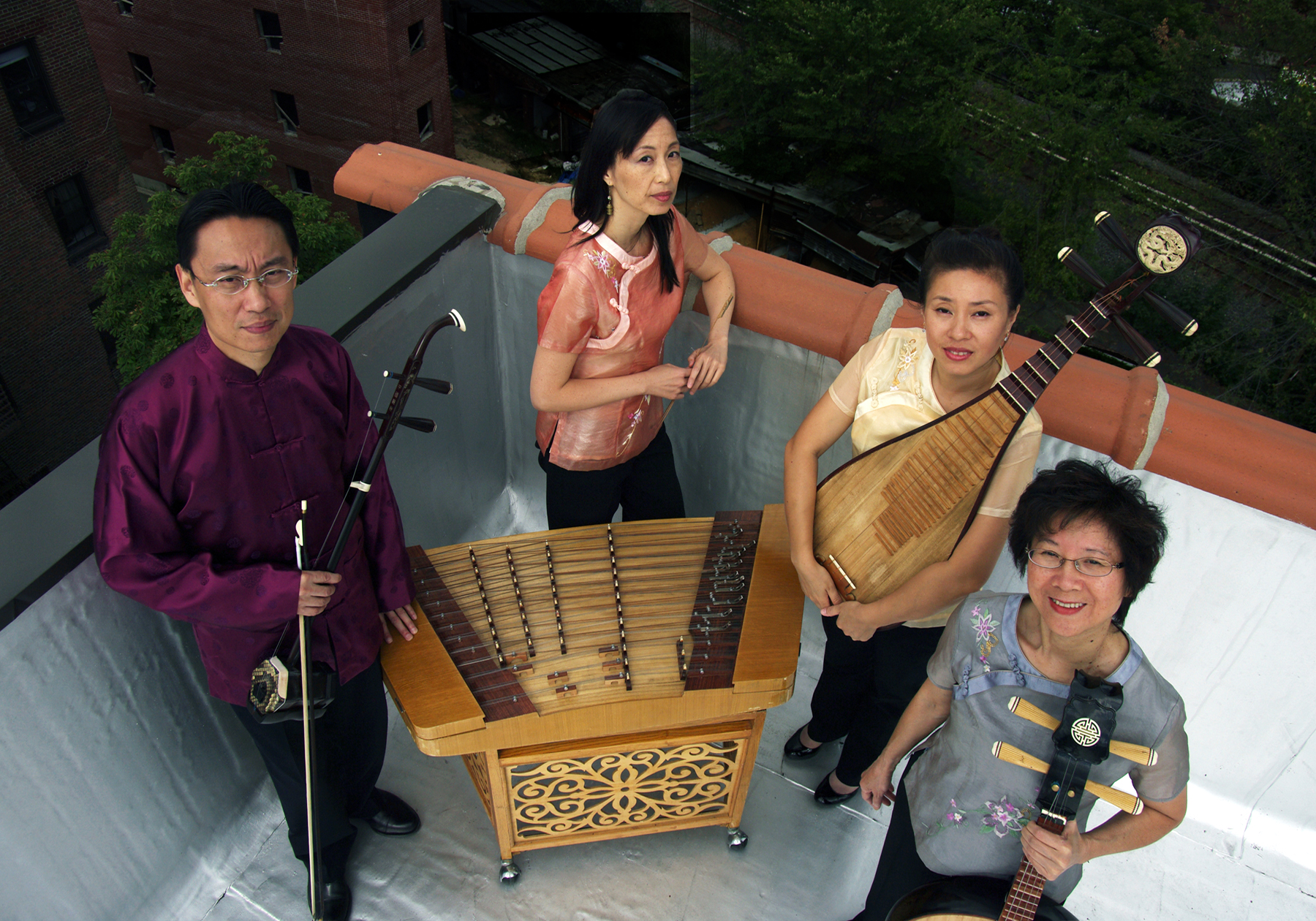
Music From China. Photo courtesy of Early Music Now.
Nearly 40 years ago, archaeologists working at a burial site in Henan Province in central China made an astounding discovery: fragments of flutes carved from the wing bones of red-crowned cranes. The cache, including six instruments that were playable and capable of producing a scale, has been dated to 6000 B.C.
The dozens of Chinese instruments developed over the ensuing millennia have been grouped into eight categories, named for the material used to make them. (Bird bones are not one of the groups.) On Saturday, April 18, the Music From China ensemble will perform on instruments categorized as silk (traditionally twisted to make strings for instruments that can be plucked or bowed) and bamboo (used for woodwinds). The concert, titled Silk and Bamboo and presented by Early Music Now, features masterworks from the Chinese classical and folk repertoire. It’s the first EMN program of Chinese music in more than 30 years and exemplifies the organization’s tagline, “Across Borders, Across Time,” according to EMN executive and artistic director Charles Grosz.
Music From China, based in New York, preserves Chinese cultural heritage through concerts, artistic residencies and education programs. The artists who will appear in Milwaukee all studied at major Chinese conservatories before relocating to the United States. Performing are artistic director Wang Guowei (playing erhu and gaohu); Yu Chen (dizi); Sun Li (pipa), and Zhou Jing (zheng).
The audience will hear one “bamboo” and four “silk” instruments. The dizi, a bamboo flute held horizontally, has a vibrating membrane that produces a bright, buzzing resonance. The erhu and gaohu each have two strings and are played with a bow; the gaohu has a higher pitch. The zheng is a zither with 21 plucked strings. The main melody is generally played with the right hand and accompanied by the left. The pipa is a lute with a pear-shaped body and plucked strings. It was introduced to China by Central Asian travelers along the Silk Road.
Musicologist Joanna Lee explains that “in Chinese society, people believed that they could play music and reach the heavens. They could also play music and move the earth.” The characteristic five-note scale conveys natural beauty and simplicity. Rhythms are often linked to the rain, the wind and cycles of nature. Musical rituals were established for the imperial court, marriage, funerals, and religious festivals.
Several pieces on the program express the harmonious elements of Chinese classical music. For example, “Three Variations on Plum Blossoms,” an ancient zither piece adapted for dizi, is inspired by the elegance of plum blossoms in the winter cold. “Fisherman’s Night Song,” a duet for erhu and zheng, portrays a beautiful twilight as fishermen return to the shore.
Chinese music also tells more dramatic stories. “Ambush on Ten Sides” is an emotionally rich, technically demanding piece for pipa that depicts a battle in the 3rd century B.C. Ethnomusicologist Mario Frisca describes changing dynamics that build “a sense of agitation and fear…transitions from joy into despair…rage and delicacy.”
Silk and Bamboo, a rare opportunity to hear live Chinese music in Milwaukee, will be performed at 5 p.m. Saturday, April 18, at St. Paul’s Episcopal Church, 914 E. Knapp St. Advance tickets are available online.

Existing members must be signed in to see the interactive map. Sign in.
If you think stories like this are important, become a member of Urban Milwaukee and help support real, independent journalism. Plus you get some cool added benefits.