Wisconsin Takes Millions in Federal Aid from Foster Kids and Parents
Both parties have called for ending 'orphan tax.' Why hasn't it happened?

Wisconsin agencies collect child support and federal benefits of children in foster care. State lawmakers haven’t restricted these practices, which face growing criticism, despite bipartisan support. Cash. (CC0 Creative Commons).
Who foots the bill when a child is placed in foster care? In Wisconsin, it’s sometimes parents — and even the kids themselves.
Like many U.S. states, Wisconsin allows child welfare departments to take federal benefits intended for children who have a disability or a deceased parent. The practice means some foster children are paying for care the state is legally required to provide — care others get for free.
The state also bills some parents for foster care — even when parents are trying to bring their kids home and struggling to make ends meet.
In Wisconsin alone, these practices cost foster children and their parents more than $10 million a year.
Now those approaches are facing growing criticism for prolonging family separation and depriving kids and families of much-needed resources. In response, some states have enacted bans or restrictions, but Wisconsin hasn’t — despite bipartisan support.
Advocates decry ‘orphan tax’
Wisconsin child welfare authorities take around $3 million each year in Social Security benefits intended for foster children, according to the state’s Department of Children and Families.
Five years ago, nearly every U.S. state was taking these payments, NPR and The Marshall Project reported in 2021. Their investigation focused on Alaska, where hundreds of former foster youth sued in 2014, demanding the state return their money. Many didn’t know about the payments — often several hundred dollars a month — until they were about to age out of the foster care system, reporters found. On their own, those young people often struggled to afford things like rent, car payments and college tuition.
“We get out and we don’t have anybody or anything. This is exactly what survivor benefits are for,” one former foster youth told NPR and The Marshall Project.
Last year, Alaska’s Supreme Court ruled in their favor. It ordered the state to notify foster children if they are entitled to Social Security benefits and allow eligible children to choose to have their benefits managed by someone else instead of the state. It did not require the state to repay the estimated $1.8 million in lost benefits.
Chief Justice Susan Carney recommended banning the state from taking such funds in the future.
“I urge the Legislature to consider joining those of our sister states that have restricted their child protection agencies from depriving vulnerable children of these benefits intended to help them overcome extraordinary trauma as they move to adulthood,” Carney wrote.
Nationwide – largely after the Alaska case was filed – 38 jurisdictions have introduced legislation or executive actions to preserve those benefits for foster children, according to the Children’s Advocacy Institute at the University of San Diego, which has been lobbying for such change for years.
Ten of those jurisdictions have barred authorities from taking any Social Security benefits intended for foster youth: Arizona, Kansas, Massachusetts, Missouri, Nevada, New Jersey, New Mexico, Ohio, Oregon, and Washington, D.C.
“The attention has been truly overwhelming. It’s like a tsunami,” said Amy Harfeld, national policy director for the institute.
Consensus grows in Wisconsin
The agency that oversees foster care in Wisconsin now favors ending the practice too. Children who turn 18 in foster care are at a higher risk of homelessness, incarceration and health problems.
For those children, the state’s goal should be to “help launch them into success,” Department of Children and Families Secretary-designee Jeff Pertl told lawmakers at a March hearing. Holding these payments in trust is one way to do that.
“We do a lot of things for kids who are aging out of care as an agency, but I would say (this is) probably one of the areas where we could spend just a little bit of resources and generate pretty significant improvements in people’s lives,” Pertl said.
Last year, Gov. Tony Evers proposed limiting the practice. Under his plan, child welfare departments must screen all incoming foster children for eligibility for Social Security benefits, apply on behalf of eligible children and hold the money in trust. The proposal included $3 million to hire a contractor to apply for benefits and manage those accounts.
The plan would have allowed the money to be used for expenses the agency would not typically cover for a child, as is the case now, but it would have barred agencies from using it to reimburse themselves for the care they’ve already agreed to provide. Leftover funds would be transferred to the child or their guardian when they leave foster care.
The proposal was one of more than 600 items Republicans on the Legislature’s budget-writing committee removed in a single vote, a move that has become routine in Wisconsin’s divided Statehouse.
Months later, President Donald Trump’s administration called for an end to the “orphan tax.” The U.S. Department of Health and Human Services sent letters in December to 39 governors. The letters demanded their child welfare agencies stop taking children’s Social Security survivor benefits, which are based on contributions made by a deceased parent.
“Every earned benefit dollar belongs to these foster youth, not the government agencies or bureaucrats,” Alex J. Adams, assistant secretary of the department’s Administration for Children and Families, said in a statement.
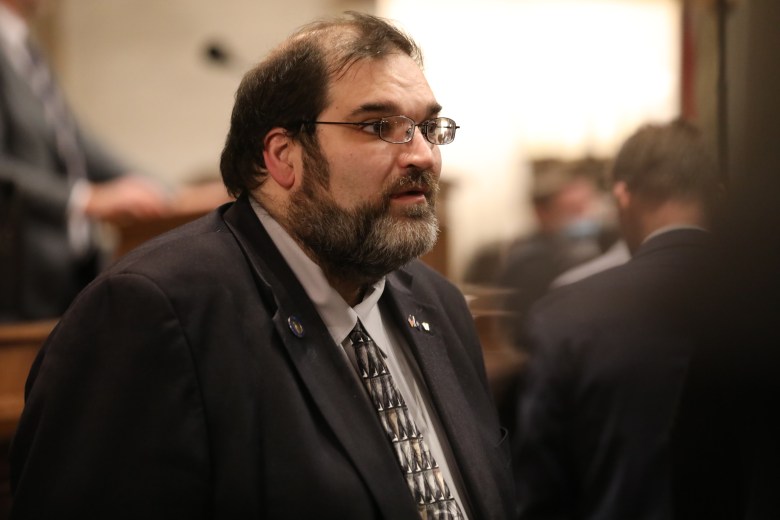
Sen. André Jacque, seen during Gov. Tony Evers’ State of the State address at the Wisconsin State Capitol in Madison, Wis., on Feb. 15, 2022, introduced a bill to require child welfare authorities to save Social Security benefits for foster children in their care. (Coburn Dukehart / Wisconsin Watch)
In February, in the final weeks of the legislative session, Wisconsin state Sen. André Jacque, a Republican from New Franken, introduced Senate Bill 990, which would require child welfare authorities to save Social Security benefits for foster children in their care. Unlike Evers’ proposal, it does not require authorities to check eligibility or apply for benefits.
“Children who enter foster care are already at a disadvantaged position in life,” Jacque said at a hearing on the legislation. “Preserving their benefits can provide a modest but meaningful financial foundation as they transition into adulthood, helping them pay for education, secure housing, purchasing a first car or beginning a new career.”
Parents billed for foster care
Years before the Trump administration decried the taking of Social Security payments, President Joe Biden’s administration urged states to limit another controversial practice: charging parents for foster care.
For years, the federal government required billing parents as a way to lower its own costs. It changed its guidance in 2022, after NPR reported the practice was separating families — sometimes permanently.
Outside of the foster care system, a parent who doesn’t have custody of their child may be ordered to make monthly child support payments to the custodial parent or guardian. Parents who don’t pay can rack up thousands of dollars of debt.
When a child is placed in foster care, child welfare departments often apply to collect that money, along with any past-due payments, in the child’s name. That can leave the parent who used to receive those payments struggling to cover rent or basic expenses.
To defray its costs, the child welfare department may seek a court order requiring the custodial parent to pay child support, too. That’s despite the fact that many of those parents are already struggling financially. About two-thirds of the foster children in Wisconsin were removed from their biological homes because of neglect — a condition often tied to poverty, Pertl said.
Wisconsin foster care authorities seldom seek new child support orders, but they do regularly apply to collect payments on existing orders, said John Tuohy, executive director of the Wisconsin County Human Service Association. The group represents child welfare departments in all 72 counties.
Child welfare authorities bill the parents of 7 in 10 foster children in the state, according to the Department of Children and Families. In recent years, parents have paid an average of more than $7.6 million a year. Studies show those bills can make it harder for parents to bring their children back home.
Researchers at the University of Wisconsin-Madison compared data from Wisconsin counties that tend to collect child support for foster children to counties that don’t. A charge as low as $100 delayed reunification by more than six months, they wrote in a 2017 paper.
Another UW-Madison study, published in 2024, found children whose parents were ordered to pay for foster care spend more than twice as long in care — an average of 21 months instead of nine — and are less likely to be reunited with their parents.
“The research suggests (allowing parents to keep that money) would help that parent to maintain a residence and have the financial capacity to have a home ready for the kids to go back to,” Tuohy said.
Meanwhile, charging parents can actually increase the cost to taxpayers. For every dollar the department spends trying to collect these payments, it recoups only 88 cents, according to Connie Chesnik, administrator of the department’s Division of Family & Economic Security, which oversees child support collection. The department estimates ceasing this practice would substantially reduce the time those children spend in foster care, saving counties approximately $18,000 per affected child.
“The evidence indicates that cost recovery child support orders for children in out-of-home care are not in the best interest of children and families, and they’re not in the best interest of government or taxpayers,” UW-Madison social work professor Lawrence Berger told lawmakers.
The Department of Children and Families wants the practice to stop, too.
“It’s very clear that this kind of change in policy and practice will yield real results in terms of reunification with families,” Pertl said.
Bipartisan support, little action
As with Social Security payments, Evers proposed allocating funds to stop child support collections for most children in foster care. The $1.87 million provision was one of the hundreds cut by the Republican-led budget committee. GOP lawmakers then introduced their own legislation at the end of the session.
“The cost of care should not be subsidized by those who can least afford it,” Sen. Jesse James, R-Thorp, said at a hearing for Senate Bill 1072, which would bar child welfare departments from collecting child support for most foster children. Rep. Karen Hurd, R-Withee, led the Assembly companion to James’ bill.
At the hearing, lawmakers from both parties voiced support but acknowledged the bills wouldn’t pass so late in the Legislative session.
Sen. Sarah Keyeski, D-Lodi, wondered aloud why the bills didn’t get a hearing until after the Assembly had gavelled out for the session.
“These are good bills, and I’m just disappointed we didn’t hear them sooner, because we could have done something about them,” Keyeski said.
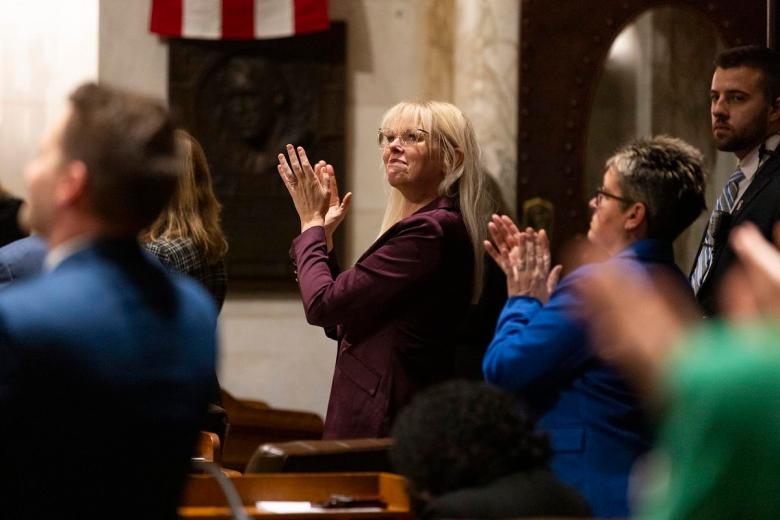
Sen. Sarah Keyeski, D-Lodi, applauds as Gov. Tony Evers delivers the 2025 state budget address, Feb. 18, 2025, at the Wisconsin State Capitol in Madison, Wis. (Joe Timmerman / Wisconsin Watch)
Lawmakers could come back to the Capitol this year to take action on spending the state’s $2.4 billion surplus, but ideas floated by Evers and Republican legislative leaders don’t include proposals on foster care payments.
Both James and Jacque said they plan to reintroduce their bills in the next budget cycle, although both lawmakers must first survive reelection bids in 2026.
“I see a path to it getting done,” Jacque said of his proposal. “It’s certainly an idea that should have bipartisan appeal.”
In Wisconsin, status quo persists
The lone opposition to the measures comes from the local governments that run foster care in every Wisconsin county except Milwaukee, where the Department of Children and Families directly administers care. Tuohy, of the Wisconsin County Human Service Association, said counties will face a budget shortfall if they can’t collect funds from children or parents.
“County human service budgets are very tight,” Tuohy said. “Counties cannot afford to absorb that fiscal impact.”
He said his group is open to such policy changes, as long as lawmakers allocate funding to make up for what agencies will lose and hire experts to administer these funds.
“Our group is willing to work with both the Legislature and the governor on those types of things. We want to do what’s best for kids and families and to get better outcomes for kids who go into out-of-home care,” Tuohy said. “But … until you address the fiscal effect, it’s hard to really talk about what’s good policy or not.”
The Department of Children and Families agrees.
“I’ve been doing this a long time. You know how we get these things done? We keep folks whole,” Pertl said. “In the scheme of the state budget, this is not a particularly expensive proposal. This is a very doable thing.”
Doable or not, any such legislation will likely have to wait until lawmakers return to the State Capitol in January. Jacque and James said they plan to add funding when they reintroduce their bills, to help counties make up the difference.
When they do, Harfeld believes the pressure will be on, especially when it comes to the taking of Social Security benefits. That practice, she said, has riled people of assorted political persuasions.
“We’ve got the support from Evangelical groups who just see this as an affront to God, in addition to violating at least six different biblical prescriptions on stealing from orphans. We have gotten a lot of attention from the MAGA right, who are seeing this now as waste, fraud and abuse,” Harfeld said. Libertarians, meanwhile, see the practice as government overreach, she said.
“How many issues are you seeing that have really broken through all of the political divides and resulted in this consensus between very unusual bedfellows?” Harfeld asked. “This is one of them.”
Have you or your children been in foster care in Wisconsin? I’d like to hear how foster care costs have affected you and your family. Please email me at nyahr@wisconsinwatch.orgor call me at 608-616-0752.
This article first appeared on Wisconsin Watch and is republished here under a Creative Commons Attribution-NoDerivatives 4.0 International License.