Evers Calls Trump’s Order Restricting Mail-In Voting ‘Bulls––t’
Governor says the order is illegal. 'We'll see President Trump in court.'

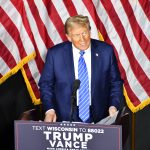
Donald Trump speaks at Discovery World. Photo Taken Oct. 1, 2024 by Graham Kilmer.
Wisconsin Gov. Tony Evers says President Donald Trump’s order to restrict absentee ballots from going to people not vetted by his administration is “bulls—,” and he looks forward to seeing the president in court.
On Monday, Trump signed an executive order, titled “Ensuring Citizenship Verification and Integrity in Federal Elections,” which instructs the U.S. Department of Homeland Security and Social Security Administration to send election officials in states like Wisconsin lists of “individuals confirmed to be United States citizens” who will be old enough to vote before upcoming federal elections. The order also requires the U.S. Postal Service to prevent mail-in ballots from being sent to anyone not on the list.
Components of the order are similar to provisions in the Republican SAVE Act, which is before Congress. The U.S. House passed that bill in February, but it’s currently stalled in the Senate.
The order comes after years of Trump spreading falsehoods about his 2020 loss to former President Joe Biden. While Trump has called mail-in voting a source of widespread election fraud, he voted by mail in Florida last month.
Soon after the president’s order was signed, Evers, a Democrat, called the order “bulls—” in a social media post.
“And it’s illegal,” said Evers. “We’ll see President Trump in court.”
In a statement sent to WPR, Democratic Wisconsin Attorney General Josh Kaul said the order “transparently attacks our democracy, seeks to restrict voting, and tramples on the Constitution.”
“I am confident, however, that key parts of the executive order will be blocked, and that it accordingly won’t prevent us from continuing to have free and fair elections in Wisconsin,” said Kaul.
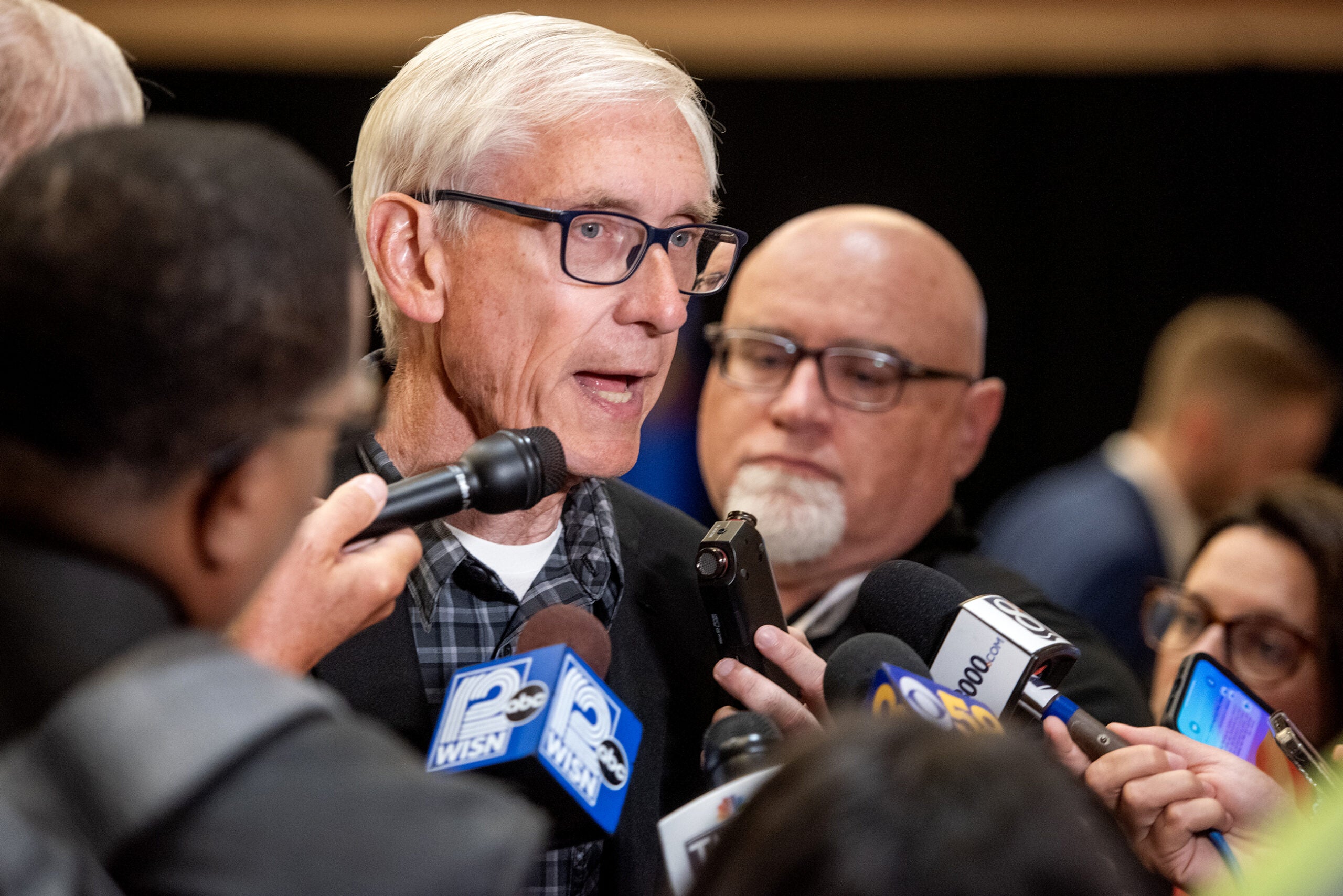
Gov. Tony Evers addresses reporters during the Wisconsin delegation breakfast Monday, Aug. 19, 2024, on the first day of the DNC in Chicago, Ill. Angela Major/WPR
Howard Schweber, an emeritus professor of law at the University of Wisconsin-Madison, told WPR the U.S. Constitution is clear that states determine how elections — even federal ones — are run. That said, it also gives Congress authority to overrule states with respect to the “time, place and manner of elections.”
“The fact that Congress can do it does not mean the president can do it through an executive order,” Schweber said.
He said Trump’s executive order is all but certain to be challenged in court, which will bring up questions about the Constitution’s separation of powers doctrine and principles of federalism.
“I suspect what will happen is it will go to federal court, some federal judge will rule it unconstitutional, the Trump administration will file an emergency petition with the Supreme Court,” said Schweber.
He said the Supreme Court “has been asked a dozen times” to address whether the president has violated the separation of powers doctrine in other cases and it’s issued unsigned orders under what’s colloquially known as the “shadow docket.”
“Trump is stressing the principle of separation of powers,” said Schweber. “The Supreme Court has adamantly refused to say anything about it, which puts us in a very odd and uncomfortable place.”
Evers calls Trump’s order restricting mail-in voting ‘bulls–––’ was originally published by Wisconsin Public Radio.
If you think stories like this are important, become a member of Urban Milwaukee and help support real, independent journalism. Plus you get some cool added benefits.