Wisconsin Led Nation in Union Membership Decline
Wisconsin now a below-average state, report finds.
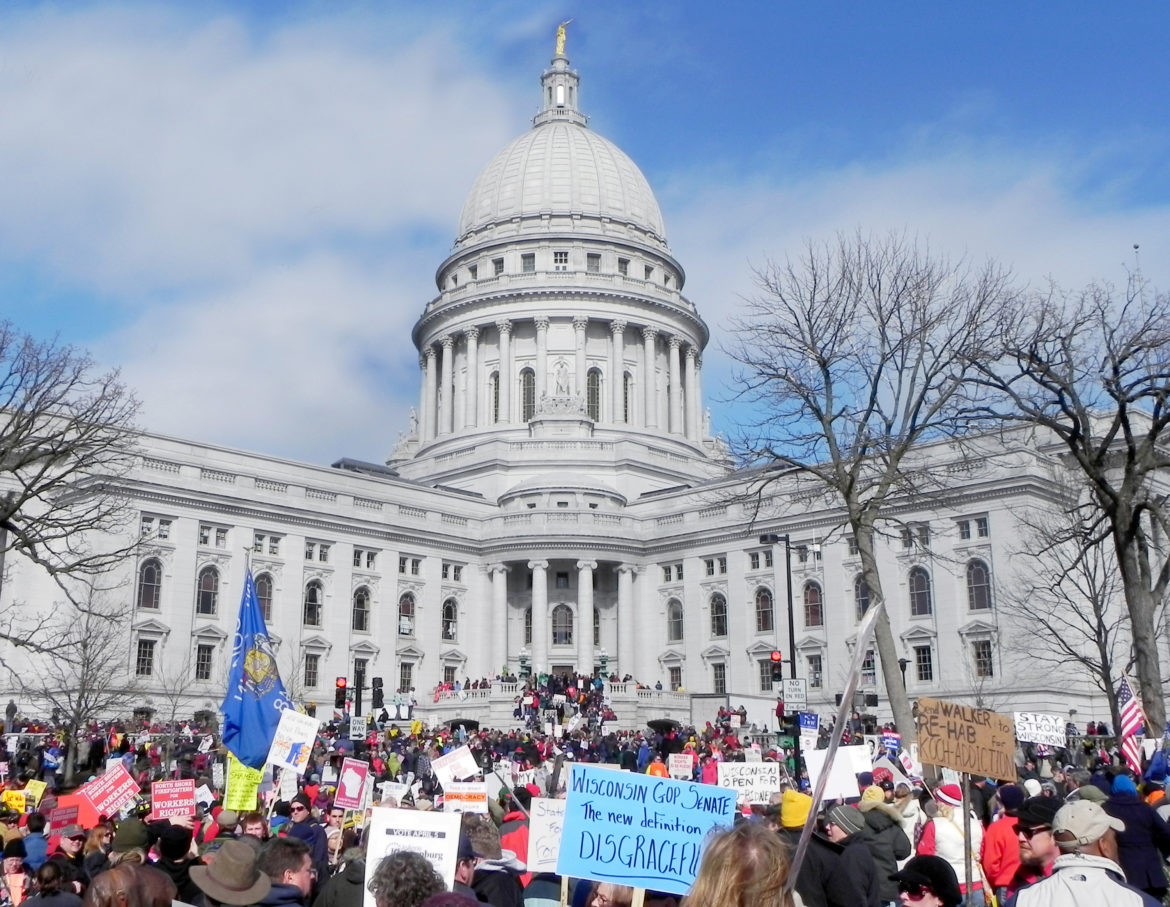
Protestors are seen here in front of the Wisconsin State Capitol on March 12, 2011. Photo by Richard Hurd. (CC BY 2.0)
Fifteen years after former Gov. Scott Walker signed Act 10 into law, the results are clear — union membership among both private and public employees in Wisconsin has plunged.
Wisconsin has experienced the steepest long-term decline in union membership in the United States, according to a new report from the Center for Economic Policy and Research.
The study, which analyzes data from 1985 to 2025, found that Wisconsin went from being a highly unionized state — with more than 22 percent of workers across both public and private sectors being in a union — to having union membership rates at or below the national average.
“There was definitely a national trend of gradual union decline, but Wisconsin fell faster and further than almost anywhere else, and it had further to fall,” labor researcher Hayley Brown, who authored the study, told WPR’s “Wisconsin Today.”
In 1985, nearly half of public-sector workers in Wisconsin belonged to a union, along with more than 17 percent of the private sector. Now, that rate has dipped to under 20 percent of public workers and less than 5 percent of the private sector.
One of the major drivers in that downward trend is the 2011 passage of Act 10, a law that effectively ended collective bargaining for teachers and most government workers in Wisconsin.
“Wisconsin’s drop was roughly 20 times the average national decline in the public sector, and a lot of that was concentrated around 2011,” Brown said. “If you look at it like on a chart, it’s a huge, huge cliff drop.”
While Act 10 didn’t outlaw union organizing, its restrictions on collective bargaining have made it difficult for public-sector unions to continue operating.
“They couldn’t bargain over benefits. They couldn’t bargain over the safety on the job. They couldn’t bargain on working conditions,” said John Heywood, distinguished professor of economics at the University of Wisconsin-Milwaukee. “The only thing they could bargain on was their pay, and that was limited by law to never exceed the rate of inflation.”
All of that, paired with a new requirement for every union to hold a recertification vote every year, means “many, many public-sector unions simply vanished,” Heywood said.
Research shows unions have a track record of benefiting workers by raising wages and improving access to benefits like health care. Workers who belong to a union also have more of a voice in communicating how to do their jobs well, which Heywood believes benefits the entire state.
“The state of Wisconsin has lost the knowledge and the input of their workers that was communicated through the process of collective bargaining,” he said.
In 2024, a Dane County circuit court judge found Act 10 to be unconstitutional because the law imposed restrictions on some public-sector workers, most notably teachers, while exempting others like police officers and firefighters. The case is anticipated to reach the Wisconsin Supreme Court, which currently has a 4-3 liberal majority, ahead of the April 7 election.
While union participation across the board is much lower than it used to be even one generation ago, some industries are seeing an uptick in labor organizing. Earlier this month, employees at Discourse Coffee in Milwaukee formed a union, joining a growing number of unionized cafes in the city.
And unions are currently enjoying more favorable public perception than they have previously, Heywood said.
“Public opinion about unions has actually improved over the last handful of years, even as union membership has declined,” Heywood said. “If you ask Americans, ‘Do you think workers should have an ability to influence their workplace together as a group?’ and you leave the word ‘union’ off, you usually get an overwhelming majority telling us, ‘Yes, they should.’”
Wisconsin saw steepest decline in union membership over 40-year period, report finds was originally published by Wisconsin Public Radio.
If you think stories like this are important, become a member of Urban Milwaukee and help support real, independent journalism. Plus you get some cool added benefits.