$80 Million In PFAS Grants Could Start Flowing This Fall
DNR targets private wells, schools and sludge testing as it builds out new PFAS programs statewide.
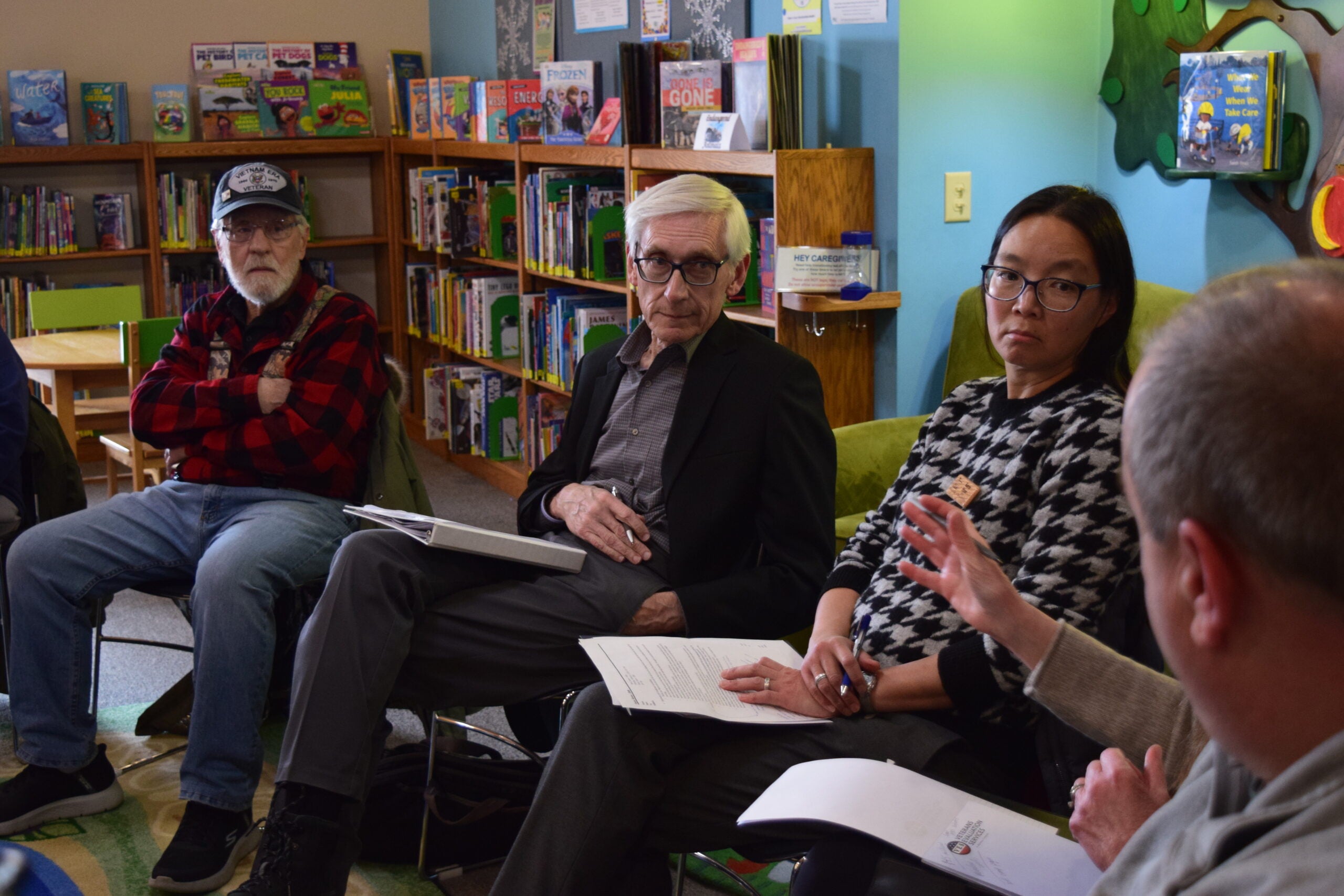
Gov. Tony Evers and DNR Secretary Karen Hyun speak with Campbell residents about the local impacts of PFAS contamination during an event on Tuesday Feb. 4, 2025. Hope Kirwan/WPR
The secretary of the Wisconsin Department of Natural Resources said the agency is preparing to set up grant programs to address PFAS contamination with some work beginning this summer or fall.
The agency is gearing up to roll out funds after the Wisconsin Senate recently passed bills to address the chemicals, and Gov. Tony Evers has pledged to sign them.
DNR Secretary Karen Hyun said the agency will first focus on PFAS sampling under a community grant program. The program will award around $80 million of $133 million set aside to address the chemicals under the bills.
Sampling would determine PFAS levels in private wells, schools and child care facilities. Sampling would also focus on biosolids, often referred to as sewage sludge. Hyun said the agency will work with local governments and tribes to prioritize work.
“We are focusing right now on understanding the degree and extent of the contamination, stopping the exposure and getting people clean drinking water,” Hyun said.
With 800,000 private wells in Wisconsin, she urged people to get their water tested to determine their risk of exposure. Hyun added they hope to launch a second round of PFAS sampling for high capacity wells, wastewater and landfill leachate early next year.
The DNR also plans to issue a general permit by July for entities spreading sewage sludge on roughly 5 percent of the state’s harvested cropland. Entities would be required to test their sludge for PFAS, and levels must fall below a 20 parts per billion threshold for them to spread the nutrient-rich material on fields.
Before any work can start, the DNR plans to begin hiring 10 positions authorized under the bills as soon as they’re signed. Hyun expects the hiring process to last four to six months.
One of the bill’s authors, Sen. Eric Wimberger, R-Gillett, said he hopes to see a solid grant framework in place within the next six months.
“We should be on our way at that point in six months, with at least planning and some money out the door to help people test,” Wimberger said. “Then, get to the next step, which is actually constructing facilities and getting people cased wells or new wells.”
The DNR plans to launch an expanded well compensation grant program this fall or winter. The program is set to provide $35 million for replacing, rebuilding or treating contaminated wells.
Town of Campbell Supervisor Lee Donahue said the town is seeking approval from state utility regulators to drill a second well as part of building a $60 million municipal water system. The town on French Island near La Crosse discovered widespread PFAS contamination more than five years ago.
The town board supervisor said passage of legislation to fund grant programs is a huge deal for her community and others across Wisconsin facing PFAS contamination.
“We will finally have access to funding that will help with a variety of initiatives, whether the initiative is connecting to a safe water source … helping with filtration systems … pushing for remediation that is long overdue and has yet to be fully implemented,” Campbell said.
Donahue said the town is trying to cobble together state and federal funds through loans and grants, including roughly $40 million awarded by the U.S. Department of Agriculture earlier this year.
Both Hyun and Wimberger said there’s potential for additional funding to be set aside. Wimberger said the state may front some costs to address PFAS contamination until ongoing litigation over pollution from the chemicals is resolved.
“Once the settlements come in, we would transition from a dynamic where there would be the state funding in this initial push to where things will come out of that settlement money,” Wimberger said.
However, litigation may drag on for years. Wimberger said it’s too soon to say whether the state would appropriate more funds under the budget. He added the initial $125 million set aside in a PFAS trust fund was only meant to be a stopgap until money became available from those responsible for contamination.
DNR Secretary says work ongoing to set up programs to address PFAS in Wisconsin was originally published by Wisconsin Public Radio.
If you think stories like this are important, become a member of Urban Milwaukee and help support real, independent journalism. Plus you get some cool added benefits.
More about the PFAS Problem
- $80 Million In PFAS Grants Could Start Flowing This Fall - Danielle Kaeding - Mar 26th, 2026
- Wisconsin Conservation Voters Celebrates Historic $132 Million Pfas Victory - Wisconsin Conservation Voters - Mar 18th, 2026
- After Years of Delay, WI Legislature Passes Bills Addressing PFAS - Danielle Kaeding - Mar 17th, 2026
- Gov. Evers Celebrates Senate Approval of Bipartisan Pfas Compromise After Years of Urging Republicans to Release $125 Million to Fight Pfas Contamination Statewide - Gov. Tony Evers - Mar 17th, 2026
- Gov. Evers Signs New PFAS, Lead Regulations - Danielle Kaeding - Mar 2nd, 2026
- Gov. Evers Builds Upon Efforts to Clean Up Wisconsinites Water, Approves New Rule Changes Strengthening Pfas Drinking Water Standards - Gov. Tony Evers - Mar 2nd, 2026
- PFAS Levels in Great Lakes Fish Are Dropping - Danielle Kaeding - Feb 6th, 2026
- Gov. Evers and GOP Lawmakers Near a Deal on PFAS Pollution - Danielle Kaeding - Jan 22nd, 2026
- Gov. Evers Optimistic About Reaching Final Deal With Republican Lawmakers to Secure Release of $125 Million in Long-Awaited Pfas Investments - Gov. Tony Evers - Jan 21st, 2026
- Bipartisan Push to Tell Counties Faster When Water Tests Fail - Henry Redman - Dec 19th, 2025
Read more about PFAS Problem here