
The True Cost of Urban Highways
All the city news you can use.
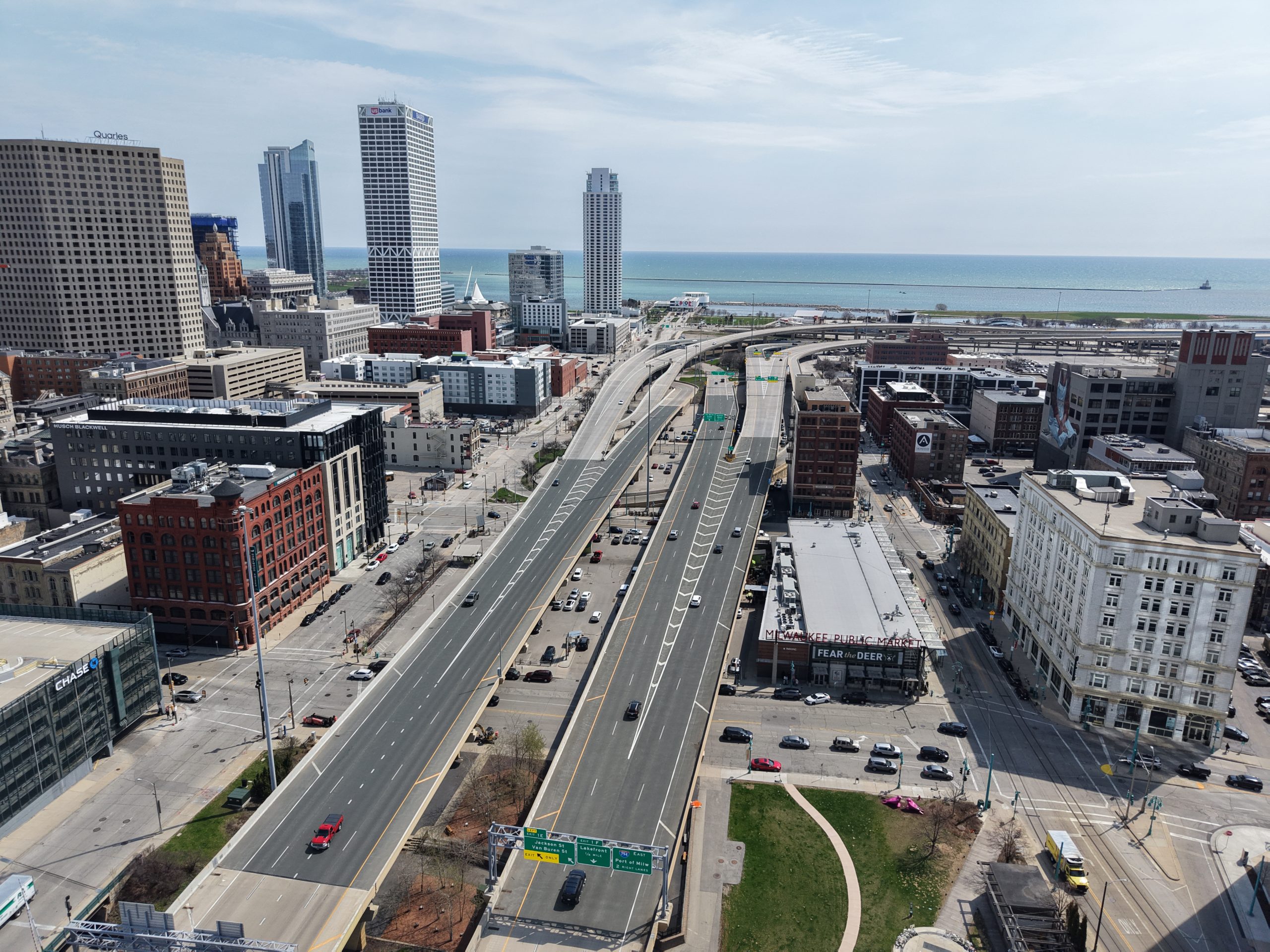
Interstate 794 between Downtown and the Historic Third Ward. Photo by Jeramey Jannene.
Every day at The Overhead Wire we sort through over 1,500 news items about cities and share the best ones with our email list. Each week, we take some of the most popular stories and share them with Urban Milwaukee readers. They are national (or international) links, sometimes entertaining and sometimes absurd, but hopefully useful.
Maybe half the pavement isn’t needed: A new report from Accelerate Resistance LA states 44% of Los Angeles’ hardened spaces including roads and driveways may not be essential. Using parcel level analysis to map all the pavement across the city and combining it with data on heat, tree cover, and other environmental impacts the organization believes it’s possible to think of new ways to improve public health and the climate (Meg Tanaka | Los Angeles Times)
Pedestrianizing Oxford Street: London is officially moving forward with pedestrianizing parts of Oxford Street in London. Vehicle traffic will be moved off the street by the summer and big retailers hope that it will bring customers and make it easier for non-auto access. (Gwyn Topham | The Guardian)
RTD paid for service not rendered: Denver’s transit agency RTD has been paying it’s operations contractor Denver Transit Partners millions of dollars for service it hasn’t received. After finding out about the discrepancy, the agency has asked the contractor to double service on two passenger rail lines in May without incurring the agency costs because of the oversight. Since 2019, Denver Transit Partners has been paid $414m to operate three electric commuter lines. (Bruce Finley | Denver Post)
What urban highways really cost: A new report from Patrick Kennedy in Dallas has found that 66k acres in US cities are consumed by highways and lost property tax revenues from that space is estimated at over $5.2B per year. Kennedy looked at the 3 mile radius around downtowns and considers this work a follow up to the Bragdon Report which urged President Eisenhower to not build through cities. (Benjamin Schneider | Bloomberg CityLab)
What makes a city beautiful: New research of the built environment found that people viewing historic buildings found them comparable in scenic quality to forests and lakes. Creating scenic built environments has been shown to improve health and well-being and this study shows that historic buildings specifically contribute to positive urban scenes. (Eugene Malthouse and Sidney Sherborne | The Conversation)
Quote of the Week
It really can’t be understated how essential it is … for the livestock industry that we properly fund our transportation system. I know it’s a politically fraught issue, but what is entirely clear to me is that the status quo moving into the future is entirely untenable.
–Kirk Wilbur of California Cattlemen’s Association in the Associated Press discussing the need for a mileage tax to support road maintenance in heavily agricultural and rural parts of the state.
This week on the Talking Headways podcast, we’re joined once again by Yonah Freemark to discuss the state of transit in the US and around the world. In Part 1 of our annual discussion, we talk about the longer term impacts of the Bipartisan Infrastructure Law, improving TOD, what the future of transportation should look like, and discuss updates to Transit Explorer.
Want more links to read? Visit The Overhead Wire and signup.
If you think stories like this are important, become a member of Urban Milwaukee and help support real, independent journalism. Plus you get some cool added benefits.


Urban Reads
-
How Urban Housing Politics are Changing
 Mar 14th, 2026 by Jeff Wood
-
Should Amtrak be Broken Up?
 Feb 28th, 2026 by Jeff Wood
-
Want to Walk More? Move to a Walkable City
 Feb 22nd, 2026 by Jeff Wood















The moment the crumbling curve of 794 downtown comes down, people will forget they ever opposed its removal. The potential of that space – in any number of configurations – is paradigm-shifting for our downtown.
I hate that it’s WisDOT’s call. They will want to rebuild to preserve the taxpayer spending needed to support extremely expensive above-grade freeway infrastructure.
Research proved removing 794 would impact 56,000 Jobs.
@pantherU the future of that corridor is also contingent on the next governor – regardless of the DOT decision. Tiffany would definitely make sure it was replaced in kind without meaningful change; he would probably use identity politics to justify it. The dems are a toss up. Evers supported widening the freeway near miller park (amfam field) even though a large base of his constituents wanted a fix at 6.
@BigRed81 – they said tearing down the park east would bankrupt the city, it didn’t. Preliminary studies done by associations who have a vested interest in the status quo will always have some sky is falling conclusion despite precedent showing urban freeways once removed benefit the city they once tore apart.