

Democrats, Unions Push $20 Minimum Wage Bill
800,000 Wisconsin workers earn less than $20 an hour, below a 'living wage.'
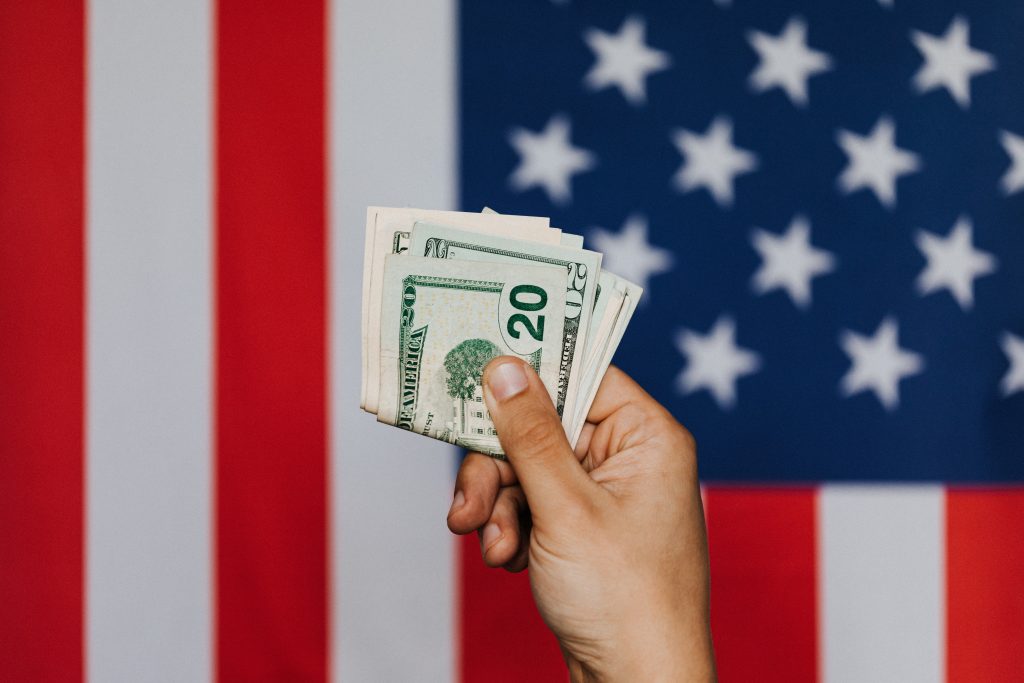
U.S Flag and money. (Pexels license)
Two Democratic state legislators announced a bill Tuesday, backed by a coalition of labor unions and political organizations, that would raise the minimum wage in Wisconsin from $7.25 to $20.
State Sen. Kelda Roys (D-Madison) and Rep. Angelina Cruz (D-Racine) have drafted a bill to raise the minimum wage to $15 immediately, followed by regular increases until it hits $20 in 2030. From then on, the state wage floor would be pegged to inflation.
The current minimum wage of $7.25 an hour leaves full-time workers below the federal poverty line. While only 1% of Wisconsin workers earn a wage at or below the state minimum, it creates a floor for wages that’s lower than in states that have raised the minimum wage. Even workers in Wisconsin at wages higher than the minimum can struggle to meet their basic needs, Roys said. “At least a million Wisconsin workers cannot afford child care or health care,” she said.
The proposed wage floor is actually a conservative figure based on the MIT living wage index, which estimates that a single individual with no children would need to earn $21.88 an hour to support themselves while working full time.
“About 800,000 workers in Wisconsin earn less than $20 an hour. They are home health care providers, early childhood educators, grocery workers, nursing assistants, the backbone of our communities,” Cruz said. “This bill is about dignity, it’s about fairness and it’s about building an economy where, if you work hard in Wisconsin, you can afford to live in Wisconsin.”
The bill provides small business owners, who employ 50 or fewer workers, more time to transition to the new wage floor. It also raises the tipped wage from $2.33 an hour to $7.50.
The legislation has backing from a coalition of unions and political organizations, including the Milwaukee Area Service and Hospitality Union (MASH), United Auto Workers (UAW), United Food and Commercial Workers International Union (UFCW), Citizen Action of Wisconsin, the Wisconsin Working Families Party and Our Wisconsin Revolution.
Raising the minimum wage would rebalance power between workers and bosses and push wages up across the labor market, said MASH President Peter Rickman.
“The share of national income going to worker wages has literally never been lower than what it is here today… the share of national income going to corporate profits has never been higher,” Rickman said. “It’s two and a half times larger than it was in the heyday of our shared prosperity economy, where we gave birth to the world’s first middle class.”
The shared prosperity and middle class of the 20th century was built through public policy, Rickman said. New Deal legislation, passed by a coalition of mostly Democrats and some Republicans, strengthened collective bargaining protections for organized labor and established a wage floor that provided everyone in the country a wage they could live on.
“They called it the minimum wage,” Rickman said. “It was never intended to be a poverty wage for those folks over there. It was intended to move the whole labor market.”
The new bill at the state level is being introduced just as the Legislature goes into a recess for the rest of 2026.
“To take a 10-month paid vacation while workers cannot afford housing, child care, to keep their homes, health care, that’s a choice that shows that Republicans don’t care at all about working Wisconsinites,” Roys said.
The politics of the minimum wage should cross partisan and geographic boundaries. Roys said the crisis of low wages is nowhere more acute than in Wisconsin’s rural communities, “where many communities have limited employment opportunities and a handful of employers, often massive multinational corporations, can suppress wages because workers have so few alternatives.”
Rickman similarly thinks the historical precedent of the New Deal and the contemporary political landscape offer opportunities for a bipartisan coalition for raising the minimum wage. A “huge gap” exists between Republican politicians and their working-class voters, who are largely concerned with the same issues that concern working-class Democratic voters, like wages and affordability, he told Urban Milwaukee. The upcoming midterm elections also provide an opportunity for Democratic candidates for government, and candidates in legislative districts across the state, to run on raising the minimum wage, he said.
“Even if it doesn’t pass this session, we know that elected officials will become accountable this fall,” Roys said. “Maybe it’s the last bill of 2026 and maybe it’s the first law of 2027.”
If you think stories like this are important, become a member of Urban Milwaukee and help support real, independent journalism. Plus you get some cool added benefits.


















Soon $7.50 will be the bus fare just to get to work.
2025 Wisconsin Living Wage Single Adult (No Children): ~$20.96 per hour ($43,596/year).
$7.25 Minimum Wage (Poverty) is result of Republicans’ alignment with Lobbyist$ & Donor$.
GREED IS 1 of 7 DEADLY SINS.
Metropolitan Association Milwaukee Commerce
(MMAC) has 2,000. An example Anti-Worker tactics:
On November 4, 2008, 68% of voters in Milwaukee approved a referendum that will require employers to provide workers in the City of Milwaukee with paid sick leave. The Ordinance requires private employers to provide one hour of paid sick leave for every thirty hours an employee works, regardless of whether the employee is full time, part time or temporary. Each employee of an employer with more than ten employees, whether full or part time, may accrue up to 72 hours (9 days) of leave in a calendar year. Employers with fewer than ten employees must allow employees to accrue up to 40 hours of paid sick leave. Sick leave begins to accrue immediately upon employment, but it cannot be used in the first 90 days of employment. The employee may also carry over any unused leave to the next calendar year, though the employee may not use more than the 72 hours in a given year (or 40 hours when the employer has less than ten employees). The employer is not required to pay out unused sick time upon termination.
The Ordinance applies to any “person who is employed within the geographic boundaries of the City by an employer.” Because there is no limitation as to the location of the employer, employers located outside of the City of Milwaukee who employ workers within the City of Milwaukee must provide paid sick leave under the ordinance. It is unclear whether employees who work at multiple job sites in a given year, only some of which are in the City of Milwaukee, must receive the paid sick leave.
Employees may use paid sick leave for a broad range of issues.
von Briesen Legal Update
It was later upheld by the Wisconsin Court of Appeals in 2011.