

Feds Contest Former Judge Dugan’s Attempt to Overturn Conviction
Prosecutors argue Dugan has no grounds to request a new trial.
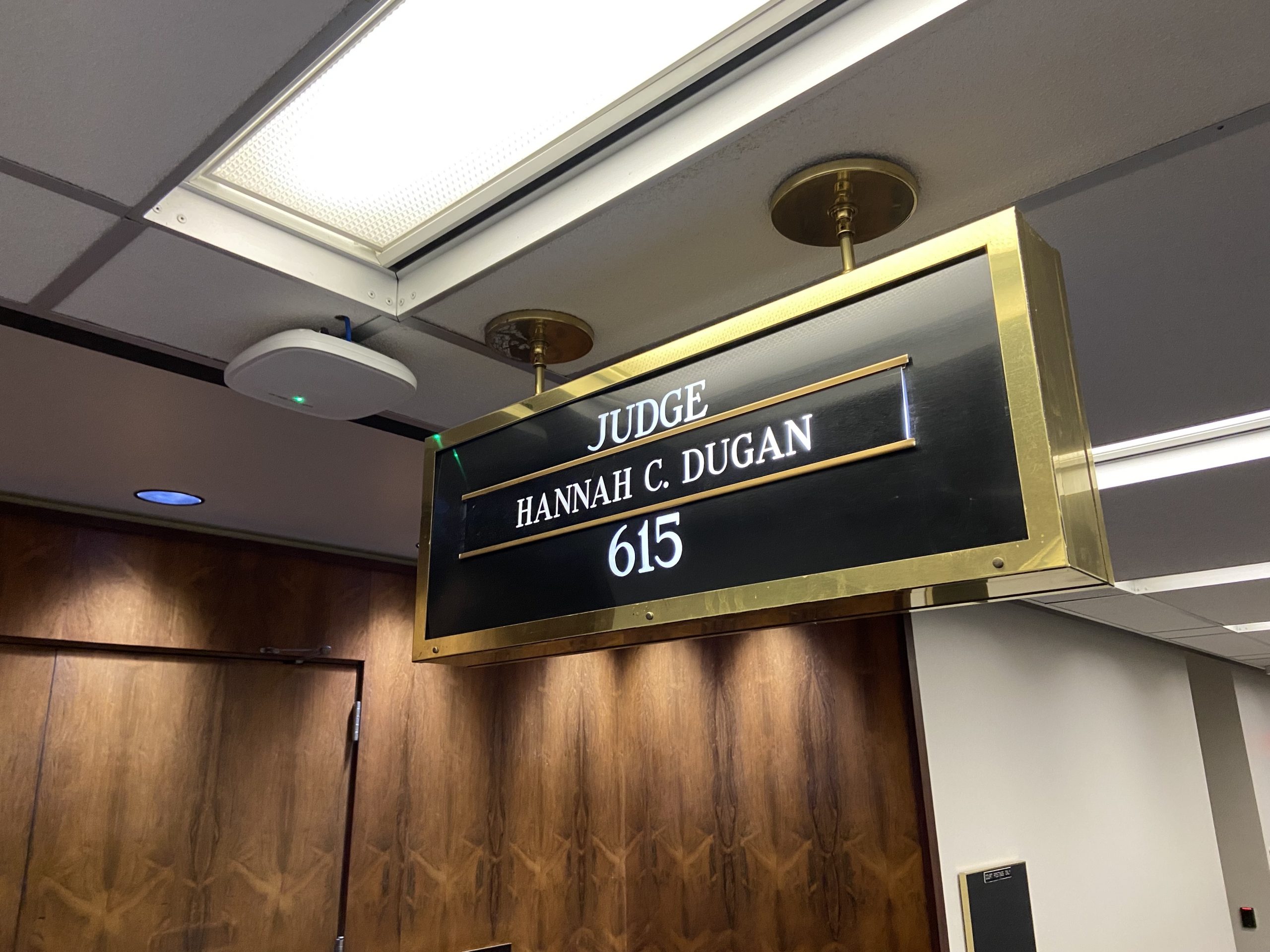
Judge Hannah Dugan’s courtroom on the sixth floor of the Milwaukee County Courthouse. Photo taken by Graham Kilmer.
Federal prosecutors are pushing back on attempts by a former Milwaukee County judge to have her conviction overturned.
Last year, a jury found Milwaukee County Judge Hannah Dugan guilty of felony obstruction.
That conviction stems from an incident in which she led a man through a side door of her courtroom on April 18 after immigration agents showed up to arrest him.Now, Dugan is asking U.S. District Judge Lynn Adelman to undo that conviction — or to grant a new trial.
In a filing Friday afternoon, federal prosecutors responded to those attempts, writing that Dugan’s attorneys are relying “on arguments that she has waived or which the Court already has rejected.”
Earlier this year, Dugan’s attorneys advanced an argument that had not been raised during her four-day trial.
Dugan was convicted of impeding federal immigration agents after they showed up to try and arrest a man within the Milwaukee County Courthouse. But in a late January filing, Dugan’s attorneys argued those agents lacked the legal authority to make such an arrests within the courthouse.
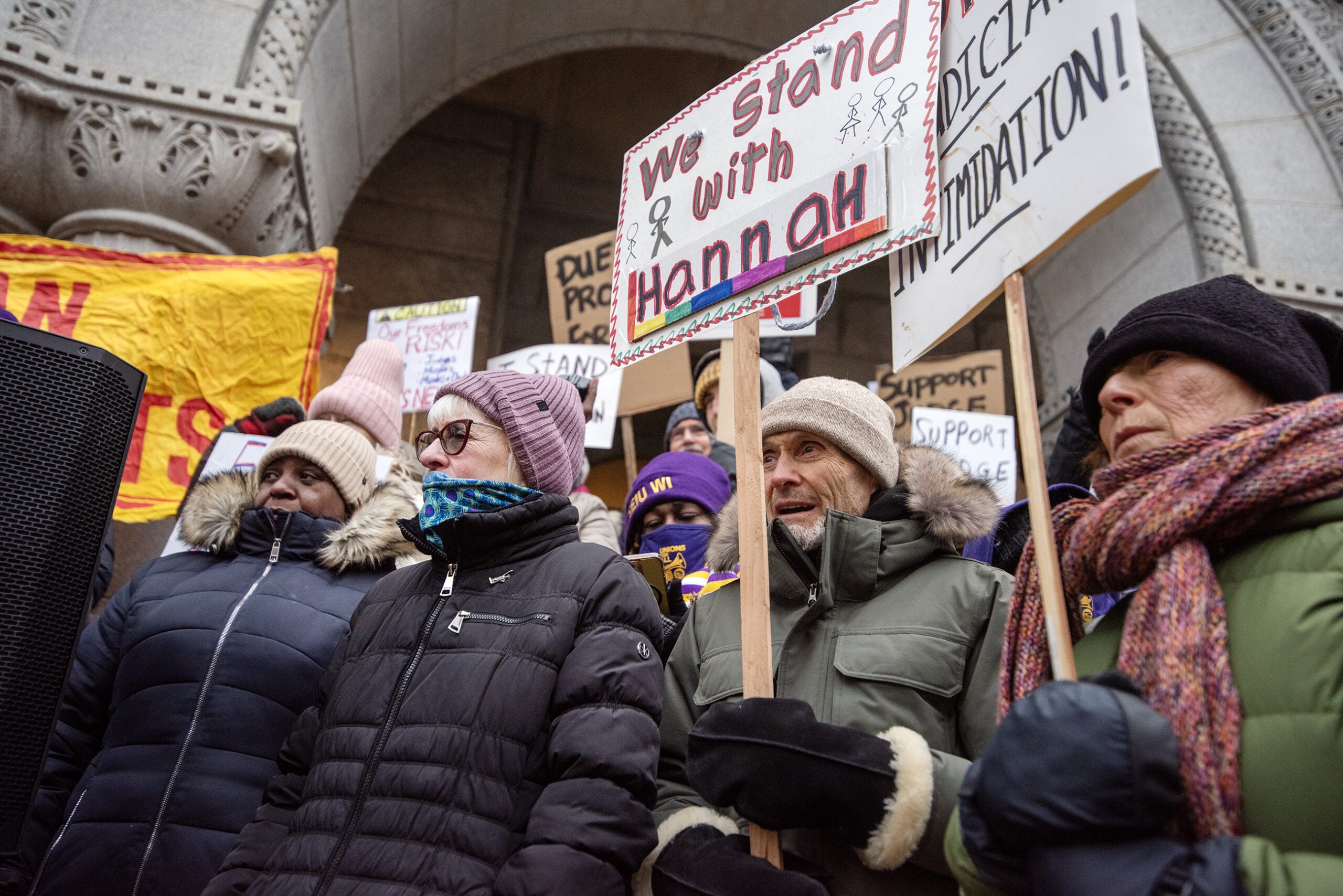
Protesters gather outside of the courthouse in support of Milwaukee County Judge Hannah Dugan on Monday, Dec. 15, 2025, at the Milwaukee Federal Building & U.S. Courthouse in Milwaukee, Wis. Angela Major/WPR
On April 18, immigration agents had arrived to the building with a warrant to arrest a man named Eduardo Flores-Ruiz for being in the country illegally. The agents had what’s known as an administrative warrant, which was signed by an official with Immigration and Customs Enforcement. According to Dugan’s attorneys, that type of warrant was not legally sufficient.
Her attorneys said court decisions have established there’s a “common-law privilege” shielding people from immigration arrests within courthouses.
In their filing Friday, federal prosecutors argue that is not the case.“Arrests at the courthouse are a common practice and can be made in a public hallway with or even without a warrant based on probable cause,” attorneys for the federal government wrote.
During Dugan’s trial, federal agents testified they told county officials they planned to arrest Flores-Ruiz in the courthouse hallway once his hearing in Dugan’s courtroom was over. Flores-Ruiz had been scheduled to appear in Milwaukee County that day on misdemeanor domestic-battery charges.
Immigration enforcement within courthouses has been controversial. President Donald Trump’s administration has argued such apprehensions are a safer option, since people have to go through metal detectors before they enter a courthouse.
But critics say ICE’s presence discourages people from showing up to court dates and makes immigrants fearful of coming forward as victims of or witnesses to crimes.
Before the April 18 incident involving Dugan, there had been several other immigration arrests last year within the Milwaukee County courthouse.
That led Milwaukee County’s chief judge to begin drafting a policy on how court personnel should respond to ICE’s presence. That policy was still in draft form on April 18, although Chief Judge Carl Ashley testified during Dugan’s trial that, based on his understanding, ICE could carry out immigration arrests in courthouse hallways.
“In discussions about this, which included Dugan, there had been no mention of a privilege against ICE arrest,” prosecutors wrote on Friday in reference to the pending courthouse policy. “Indeed, the operating assumption of the participants in this discussion was that ICE arrests based on administrative warrants were lawful in public areas of the courthouse.”
In their latest filing, prosecutors noted that Dugan failed to raise the argument about the legality of immigration arrests at courthouses before her trial, and said it’s too late to bring it up to now.
Prosectors also pushed back against the assertion by Dugan’s attorneys that Adelman gave flawed instructions to the jurors who convicted Dugan.Additionally, Dugan’s attorneys argue prosecutors have failed to show she acted corruptly — a necessary element of the charge for which she was convicted. Instead, they argue everything Dugan did on April 18 — including cancelling Flores-Ruiz’s hearing and offering to reschedule it over Zoom — was legal and within a judge’s authority.
Federal prosecutors, however, have countered that Dugan was not allowed take such actions with the illegal goal of impeding law enforcement.
“Nothing in that statute or in the cases cited by Dugan authorizes a Wisconsin judge to interfere with the enforcement of federal immigration law, provided she does so using the means at her disposal by virtue of her position,” they wrote.
Dugan resigned from her judgeship in early January. A date for her sentencing has not yet been set.
Feds push back on former Judge Dugan’s attempts to overturn conviction was originally published by Wisconsin Public Radio.
If you think stories like this are important, become a member of Urban Milwaukee and help support real, independent journalism. Plus you get some cool added benefits.





















The operative word in the prosecution’s argument is “law enforcement.” ICE agents do not meet even the barest requirements of law enforcement. They demonstrated this quite clearly in Minneapolis.
ICE agents ignore the constitutional rights of all persons. They conduct themselves in direct violation of the 4th, 5th, 6th, 8th and the 14th amendments of our constitution. And do not forget ICE’s violation of the 2nd amendment when they shot and killed Pretti. ICE agents are not “law enforcement.” They do not conduct themselves in accordance with state and federal laws. We have a moral obligation to protect our Black, Brown, and Indigenous neighbors. We have a moral obligation to speak out when laws are being broken by those charged with enforcing laws. Dugan may have violated the letter of the law (that is questionable.) However, she acted within the spirit of the law set forth in the Declaration of Independence and the Constitution.
New rules: Judges & prosecutors at any level who do not agree wholeheartedly with the Trump Administration must be sued and/or punished. God bless the new America! Constitution? It’s just a suggestion!