

Bill Targets ‘Revolving Door’ Between State Regulators and Utilities
PSC commissioners must wait 3 years after leaving office to take jobs with utilities.
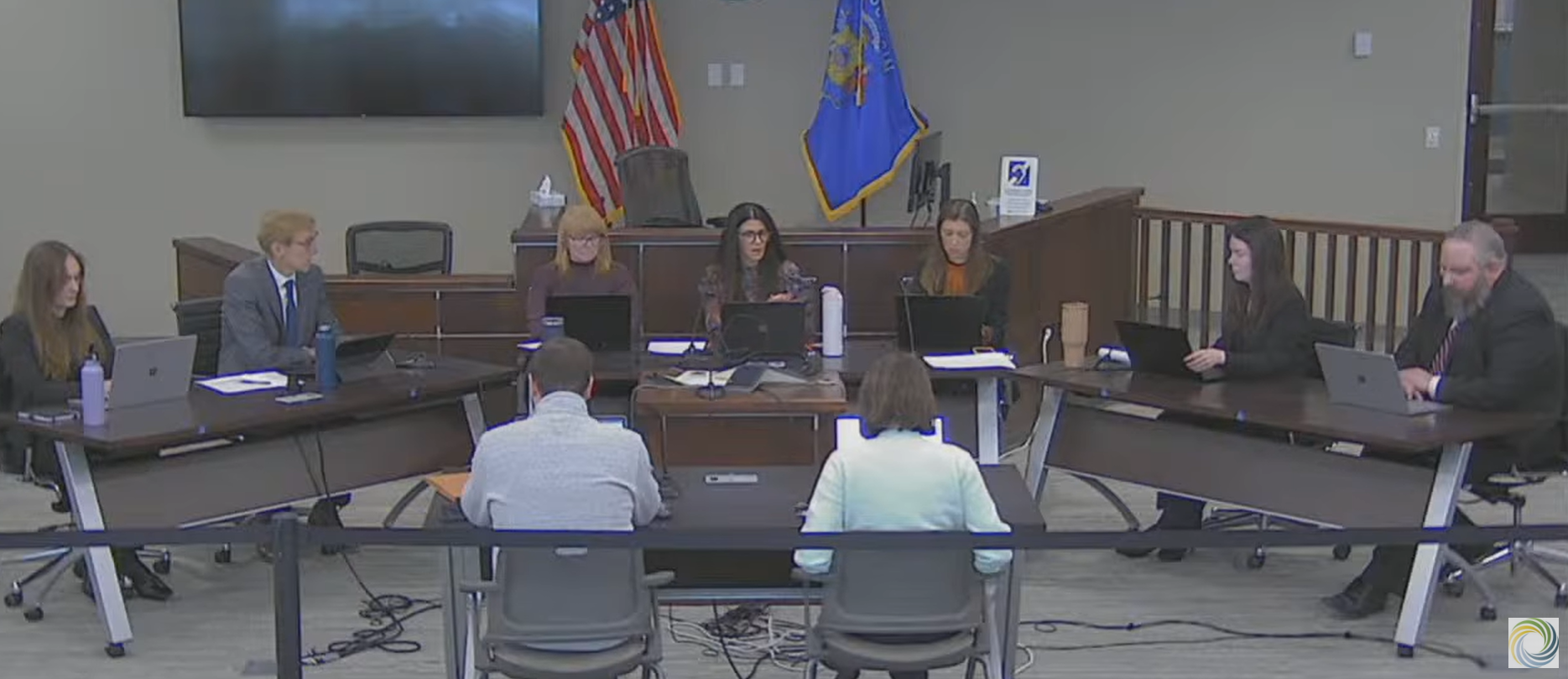
The Public Service Commission of Wisconsin meets on Monday, Feb. 9, 2026. Source: Public Service Commission of Wisconsin
A group of Republican lawmakers want to address the “revolving door” between Wisconsin utility regulators and the companies they are tasked with regulating.
Members of the Public Service Commission of Wisconsin, appointed by both political parties, have gone on to take jobs with state utilities.
Four GOP lawmakers are circulating a bill for cosponsorship that would force PSC commissioners to wait three years between leaving public office and taking a job with an investor-owned utility or transmission company. The restriction applies to policymaking and executive roles, as well as operations management and government relations positions.
In the last three years, two former commissioners have taken executive roles at utilities not long after stepping down from the PSC.
Former PSC chair Rebecca Valcq, appointed by Gov. Tony Evers, took a job with Alliant Energy in 2024, about six months after leaving the commission. Last year, she was named as the next president of Alliant’s Wisconsin energy company.
And former commissioner Ellen Nowak, appointed by former Gov. Scott Walker, took a job with American Transmission Co. in 2023, the same year her term on the commission ended.
Under current state law, those who leave the commission and work for utilities are prohibited from appearing before the commission within 12 months of their departure.
The lawmakers behind the proposal are state Reps. Amanda Nedweski, R-Pleasant Prairie, and Bob Donovan, R-Greenfield, and state Sens. Chris Kapenga, R-Delafield, and Rob Hutton, R-Brookfield.
“Both Democratic and Republican appointees have taken positions with companies they helped regulate at the Public Service Commission,” a memo from the legislators reads. “This is a good-government reform that reinforces public trust and ensures that service on the Public Service Commission is truly about protecting ratepayers — not auditioning for a future job.”
Nedweski told WPR that constituents have been increasingly contacting her office with concerns about data centers and the potential for those developments to raise the costs of heating and powering their homes.
She said many of her constituents are already struggling with high energy bills. She said some fear that PSC commissioners approve rate hikes to protect future job prospects when they leave public service.
“I don’t want to make claims that I can’t substantiate, but we do want to address the concerns of the public,” she said. “And if the public perception is that this revolving door is working as a disadvantage to rate payers, we want to be able to address it.”
Under the bill, violating the three-year employment prohibition would be enforced as a violation of the state’s code of ethics by the Wisconsin Ethics Commission. The bill would also apply retroactively to commissioners who leave the PSC during the 12 months before the bill becomes law.
If it becomes law, Nedweski said the bill “certainly could” discourage qualified candidates from serving on the Public Service Commission.
“But we would want the people who are serving on the PSC to be serving on it for the right motivation,” she said.
Karlee Weinmann is the research and communications manager at the Energy and Policy Institute, a clean energy advocacy group and self-described utility watchdog. She said the bill would provide a “common sense” reform.
She said Wisconsin residents “shouldn’t have to guess” the motivations of state officials tasked with protecting public interests from “profit-driven monopoly utility corporations.”
“Anything that creates separation between the time when a regulator is serving in their public capacity as a utility regulator and when they are acting on behalf of a regulated entity, like a utility, is helpful in protecting confidence that the public can have in the regulatory agency,” Weinmann said.
Nedweski said it’s hard to say whether the revolving door bill has a shot of becoming law this legislative session.
The deadline for cosponsors is Friday and the last scheduled regular session day is March 19. The Legislature could choose to wrap up before that.
“If the committee that it gets referred to wants to take it up and get it done quickly, I would be very pleased about that,” Nedweski said. “If for whatever reason, it’s not something that gets done this session, I’d be happy to reintroduce it next session.”
Wisconsin lawmakers propose bill to slow the ‘revolving door’ between regulators and utilities was originally published by Wisconsin Public Radio.
If you think stories like this are important, become a member of Urban Milwaukee and help support real, independent journalism. Plus you get some cool added benefits.
Political Contributions Tracker
Displaying political contributions between people mentioned in this story. Learn more.





















(read this on Wisconsin Watch very recently)
“Of course no company is too big to fail,” Reese wrote last month. (We Energies Vice President and Treasurer Tony Reese)
“But in the very unlikely event that a customer as massive and financially stable as Microsoft becomes unable to meet its financial obligations,” his company’s proposal promises “adequate protection” to the utility and customers.
“Making sure our customers aren’t stuck paying data centers’ costs is at the foundation of our customer protection plan,” We Energies spokesman Conway told Wisconsin Watch.
Considering that Wisconsin ratepayers still owe nearly $1 billion on “stranded assets” — power plants that have been shut down due to obsolescence — critics of the data center proposals are skeptical.
Will the utility’s proposed guardrails hold up in a worst case scenario? That’s now up to the PSC.
(To me this “reform” tastes like a very weak tea and does nothing to ensure who will foot the bill when the next financial collapse happens, which is probably just around the corner. Basing an economy on credit driven financial speculation and having a clown in orange face paint, a poopy diaper, and fascist tendencies as your ring leader doesn’t seem very sound).