A Rebellion Against Valentine’s Day
Quasimodo Physical Theatre makes a salad at Present Music concert.
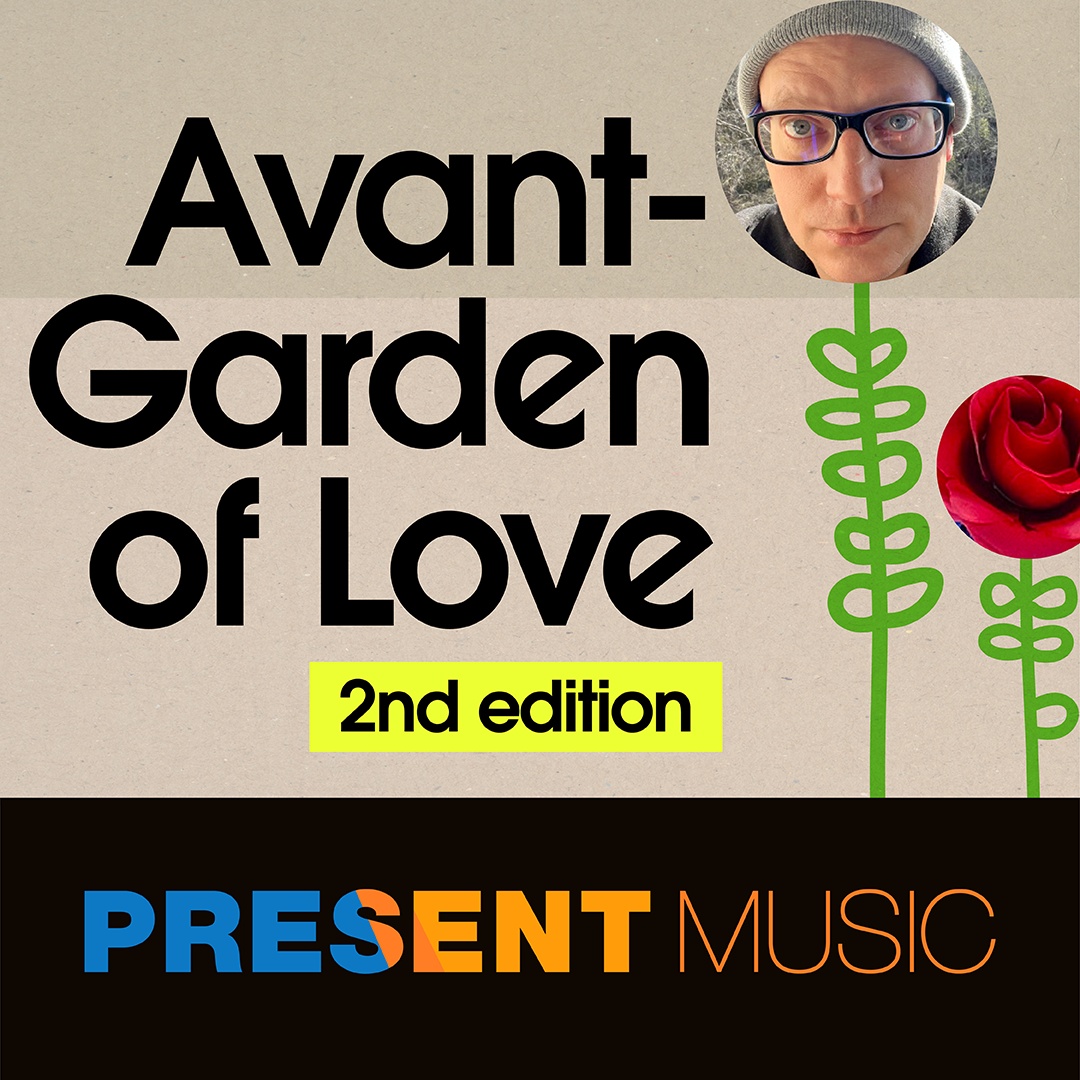
Avant Garden of Love (2nd Edition). Image courtesy of Present Music.
Present Music returns to the theme “Avant Garden of Love“ with two “cabaret style” programs on February 13 and 14 at UW-Milwaukee’s Jan Serr Studio.
Following the 19th-century Romantic Age, the last well-defined musical genre in the history of Western classical culture, the 20th century has often been marked by a collage of different approaches—often with an anti-romantic element that turns away from past traditions.
So how does Present Music celebrate Valentine’s Day? In this case, by presenting examples from the 20th century music that explore different ways of thinking about love. Artistic Director Eric Segnitz sums up the program: “It’s a rejection of Romantic Era formulas, you know? That’s what makes it a Valentine’s concert.” Segnitz explains that what all the movements covered in the program “have in common … is that they were born out of a certain rebellion.”
Ideas from one 20th-century movement will be cross-pollinated with one another. All follow a Valentine’s Day conceit while challenging conventional forms of romanticism. The overlapping of inspirations creates something new.
Early Cinema and Surrealism
The dawn of the 20th century included the invention of cinema. While Hollywood was normalizing that extraordinary medium, the surrealists of Europe were exploring its odd edges. Canadian Norman McLaren worked within this tradition. Selections from his 1930s experimental surrealist film “Camera Makes Whoopee” will be shown, accompanied by “Modern Love Waltz” by Philip Glass.” Glass’s composition, a light waltz that’s effectively romantic, creates a contradictory soundtrack to the images McLaren selected, exploring what he called the “visual music” of romance through mixed techniques including animated objects, optical effects, and live action.
Dadaism: Embracing Nonsense and Multiple Realities
Another early effort, Dadaism, born of deep pessimism in Europe given its wars, industrial revolution, and growing authoritarianism, concluded that perhaps more nonsense would be as fruitful as anything else. Co-founded by Tristan Tzara, Dadaism celebrated random associations free from the restraints of logic and tradition. Tzara’s “Simultaneous Poetry” technique invited multiple readers to recite different poems simultaneously. The audience is invited to participate, reading segments of material distributed throughout the room. Is this a rejection of the works? A deliberate chaos or cacophony of voices? Or a recognition of how different thoughts about love all coexist, embracing different realities from romantic poetry to contemporary expressions, such as Craigslist posts?
Minimalism
For one work, the “relationship” is between live and pre-recorded elements: Steve Reich‘s Pulitzer Prize-winning “Double Sextet,” which Segnitz regards as “one of the great works so far in the 21st Century.” This driving composition blurs the line between human and machine, with players mirroring a pre-recorded version of the same work. Segnitz emphasizes that it’s “an extremely complicated piece … a big sound” with changes in density throughout.
Postmodern Song
Postmodern balladeer Corey Dargel will sing selections of his own works that try on differing identities in the current landscape of love. His songs “Everybody Says I’m Beautiful,” “On This Date Each Year,” and “Toes” explore the quirky edges and modern-day contradictions of love. Most provocatively, his world premiere commission, “true love not pretend,” investigates intimacy through dialogue with AI chatbots, who argue that machine love is superior to the “real thing.”
Fluxus – “Open-Ended Scores”
Alison Knowles, founding member of Fluxus, pioneered accessible, participatory “scores” that reworked the everyday into art. One of her programs, “Proposition #2: Making a Salad,” centered on a team of performers preparing a salad and sharing it with the audience.
Present Music has invited Quasimondo Physical Theatre to join Present Music performers to embellish the making-a-salad experience. The Quasimondo experience has always been fresh and unpredictable. We’re assured that yes, there will be a 12-foot ladder where the salad will be dropped onto a tarp and mixed, ending with a community feast. A variety of past Making a Salad events may be viewed on YouTube.
Minimalist John Cage explored how sound can be created from ordinary objects, recognizing that music and rhythm can be found everywhere. For his piece, “Living Room Music,” participants find different ways to produce rhythms with what’s in the room. Drawing from both Knowles and Cage, performers will create music by using amplified vegetables as percussion instruments. Amplified cutting, snapping, and mixing will add the rhythm (the flavor?) of everyday life—connecting minimalist sound exploration with Fluxus participatory art
The program is basically an immersion from beginning to end. Anti-romantic? The event may just right for an out-of-the-ordinary date, for those who like to experiment, to be involved and not just viewers, or to enjoy a replay of some of the crazier music history of the 20th century.
The program starts at 7:30 p.m. each Friday and Saturday evening, Feb. 13-14. The Jan Serr studio is located on the top floor of the UW-Milwaukee Peck School of the Arts Kenilworth building at 2155 N. Prospect Ave., south of campus. Tickets may be purchased online or at the door.
If you think stories like this are important, become a member of Urban Milwaukee and help support real, independent journalism. Plus you get some cool added benefits.


Preview
-
Present Music Celebrates Hindu Festival
 Mar 16th, 2026 by Michael Barndt
-
Frankly Music Showcases Virtuoso Players
 Mar 10th, 2026 by Michael Barndt
-
Six Centuries of Secular Song
 Mar 3rd, 2026 by Michael Barndt