
Measles Confirmed in UW-Madison Student
Health officials warn of 5 locations where the public was exposed last week.
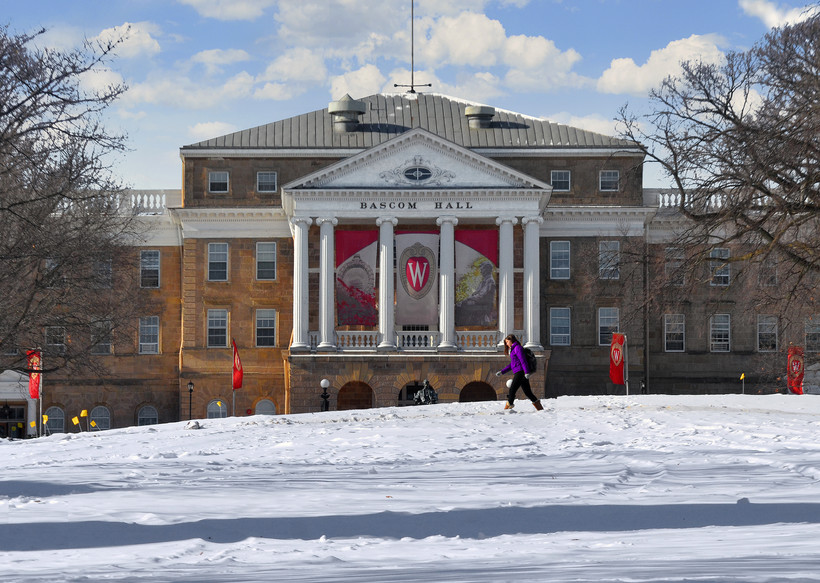
A student walks in front of Bascom Hall on the UW-Madison campus. Richard Hurd
State and local health officials have confirmed a case of measles in a University of Wisconsin-Madison student and identified several campus locations where the public may have been exposed.
The student contracted the highly contagious measles virus during international travel, according to the Wisconsin Department of Health Services.
The case is not related to the measles infection confirmed in a Waukesha County resident last week. That case was also from international travel.
According to UW-Madison’s University Health Services, the affected student lives in an off-campus apartment in Madison and is recovering after receiving medical care.
Jake Baggott, associate vice chancellor & executive director of University Health Services, said UW-Madison has directly notified around 4,000 people who may have been exposed. Speaking to reporters on Monday, Baggott said immunization data voluntarily reported by students shows many are already protected against the virus.
“We estimate, based on our own data, that about 95 percent of our campus is vaccinated against measles, which is a good place to be,” Baggott told reporters.
Officials shared several locations where the public was exposed Monday through Wednesday last week, including UW-Madison’s Union South, a Qdoba location near campus and the Waisman Center, where several UW Health specialty clinics for children are located.
Kate Louther, deputy director of Public Health Madison and Dane County’s Community Health Division, said when her agency makes contact with someone who has been exposed, they identify individuals who may be eligible for post-exposure treatment.
“There is a window that if we do know of certain vulnerable populations that are not immune, there are some treatment options that we can provide,” Louther told reporters Monday.
Measles spreads from person to person through respiratory droplets, and can remain in the air or on surfaces for up to two hours after a sick person coughs or sneezes. When one person gets the virus, up to 90 percent of the people around them may also become infected if they’re not vaccinated, according to DHS.
Symptoms appear around 10 to 21 days after exposure, and include runny nose, a high fever and red, watery eyes. Measles can cause serious health complications like pneumonia and brain damage, and can sometimes be deadly. DHS said 1 in 4 people who get measles in the U.S. are hospitalized.
Health officials say anyone developing symptoms should call their doctor’s office or clinic before visiting to ensure other patients are not exposed to the virus.
Janel Heinrich, director of Public Health Madison & Dane County, said in a press release that the agency is working to identify people who exposed and check their immunization status.
“If they are someone who has not been vaccinated, we require they quarantine and stay home from work or school,” Heinrich said.
Individuals who are unprotected and exposed to measles should quarantine for 14 days starting one week after the exposure, according to the agency’s website.
University Health Services also instructed students and staff who have not been vaccinated against measles to quarantine for 21 days from the date they were exposed to the virus. Anyone who has received the measles, mumps, rubella, or MMR, vaccine is not required to quarantine, but is encouraged to monitor for symptoms.
Two doses of the MMR vaccine, which is a part of the American Academy of Pediatrics Childhood Vaccine Schedule, is 97 percent effective at preventing the disease. One dose is typically given at 12-15 months of age, and a second dose is given before the start of kindergarten at 4-6 years of age. The vaccine usually protects people for life, according to the CDC.
There were 36 confirmed measles cases and two related hospitalizations in 2025, according to the Wisconsin DHS. An estimate from the U.S. Centers for Disease Control and Prevention during the 2023-2024 school year suggested Wisconsin’s MMR vaccination rate for kindergartners was the second lowest in the nation.
Measles confirmed in UW-Madison student was originally published by Wisconsin Public Radio.
If you think stories like this are important, become a member of Urban Milwaukee and help support real, independent journalism. Plus you get some cool added benefits.