‘Nuremberg’ Tries To Indict Us All
James Vanderbilt’s film leans hard on the message but struggles to find complex characters.
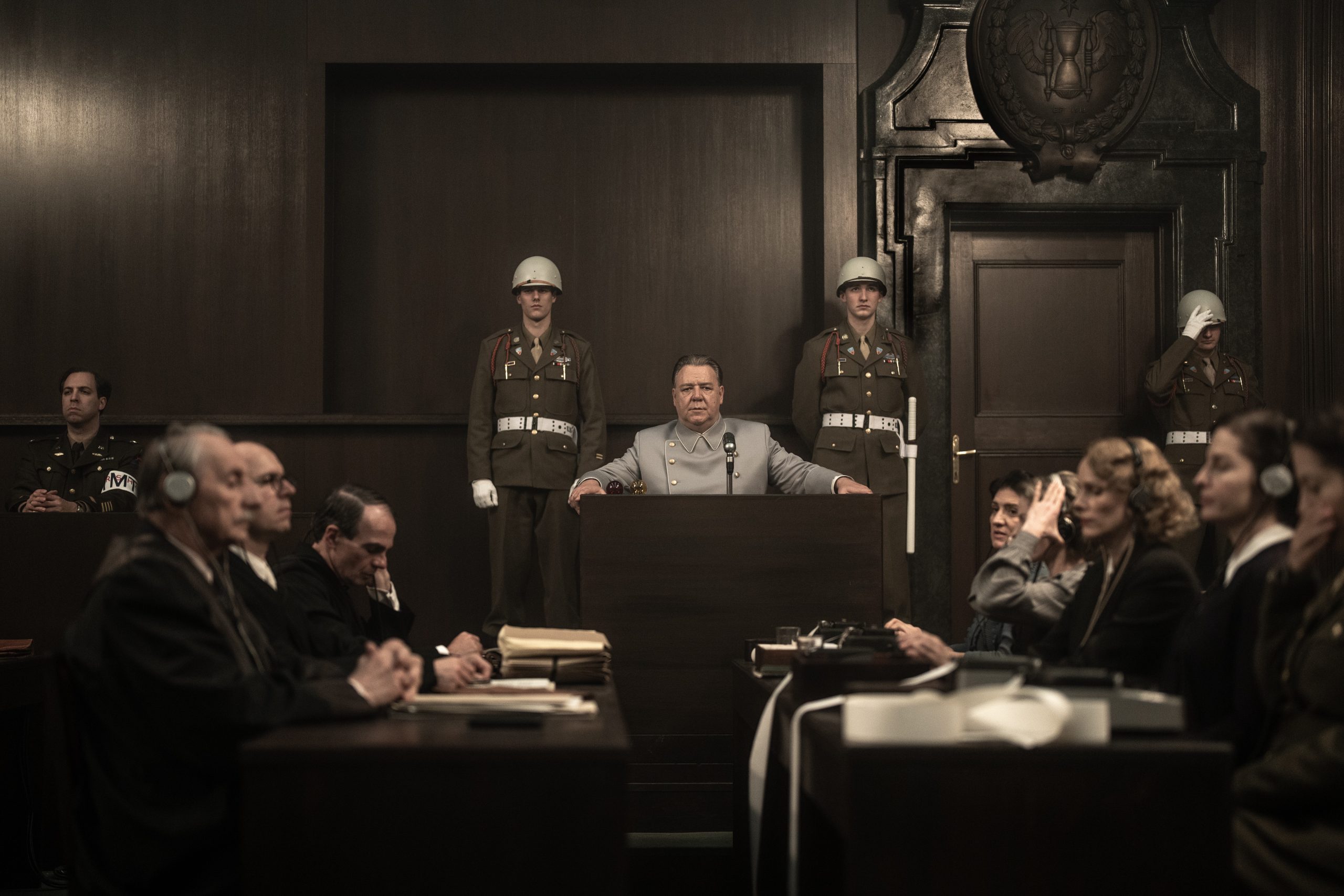
Russell Crowe as Hermann Göring in ‘Nuremberg’
Image: Scott Garfield. Courtesy of Sony Pictures Classics.
The most searing three minutes in Nuremberg (2025) are the exact same searing moments in 1961’s Judgment at Nuremberg, a much better film. Those minutes are the newsreel footage taken when Allied forces freed the concentration camps in Nazi Germany.
Even as a child — the footage was part of the 1956 French documentary Night and Fog — and as a college student for “Judgment,” I found those images wrenching: still horrifying, matter-of-fact celluloid of barely living Jewish corpses on army stretchers, of fields and oven chambers full of rotting bodies, the Allies forced to bulldoze them into mass graves. The intervening years of movie-manufactured horror and vampire fetishes can’t touch these enduring realities.
In both films, the showing of these images to this international tribunal in Nuremberg (1945-49) seals the fate of the accused, though Nuremberg deals with the very first trial of the Nazi bigwigs, particularly Hermann Göring, while the 1961 film deals with the politics as well as the realities of dealing with the less important Nazis at a time when the U.S. public had lost much of its outrage and interest.
The 1961 film had wily, somber, realistic actor Spencer Tracy as the judge and the brilliant newcomer Maximilian Schell as the German defense lawyer. It also had Richard Widmark at his best and emotional cameos from Montgomery Clift and Judy Garland, plus a Hollywood star of considerable gravitas to substitute for good acting, Burt Lancaster, who was wisely ordered by director Stanley Kramer not to attempt a German accent.
In 2025, drawing direct parallels to how these racist hatreds could erupt in any country anytime (Americans then and now would rather believe there was something in the German water), Nuremberg plays around a lot with that “we are all guilty” concept. While its heart may be on the right side, the 2025 film feels ham-handed and melodramatic.
In 2025, we have Russell Crowe essaying a good German accent, playing up his extra weight and amused grin as Göring. He is made somewhat sympathetic as a family man while boastfully arrogant as the surviving leader of the Third Reich after Hitler’s death. The movie stretches scenes to make the whole trial seem a duel of wits between Göring and the world.
I wouldn’t call this a terrible movie, since there is some good acting seeking to find ways into the bounce-around plotting. While the technical elements are slick and the film spouts clarion messages in melodramatic dialogue, it lacks the character subtlety writer-director James Vanderbilt would need to succeed. At least it enhances our memory of the 1961 film.
Perhaps echoing the director’s heavy, intrusive style, composer Brian Tyler has laid on a soundtrack of such ominous messaging that the ears bleed.
Crowe is being pushed too hard for an award, but the real acting gems in the film are elsewhere. Michael Shannon brings a measured tone and an inscrutable lawyer’s face to Robert Jackson, who stepped down from the U.S. Supreme Court to create and run this international tribunal, spouting ideals that survive to this day.
Shannon gets to be a powerful Jackson, delivering an opening statement that still reigns as one of the legal community’s most eloquent:
“What makes this inquest significant is that these prisoners represent sinister influences that will lurk in the world long after their bodies have returned to dust.”
Powerful interpretation also comes from Richard E. Grant as the British prosecutor who gets to deliver the final nail in the coffin against the Nazis. His clipped delivery almost rescues what becomes a clumsy attempt to make this a psychological duel between Goring and the good guys.
Nuremberg opened in November on some 2,000 U.S. movie screens. It remains available on many streaming platforms.
Dominique Paul Noth served for decades as film and drama critic, later senior editor for features at the Milwaukee Journal. You’ll find his blog here and here. For his Dom’s Snippets, an unusual family history and memoir, go to domnoth.substack.com
If you think stories like this are important, become a member of Urban Milwaukee and help support real, independent journalism. Plus you get some cool added benefits.


Movies
-
Oscar Show Catches Hollywood in Transition
 Mar 16th, 2026 by Dominique Paul Noth
-
Can Film Incentives Turn Wisconsin Into A Movie Hub?
 Mar 10th, 2026 by Sophie Bolich
-
‘Wicked: for Good’ Isn’t Really
 Jan 14th, 2026 by Dominique Paul Noth
Review
-
Honeypie Cafe Boasts Good Home Cooking
 Mar 14th, 2026 by Cari Taylor-Carlson
-
‘Ain’t Misbehavin’ Is High Quality Fun
 Mar 9th, 2026 by Dominique Paul Noth
-
Sobelman’s Offers Classic Burgers
 Mar 7th, 2026 by Cari Taylor-Carlson