

More Than Policy, Dem Candidates Differ on Style and Tone
The seven-leading gubernatorial candidates participated in a forum Wednesday night.
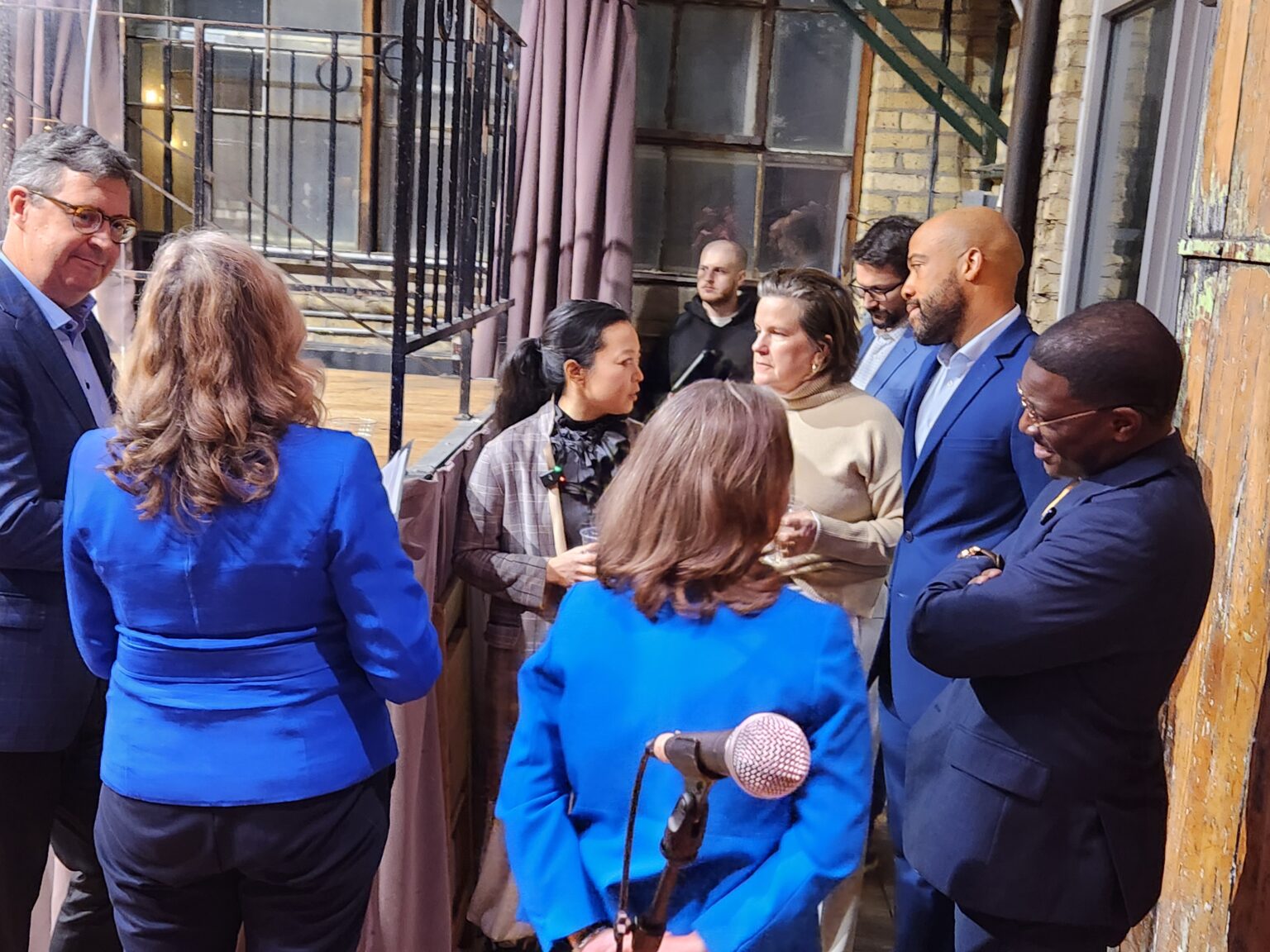
The Democratic gubernatorial field prepares to take the stage Wednesday. Left to Right: Joel Brennan, Kelda Roys, Francesca Hong, Sara Rodriguez, Missy Huges, Mandela Barnes and David Crowley. (Photo by Erik Gunn/Wisconsin Examiner)
In a music hall just east of Milwaukee’s trendy Walker’s Point neighborhood Wednesday evening, seven Democratic hopefuls in the 2026 race for governor fielded questions from an assortment of small business owners before a friendly crowd of more than 300 people.
Their answers showed only occasional differences on matters of policy. The greater contrasts were in style, tone, vocabulary and presentation.
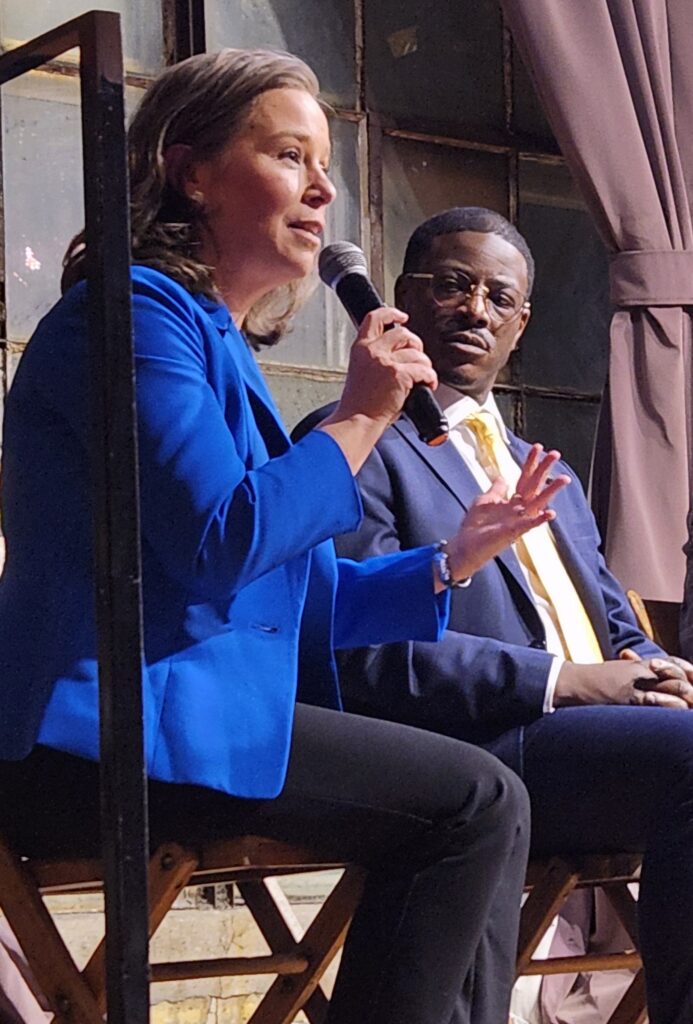
Lt. Gov. Sara Rodriguez, who is seeking the Democratic nomination to run for governor, speaks at a forum Wednesday, June 21, 2026 in Milwaukee. David Crowley looks on. (Photo by Erik Gunn/Wisconsin Examiner)
Answering an audience member’s question about how each of the hopefuls would address Wisconsin’s teacher shortage, Lt. Gov. Sara Rodriguez drew attention to a new state program to create teacher apprenticeships — enabling working teaching assistants “to get a bachelor’s degree while they are teaching assistants with full-time wages, full-time benefits. They will graduate with no debt.”
It was modeled after a similar apprenticeship program to produce more nurses, noted Rodriguez, a nurse who entered politics in mid-career.
Milwaukee County Executive David Crowley said prospective teachers should be encouraged, but added that working teachers also need support after years of being demoralized by disrespect and inadequate funding from the Republican-led Legislature.
“We have to create a much better pipeline, making sure that we’re supporting those who are currently in the profession and utilizing them to be the trusted messengers to help recruit more young people into the field,” he said.
“Put a stake in Act 10, and repeal it, and ensure that it never happens again,” said state Rep. Francesca Hong — referring to the 2011 law that stripped most public employees of most union rights and that has been blamed for contributing to teacher shortages in Wisconsin. “Fully fund public education. Reimburse special education at 90% from the state, in parity with voucher schools,” she said, adding, end the voucher program “so we no longer siphon away resources from our public schools to private schools.”
State Sen. Kelda Roys, former Wisconsin Economic Development Corp. CEO Missy Hughes, former Department of Administration Secretary Joel Brennan and former Lt. Gov. Mandela Barnes also took part in the Wednesday night forum.
With Democratic Gov. Tony Evers’ decision this past July not to run for a third term, the 2026 governor’s race is the first in Wisconsin without an incumbent since 2010. It has drawn a broad field of potential successors in Evers’ own party.
Cletus Hasslinger, 78, of Milwaukee, attended a similar forum back in 2018, when Evers was one of 10 candidates seeking the Democratic nod to run for governor. He turned out for the Wednesday night event and was impressed.
“This is a much stronger group!” Hasslinger said. “It energizes me.”
Sponsored by small business advocates
The forum was held at The Cooperage, a venue in the shadow of Milwaukee’s iconic Hoan Bridge, and was organized by Main Street Action, the political arm of Main Street Alliance. MSA is a small-business organizing group with an agenda centered on economic fairness, contrasting many of its interests with those of large corporations.
The group has embraced the Affordable Care Act, Medicaid expansion and state and federal support for child care and paid leave for workers, among other policies. MSA also campaigns for tax policies that would require big business to pay more and stronger government action against corporate concentration.“We elevate the testimony, the stories of small business owners,” said Richard Trent, MSA’s national executive director, who counts MSA’s national membership at 30,000 people and said Wisconsin is one of the organization’s hubs.
“So much of how we think about our economy, how we think about what’s best for our cities, our towns — that whole narrative is shaped by the largest corporations, the wealthiest Americans,” Trent told the Wisconsin Examiner. “It’s the small business owners who are driving most of the productivity in our economy, yet get almost none of the say in the policies that actually strengthen their communities.”
The eighth Democrat seeking the nomination, former state Rep. Brett Hulsey, was not invited to join Wednesday night’s forum, which qualified participants if they were polling at better than 0% or if they had raised at least $100,000 in donations.
U.S. Rep. Tom Tiffany and Washington County Executive Josh Schoemann are seeking the GOP nomination. Trent said there aren’t plans for a Republican forum before that party’s primary, also in August, but that MSA intends to bring the winners of both nomination contests together for a forum in the fall.
Questions draw out similar stances
Moderated by Dan Shafer, who publishes “The Recombobulation Area,” a political analysis and opinion column on Substack, and who holds the title of political editor at Civic Media, the forum ran about 20 minutes over its original 90-minute allotment.
Shafer brought a half-dozen business owners and Main Street Alliance members to the stage, each posing a question to the gubernatorial hopefuls, then finished the session with a handful of questions submitted by audience members.
Many of the answers didn’t diverge wildly. Expanding BadgerCare to cover more people had broad support. So did the idea of a BadgerCare “public option,” enabling people to pay into the Medicaid-funded health plan if their incomes were not low enough to qualify them for the program.
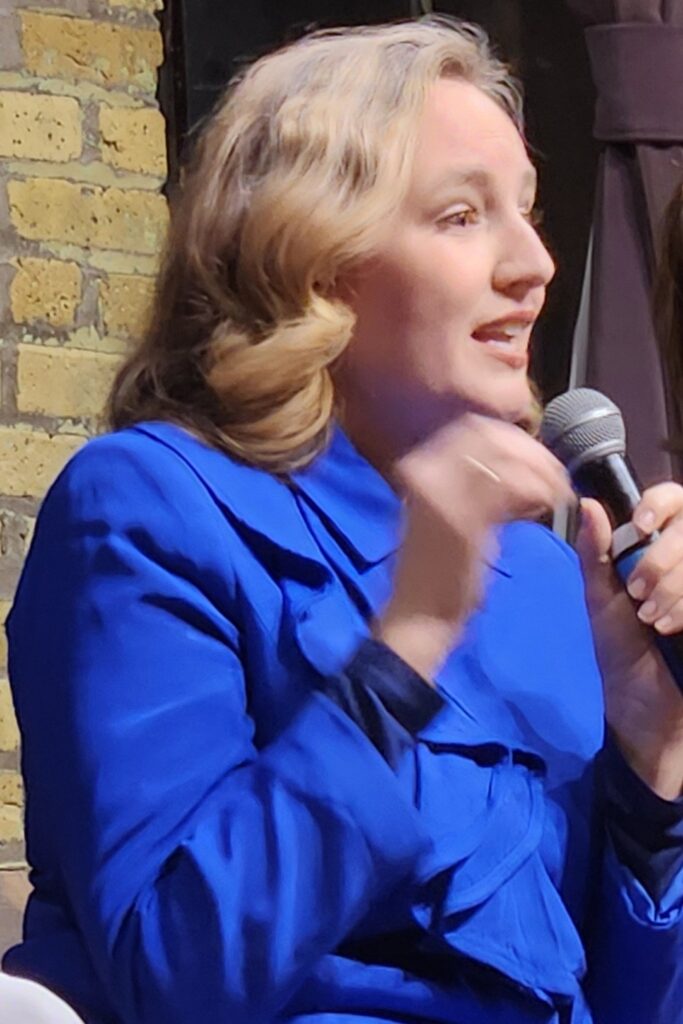
Kelda Roys speaks during a forum for Democrats running for governor on Wednesday, Jan. 21, 2026. (Photo by Erik Gunn/Wisconsin Examiner)
Roys suggested another variation, allowing Wisconsin residents to buy into the health plan that is available to state employees.
Support for child care funding from the state was also widely endorsed, as was a paid leave program funded through a payroll deduction.
Rodriguez observed that a paid family leave program was in “the last budget that the governor and I put out” (it was cut by the Joint Finance Committee’s GOP majority). Crowley said after he took office as Milwaukee County executive, his administration created a paid family leave policy for county employees to help recruit workers.
Hong pointed to legislation she introduced in the Assembly in the previous session that would have created “one of the most comprehensive paid leave” programs. And Roys cited a paid leave bill she co-authored in 2011, during her previous time in the Legislature.
“Making this universal is going to help small businesses start,” Roys said. “It’s going to help them attract and retain employees and compete with the big businesses who can afford to offer more generous policies.”
Core themes and personal biographies
All seven participants largely stuck to the core themes they’ve sketched out in their campaigns and the biographical details that they hope will persuade primary voters in August why they’re the best choice to carry the party’s standard in November.
Rodriguez highlighted her current role as lieutenant governor — visiting “all 72 counties every year” since assuming that office. She led a health care workforce task force that Evers appointed in 2024.
Crowley emphasized ways in which, as a county executive, he has to deal with issues at the local level that the forum was putting on the agenda for the next governor: housing, health care costs, family leave policies and preparing for U.S. Immigration and Customs Enforcement officers to descend on Milwaukee.
Hong stressed her experiences as a restaurateur and as a single mom, and her stark assessment that “as a worker and as an employer, the system is rigged against us where people value corporate power and greed more than anything else.”
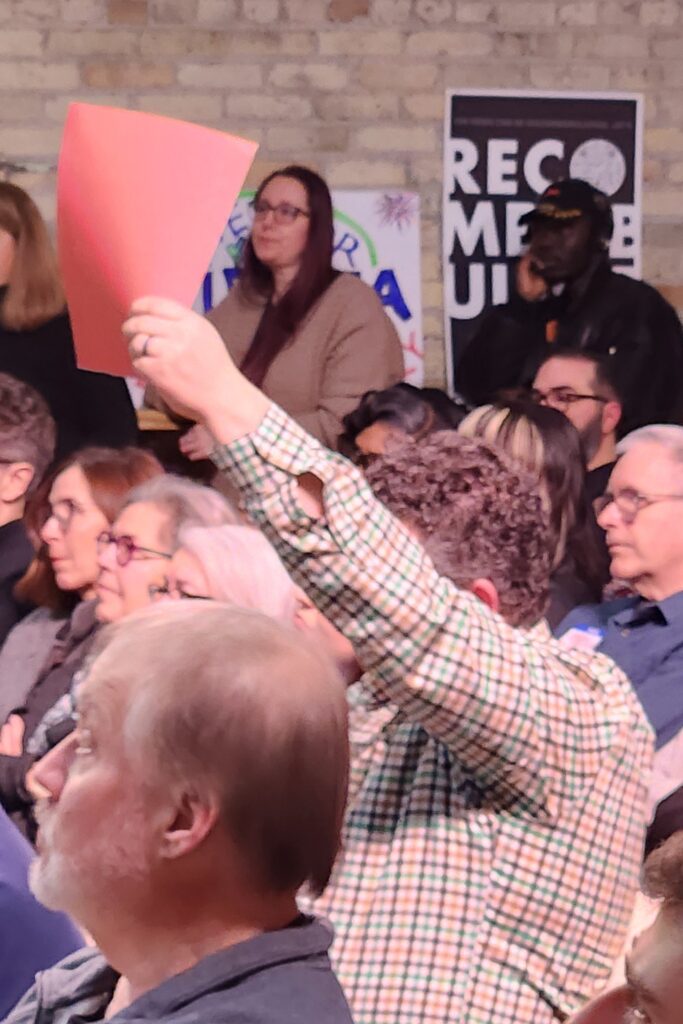
Shawn Phetteplace of Main Street Alliance holds up a red card to alert a forum speaker that their time for talking is up. (Photo by Erik Gunn/Wisconsin Examiner)
Roys presented herself as a fierce challenger to the Republicans controlling the White House and Congress: “We need a governor with a spine of steel who will stand up to this Republican regime in all the ways that they are hurting Wisconsin, and especially our small businesses and our family farmers,” she said.
But Roys also declared herself to be experienced in the operations of state government, having had a state Assembly seat previously during the administration of Gov. Jim Doyle and the beginning of Gov. Scott Walker’s first term. And she cast herself as a visionary who sees “a window of opportunity to make real change” in Wisconsin in the coming years.
Hughes said that in her time at WEDC, “I have worked with small businesses all across the state, with Main Street businesses working to understand the challenges that they face,” including day-to-day operations, finding workers and supporting employees who need child care or other resources.
She called attention to an economic plan she released this week with provisions for education, labor-management partnerships and expanding affordable housing.
Brennan described himself as an experienced problem-solver and relationship builder, and a voice for calm in a time of turmoil.
“We live in times that are unlike any other. And we are angry. We’re angry at Donald Trump for what he has done to really do away with some of the values that we hold dear as Americans and as citizens,” Brennan said. “But when some people get angry, they want to get even. When I get angry, I want to roll up my sleeves and get something done.”
Pandemic relief roles
Hughes and Barnes both emphasized roles in Wisconsin’s Main Street Bounceback program, which provided $10,000 grants for businesses to upgrade their operations, including taking over vacant storefronts, in downtowns across the state. Barnes was lieutenant governor in Evers’ first term, forgoing reelection in 2022 in order to run for Senate against Republican Sen. Ron Johnson, a race he lost by about 26,000 votes.
Barnes’ executive branch duties included helping to promote “our Main Street Bounceback program, which helped so many small businesses across the entire state that had been dealt a bad hand,” Barnes said. “We stepped up, we filled the gap, and we met a need. That’s exactly what I intend to do as governor.”
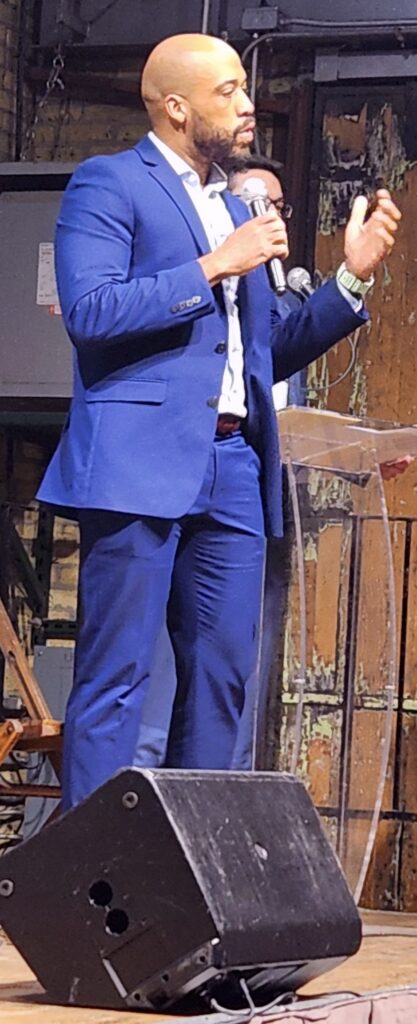
Forme Lt. Gov. Mandela Barnes explains his reason for running for governor. (Photo by Erik Gunn/Wisconsin Examiner)
Hughes brought up the program when Chloe Longmire, a Milwaukee entrepreneur, asked the candidates how they would work with economic development agencies to help women-owned and minority-owned small businesses.
“Coming out of the pandemic, I saw across the state Main Streets where businesses had survived and businesses had not survived, and there were vacant spaces,” Hughes said. Main Street Bounceback was designed to enable businesses to occupy vacant spaces easily, with a one-page application and the support of a community member.
“And we trusted those business owners to invest that money in the ways that needed to happen,” Hughes said, with 9,500 businesses in each of Wisconsin’s 72 counties getting aid. “We saw Main Streets at 100% capacity — full, looking for more businesses, looking for more opportunities to move businesses into vacant spaces.”
Brennan, as secretary of the Department of Administration, tracked how the state’s $4.5 billion in pandemic relief was spent. A program focused on movie theaters made a particular impression, he said, with one memorable venue in central Wisconsin that passed through three generations to the granddaughter of the first owner.
“And the $30,000 that they were getting from the COVID relief money was going to pay for utilities, going to pay for their mortgage — it was going to be the light at the end of the tunnel,” Brennan said. “That’s the kind of thing you need to do in a crisis, but it’s also the way you need to be responsive when you’re operating day-to-day, and that’s what we’ll do in a brand new administration.”
After reiterating his involvement in Main Street Bounceback, Barnes pivoted to the original question’s emphasis on businesses owned by women and minorities.
“We should have to incorporate targeted investments in communities,” he said. From there he pivoted again, to a proposal he announced earlier Wednesday for the state to invest in grants for startup grocery stories in food deserts.
“People aren’t able to afford groceries, and we’re going to connect our family farms . . . to bring local food into communities because we can’t have a food desert in a state that produces as much food as we do in Wisconsin,” Barnes said.
A range of answers on taxing the rich
Questions about Wisconsin taxes drew a wider variety of responses.
Roys dismissed the manufacturing and agriculture tax credit, available primarily to larger businesses, as “a giveaway to the wealthiest individuals and corporations in the state” that fails to help economic development.
“We need to restore our progressive taxation system where the amount of money that you pay in to support the public services that all of us enjoy and all of us rely on is based on the money that you earn,” she said. “Right now, working people, the middle class are shouldering a disproportionate burden for paying those services.”
Hong was equally dismissive. “Our small businesses are paying a higher tax rate than some of the wealthiest corporations,” she said. “So, get rid of it. No major corporations should be paying no income tax.”
Crowley said tax credits should focus on small and mid-size companies. “Millionaires and billionaires, let’s face it, they don’t deserve a tax credit,” he said, adding that he would favor a blue ribbon commission to examine state taxes and spending comprehensively.Rodriguez called for measurable job gains in return for the credit. “If we are going to get tax benefits, we need to tie it to actually increasing the number of people that they are hiring,” she said.
Hughes said that when she was at WEDC and met with business leaders looking to relocate to Wisconsin, they were much less interested in taxes than issues such as the strength of local schools and the university system and the availability of workers.
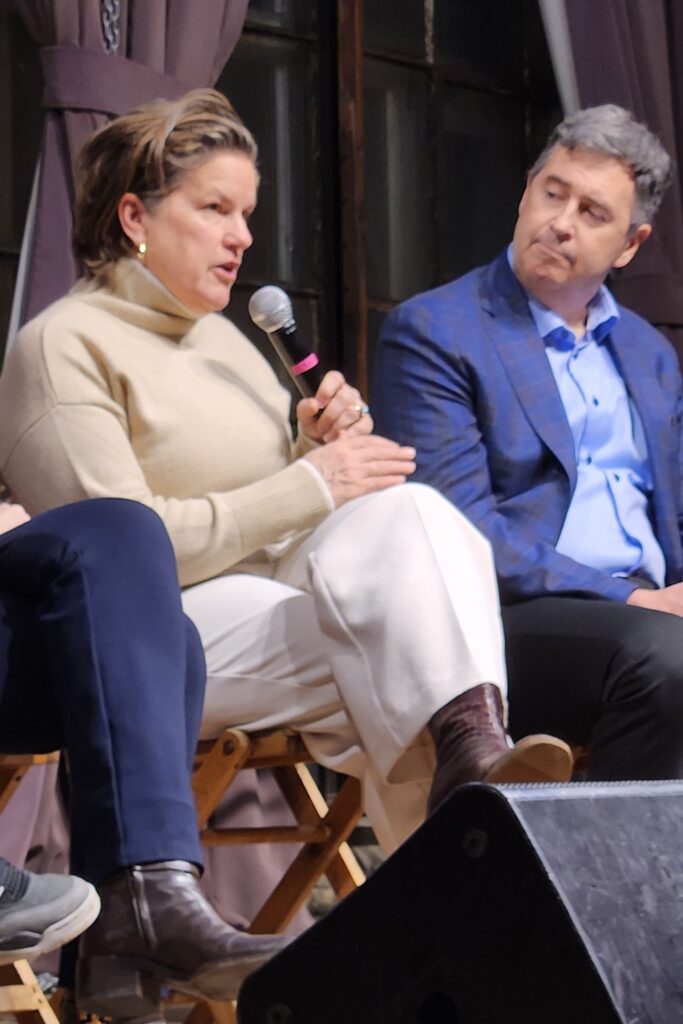
Missy Hughes speaks during a forum for Democrats running for governor on Wednesday evening, Jan. 21, 2026, as Joel Brennan listens. (Photo by Erik Gunn/Wisconsin Examiner)
She demurred on a question about raising taxes on the wealthiest to provide services for people in need and suggested that a sustainable economy is more important.
“My focus is going to be on growing the economy, because my fear is that if we simply increase taxes on the wealthy, the next team will get elected and come back in and take that away,” Hughes said.
“It could mean that we increase taxes on the most wealthy, but in addition to that, we need to be thinking about creating a system that works election after election and administration after administration,” she said. “Growing the economy and making sure that everyone is paying their fair share is the foundation of my candidacy.”
The last question of the night looked to the unease that has been gripping the country after federal immigration agents descended on Minneapolis earlier this month and an Immigration and Customs Enforcement officer shot and killed Minneapolis resident Renee Good.
How would each of the Democratic hopefuls navigate “maintaining law and order and avoid being positioned by the right as being soft on crime, while ensuring the state citizens won’t be infringed upon by federal government overreach?” Shafer asked, reading from a written submission.
Rodriguez cited her recent statement calling on lawmakers to apply the same rules for ICE as for local law enforcement: ready identification, body cameras and no masks for agents, and forbidding them from going into “sensitive areas” such as schools without a judicial warrant.
“It is personal to me,” said Rodriguez, whose husband is a U.S. citizen born in Mexico.
Crowley said Milwaukee County is currently discussing how it will respond to an ICE influx. “Standing up for people’s constitutional rights, whether a citizen or not, is not soft on crime at all, he said. “We have to make sure that we continue to protect everybody and make sure that we are a safe community.”
Hong said she’s been in touch with mutual aid groups in Minneapolis, and that “ICE is a rogue agency…. Abolishing ICE is a meaningful policy.” Roys vowed to bring the weight of criminal as well as civil liability down on ICE and act against people who “break our laws and brutalize our people.”
Hughes said at meetings in Eau Claire, community leaders told her they are looking to members of the immigrant community “and understanding what they needed and what they were looking for.” Brennan urged learning from the civil rights work of Martin Luther King Jr., “locked in arms with his fellow man and with the people in his community.”
Barnes said he has spoken with people in Minneapolis, and said the next governor must be unafraid of retribution from the White House. “We need change and somebody who’s going to stand up and be strong in this moment,” he said.
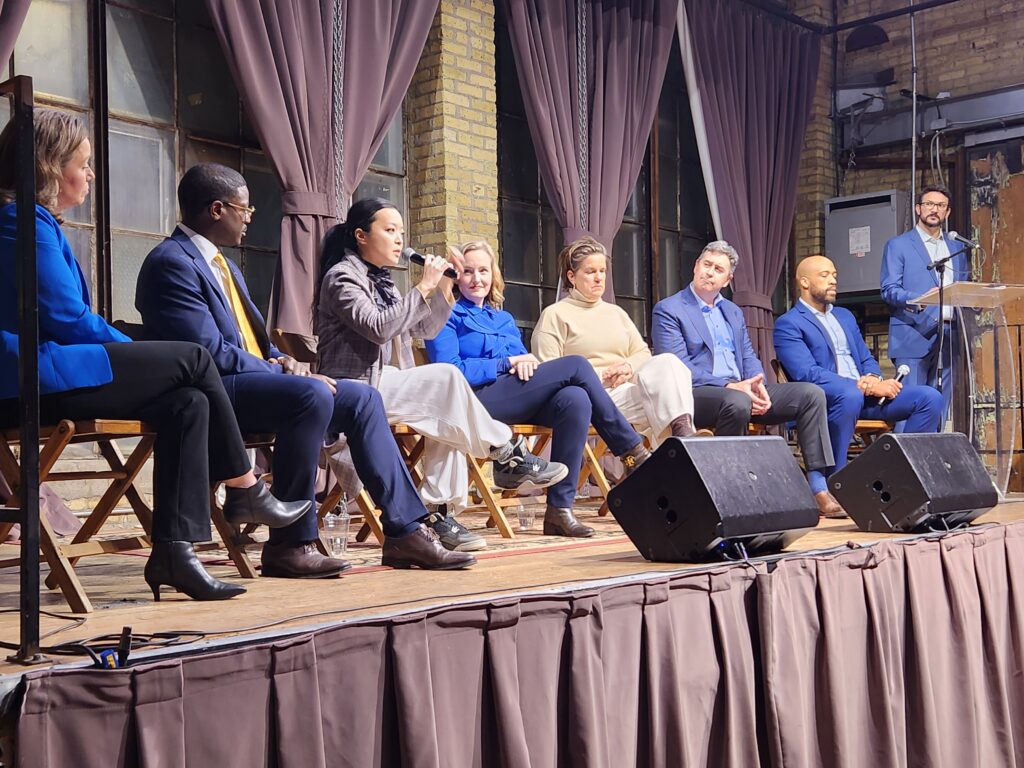
State Rep. Francesca Hong speaks during a forum for Democrats seeking the party’s nomination to run for governor. (Photo by Erik Gunn/Wisconsin Examiner)
At forum for Democrats running for governor, style and tone differ more sharply than policy was originally published by the Wisconsin Examiner.
If you think stories like this are important, become a member of Urban Milwaukee and help support real, independent journalism. Plus you get some cool added benefits.
Political Contributions Tracker
Displaying political contributions between people mentioned in this story. Learn more.















We have an opportunity to break with politics as usual and elect a real visionary, Francesca Hong.
Thank you for sharing this reporting.