250 Deadlines in Crowded Political Year
April, August, November elections dominate packed political calendar.
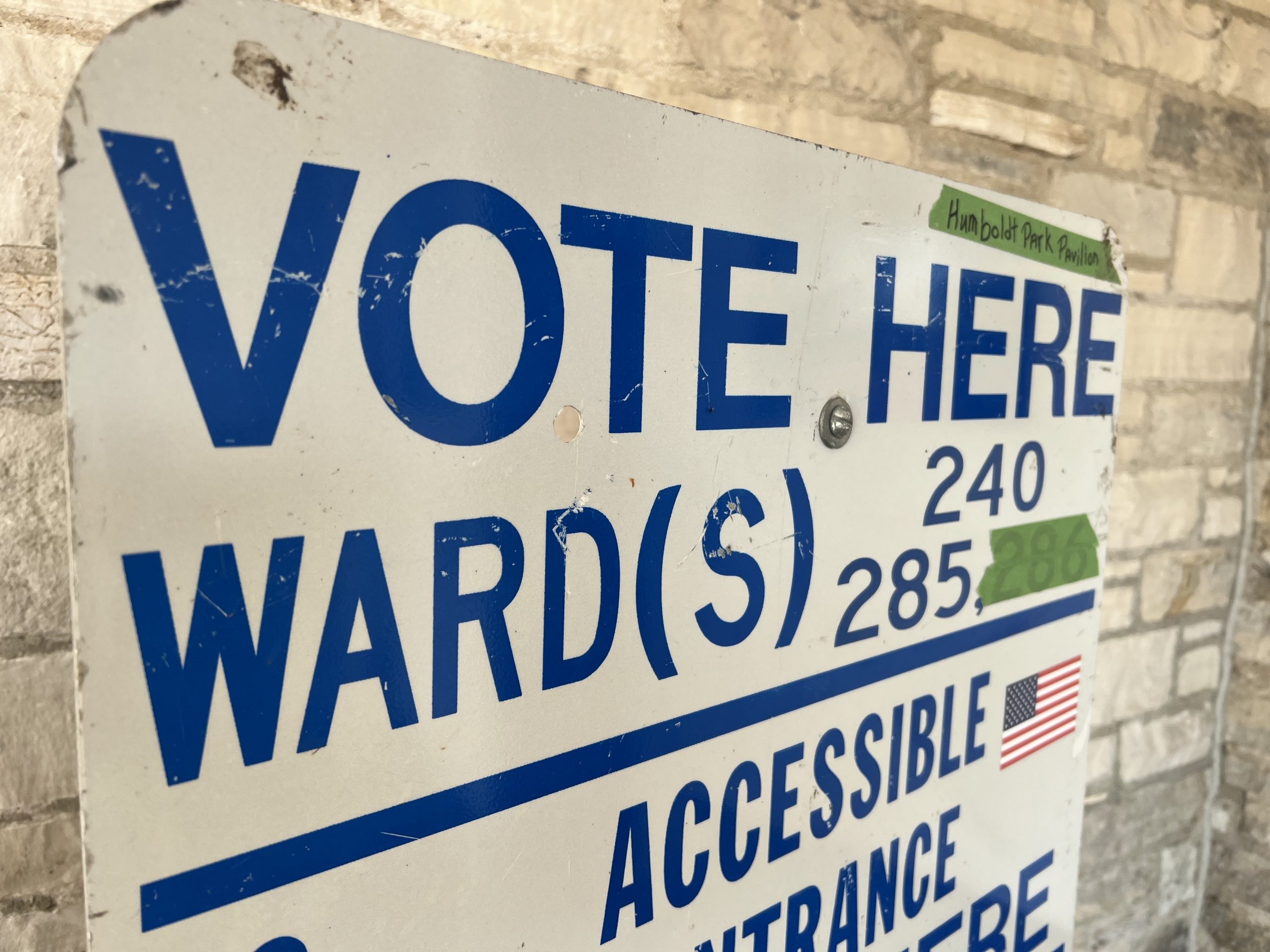
Vote here sign. Photo by Jeramey Jannene.
Weary of politics? You’ll get no rest this year.
There’s an April election for an open Supreme Court seat, an August primary that will decide candidates for governor and November elections for governor and other statewide offices, eight U.S. House members and 116 seats in the Legislature, and two likely constitutional amendments.
The Wisconsin Elections Commission website lists more than 250 deadlines that candidates, voters and local clerks must meet to make all that happen. Here are the most important ones:
Feb. 17: Spring primaries, if enough candidates filed for local school district, county, municipal or judicial offices to require a runoff that decides who will be on the April general election ballot. Candidates had to file nomination papers by Jan. 6.
Feb. 17: Democratic Gov. Tony Evers gives his eighth and final State of the State speech to the Republican-controlled Legislature. Evers recently said he will ask lawmakers to approve $1.3 billion more for public schools to control property taxes, and repeat past calls for gun-control changes, a deal on spending $125 million to fight PFAS pollution, health-care reforms, and major prison-reform changes that go beyond closing the Green Bay prison.
March 19: The last day that Republican legislative leaders have scheduled regular-session votes. What to watch for: Do lawmakers pass proposals to legalize on-line gaming at tribal facilities, regulate AI data centers, limit what food stamps can buy, and put two proposed constitutional changes on the November ballot?
The constitutional changes would prohibit state government from putting limits on houses of worship during public health and other states of emergencies and prohibit state and local governments from discriminating against or giving preferential treatment based on sex, race, ethnicity or national origin.
April 7: Spring general election for nonpartisan offices. The only statewide race is between two Court of Appeals judges — Chris Taylor and Maria Lazar — for a 10-year term on the Wisconsin Supreme Court. Absentee ballots must be returned by 8 p.m.
May 22: 5 p.m. deadline for incumbents for partisan offices — including for Wisconsin governor, lieutenant governor, attorney general, state treasurer, secretary of state, U.S. House and 116 seats in the Legislature (99 in the Assembly and 17 in the Senate) — to file statements saying they are not seeking re-election.
Failure to meet this deadline extends the filing deadline for that specific office by 72 hours.
June 2: 5 p.m. filing deadline for candidates for partisan offices to file nomination papers, declarations of candidacy, and campaign registration statements for the November general election.
July 22: Deadline for voters to use mail or internet to register to vote in the Aug. 11 partisan primary. Voters must register in person with the local clerk or at the polling place on election day.
July 28: Clerks may begin to issue absentee ballots for the Aug. 11 partisan primary.
Aug. 7: Midnight deadline for write-in candidates to register for the Aug. 11 primary. And a 5 p.m. deadline for voters to register at their local clerk’s office.
Aug. 11: Fall partisan primary that will decide several important races: Who will be the Democratic and Republican candidates for governor and lieutenant governor? Who will be the Republican nominee in northwest Wisconsin’s open 7th U.S. House district? Who will be the Democratic candidate in western Wisconsin’s 3rd U.S. House district? Who will win primaries for seats in the Legislature?
All absentee ballots must be returned by 8 p.m.
Aug. 25: Deadline for referendums on proposed constitutional amendments to be certified for the November general election.
Sept. 17: Clerks begin issuing absentee ballots, which must be recorded in the Elections Commission’s WisVote data base.
Oct. 14: Deadline for voters to use mail or internet to register to vote. Voters must register in person with the local clerk or at their polling place on Election Day.
Oct. 30: Midnight deadline for write-in candidates to register and 5 p.m. deadline for voters to register in person with their local clerk.
Nov. 3: General election that will decide who will be the next governor, lieutenant governor, attorney general, state treasurer, secretary of state, Wisconsin’s eight U.S. House members, and which party will control the state Legislature in 2027.
All absentee ballots must be returned by 8 p.m.
Dec. 1: Deadline for state Elections Commission chair to certify November general election results.
The good news? There’s no partisan elections in 2027.
Steven Walters started covering the Capitol in 1988. Contact him at stevenscotwalters@gmail.com.
If you think stories like this are important, become a member of Urban Milwaukee and help support real, independent journalism. Plus you get some cool added benefits.


The State of Politics
-
Evers’ Last Appeal to the GOP Legislature
 Jan 12th, 2026 by Steven Walters
-
Evers Has Appointed 63 Judges
 Jan 5th, 2026 by Steven Walters
-
Top 10 Stories of The Year
Dec 29th, 2025 by Steven Walters